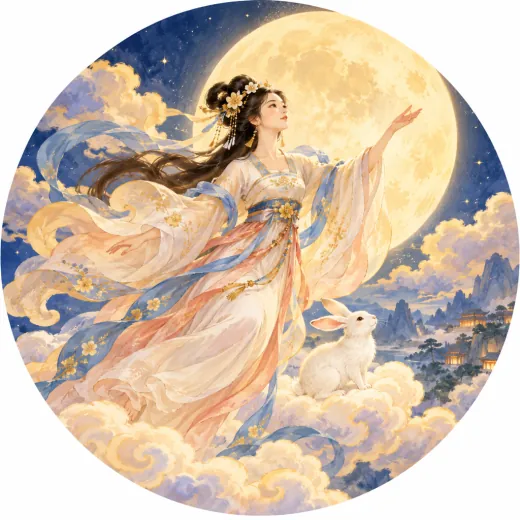
Chang'e and Hou Yi
嫦娥 and 后羿
not scary at all
Long ago there were ten suns in the sky, and the earth was burning. The great archer Hou Yi shot down nine of them with his arrows, leaving only one. Then he asked the Queen Mother of the West for an elixir that made people immortal. But it was his wife Chang'e who took it; in a later version she drank it to protect him from a thief. Becoming light, she floated up to the Moon and stayed there forever; later traditions give her a jade rabbit as company, pounding magic herbs in a mortar.
Did you know? The Chinese space probe that in 2019 became the first to land on the far side of the Moon is called Chang'e 4, and its little rover is Yutu-2: Yutu means “jade rabbit”.
The story
They say that once upon a time there were ten suns in the sky.
Not one after another, as there are now: ten at once, born of the same mother, living in a towering tree in a sea to the east. Every morning one of them, taking turns, climbed onto the chariot of a crow and crossed the sky, while the other nine waited below among the branches. So it went for centuries. Then one morning the ten brothers, perhaps for a joke, perhaps out of boredom, decided to go out all together.
On earth, at first, people thought it was a miracle. Then the light grew too strong. The rivers dried up, the fields caught fire, the leaves curled on the branches. Children no longer left their houses, and the old people, under the eaves, waited for a night that never came.
Emperor Yao, who ruled at that time, sent for the only man who might be able to help him: an archer named Yi.
Yi was a man of few words. He came from a family of simple people, and he carried a red bow and a quiver of white arrows. For days he walked through the heat, looking up at the sky with his hand shading his eyes. Then he stopped on a plain and raised his bow.
The first arrow flew with a hiss. Up above, one of the suns went out like a lantern, and from the sky fell a great crow with three legs. A second arrow, and a third. With every shot the world grew a little cooler. When the ninth sun fell, Emperor Yao, watching from the riverbank, raised his hand.
“One is enough,” he said. “We need one.”
Yi lowered his bow. The last sun, trembling, took its place in the sky again, and for the first time in a long while there was evening.
That was not his only great deed. The Huainanzi tells how Yi also freed the earth from monsters: the Dafeng, an enormous bird that stirred up storms, and the Xiushe, a snake so long that nobody could see the end of its tail. Whenever he passed through, the villagers came out of their houses to watch him in silence.
Yi was called Hou Yi, Lord Yi, and he went home. There his wife was waiting for him.
The ancient text calls her Heng E, a name nobody remembers today: for centuries now everyone has said Chang'e. Not much about her has come down to us, just a few lines. But it is enough to know that Yi loved her, and that when she saw him coming, she ran out barefoot.
The years went by. Yi, who had shot down nine suns, began to think about something else: how short a life is, even the happiest one. He did not want to stay in the world alone once she had grown old. So he made a very long journey to the west, all the way to the mountains where the Queen Mother of the West lives, and asked her for the elixir that makes people immortal.
The Queen gave it to him. There was only one dose.
“If two of you drink it,” she told him, “neither of you will be immortal. If only one of you drinks it, that one will live for ever.”
Yi went home and hid the elixir. He did not want to drink it alone; nor did he want to share it. He wanted to find a way, and there was no way. For months he kept it there, in a box, beside the window.
One evening Yi went out hunting. Chang'e, alone in the house, saw the box. Why she did what she did next, the sources do not say. Later versions have tried to explain it: to protect it from a thief, out of curiosity, out of fear of growing old, out of love. The ancient text says only that she took it.
She opened the box. The elixir had the scent of something you can never forget. She drank it.
At once she felt her body grow light. Her feet no longer touched the floor. The curtains stirred, although there was no wind. The roof seemed far away, then it vanished. Chang'e rose into the air above the village, above the trees, above the glittering river, higher and higher.
And there was no longer any way back.
She rose until she saw before her a white, silent disc. The Moon.
Before she left, one ancient text says, she had consulted a diviner named Youhuang. The diviner had read the signs and told her that all was well: she should go west, where she would meet the darkness. She was not to be afraid, not to be alarmed. Later, everything would become great and bright.
The darkness was there. The silence was there. Nothing grew on the Moon; there was no water and no song. Chang'e found herself alone on a white plain, and when she looked for her own body she found that, according to those old texts, she had turned into a toad.
That is what the ancient sources say. Other storytellers, more gently, let her remain a beautiful woman in a pale robe, in a palace of crystal. They gave her a companion: a rabbit, a rabbit as white as jade, who spends eternity pounding herbs in a mortar to make an elixir for someone who has never come to fetch it.
Meanwhile, down on earth, Yi had come home.
He found the door open and the box empty. He called his wife's name. He called it inside the house, then outside, then along the river, and his voice came back to him from every side. He climbed onto the roof. He raised his eyes.
The Moon was full and clear. And on its disc, near the edge, there was a small shadow that perhaps had not been there before.
Yi did not draw his bow. There was no sun to shoot down, and no arrow could reach that high. He stood on the roof until late into the night, the great bow in his hand, looking at the woman who had chosen to live for ever without him.
Since then, all over China, people who look up on clear nights know that someone is up there.
And they do not know whether she is watching the earth, or waiting.
Relatives around the world
Listen / Read next
- Music to read by: Cinematic JourneyEpic film-style music, no lyrics, by Ciro Simone IrmiciSpotifyYouTube Music
Sources
- Huainanzi (2nd century BC)
- Anne Birrell, Chinese Mythology: An Introduction (1993)
