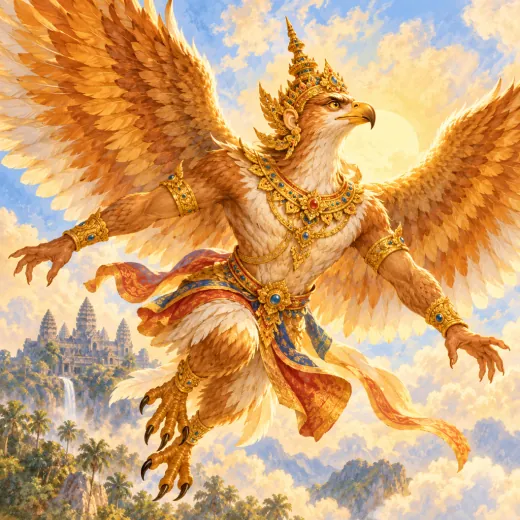
Garuda
Garuḍa, in Sanskrit
not scary at all
Garuda is the king of the birds, with a body that is partly human and partly eagle, golden wings and a mighty beak. He is the mount of Vishnu. When he was born he shone so brightly that the gods mistook him for fire. To free his mother, who was held prisoner by the serpents, he flew up to heaven to fetch the amrita, the drink of immortality, getting past walls of flame and wheels of blades. Since then the serpents have been his enemies.
Did you know? Garuda is the national emblem of Indonesia and Thailand, and the Indonesian airline is named after him.
The story
After a very long wait, in a warm jar that nobody watched any more, an egg cracked open.
Out came a bird.
He was so big that his shadow covered the valley, and so bright that the gods, seeing him from far away, thought he was Agni, the god of fire, and rushed to him to pray. “Do not burn us, we beg you! Do not consume the world!”
The bird did not understand. He looked at his wings: they were golden. His name was Garuda.
“I am not fire,” he said. “I am a son, and I am here for my mother. But if my light frightens you, I will dim it a little.”
His mother's name was Vinata, and she was a prisoner.
It had all begun a long time before. Kashyapa, a sage, had two wives, who were sisters: Kadru and Vinata. He had granted each of them a wish. Kadru asked for a thousand sons, all of them serpents. Vinata asked for two, stronger and more beautiful than all her sister's sons. The two women laid their eggs in two jars, and waited.
After five hundred years, a thousand serpents came out of Kadru's eggs. Vinata, who had waited just as long, ran out of patience and broke one of hers. Inside was a child whose body was not finished, only half made. He was Aruna, Vinata's first son. He was angry with his mother: “Because you were in such a hurry, you will be your sister's slave for five hundred years. But if you wait patiently for the other egg, your second son will set you free.”
And so Vinata waited. Meanwhile, her sister set a trap for her.
One day the two women saw Indra's horse in the sky, Uchchaihshravas, white as the moon. “What colour is its tail?” asked Kadru. “White,” said Vinata. “Black,” said Kadru. They made a bet: whoever was wrong would become the other's servant.
Kadru ordered her sons to coil themselves around the horse's tail and make it look dark. Some of the serpents refused. But Kadru, in her anger, cursed them: they would be burned in the fire of a sacrifice. The others obeyed. And when the two sisters went to look closely, the horse's tail was black.
Vinata lost. For years she was Kadru's servant.
Garuda grew up quickly. One day he saw his mother carrying Kadru and her thousand sons on her back, and then the serpents ordered him to carry them to an island in the middle of the sea. He obeyed. He flew so high that the sun scorched the serpents on his back, and Kadru had to ask Indra for rain to save them.
When they were on the island, Garuda asked his mother: “Why must we serve the serpents?” And Vinata told him about the wager.
So Garuda went to the serpents. “What must I do to set my mother free?”
“Bring us the amrita,” they answered, “the nectar that gives eternal life.”
The amrita was in heaven, guarded by the gods.
He went back to his mother. Vinata smiled at him as she always did. “What do you mean to do, my son?”
“Set you free. I am going to fetch the amrita.”
She looked at him for a long time, and did not try to stop him. “Heaven is where the gods live, and the gods give nothing away. Go, and may the wind keep you high.” She gave him her blessing, and Garuda spread his wings.
He rose above the clouds, above the mountains, above everything. The air grew thin and cold, and below him the earth shrank to a drawing. The sky turned a deep blue. In front of the city of the gods, Garuda found the first defence: a wall of fire, tall and blazing, that hid the sun. He did not fly through it. He went down to a great river, drank until his beak was full, came back and put out the flames with the water. The fire hissed and collapsed.
The second defence was a wheel. It spun without stopping, with blades as sharp as razors, and no one could pass without being cut to pieces. Garuda watched and waited. Then he made himself small, smaller than a mosquito, and slipped between the spokes without touching them.
The third defence was two giant serpents, who spat venom from their eyes. Garuda raised a cloud of dust. Blinded, the serpents saw nothing. When the dust settled, Garuda was already behind them, with the amrita in his claws.
The gods noticed too late. Indra raced after him with his thunderbolt. He struck Garuda on the wing. The thunderbolt is the mightiest weapon in heaven, but Garuda did not break. He smiled.
“I respect your thunderbolt, and I respect you, Indra. In your honour I will let one feather fall.” And a golden feather fell from his body. The gods looked at it, and understood that they were facing someone greater than the weapon that had struck him.
Indra offered him his friendship. “You are stronger than I am, and I do not want to be your enemy. Give me the amrita. I will give you anything you ask.”
“I can't. My mother is a slave, and I must take it to the serpents. But once I have set her free, you can take it back.”
As he flew towards home, Vishnu appeared in front of him. Garuda had not touched the amrita, not even a sip. Vishnu smiled.
“Your heart has not let itself be conquered by desire. Ask me for whatever you wish.”
“I want to be immortal and never grow old, without drinking the nectar. And I want to be higher than you.”
Vishnu laughed. “Let it be as you ask. You will be on my banner. And in return, I ask you to carry me on your back.”
And so Garuda and Vishnu became companions.
Back on the island, Garuda set the amrita down on the kusha grass in front of the serpents. “I have done my part. Set my mother free.” Vinata was free. “Now go and wash before you drink,” said Garuda. “You must be pure.”
The serpents went to the river. When they came back, the amrita was gone: Indra had taken it back. Only the grass was left. The serpents threw themselves down to lick it, hoping for at least a drop. The grass had sharp edges, and their tongues split in two.
Ever since, serpents have had forked tongues, and Garuda has been their enemy. And in the sky, whenever Vishnu travels, there is always a golden shadow carrying him higher than any mountain.
A living tradition, told with respect: how we tell myths.
Relatives around the world
Listen / Read next
- Music to read by: Cinematic JourneyEpic film-style music, no lyrics, by Ciro Simone IrmiciSpotifyYouTube Music
Sources
- Mahabharata, Book I (Astika Parva)
