Rangi and Papa
Ranginui and Papatūānuku
not scary at all
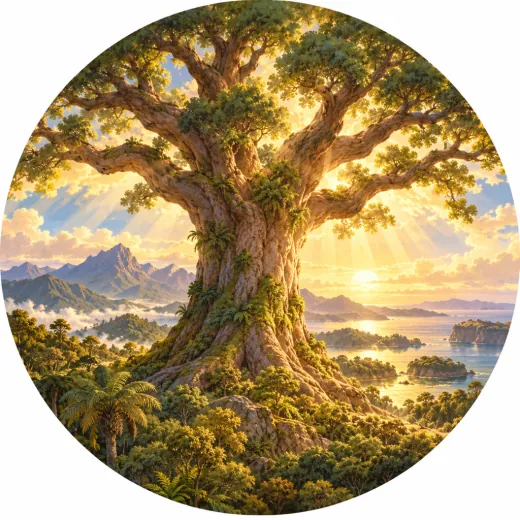
In Māori tradition, in the beginning Sky Father, Ranginui, and Earth Mother, Papatūānuku, were locked in such a tight embrace that no light could get between them. Their children lived squashed in the dark. After much discussion, one of them, Tāne, the god of forests, lay on his back and pushed with his legs until the sky came away from the earth. Light came in and the world was born. But the parents still suffer from being apart: the rain is Rangi's tears, and the mist is Papa's sighs.
Did you know? In Māori tradition, after the separation Tāne dressed the Sky in stars and the Earth in forests.
The story
Before there was a world, there was darkness.
Not darkness like the night, with stars and the sound of the wind. A complete darkness, warm and tight. Because in those days the sky and the earth were not apart. Ranginui, the Sky Father, lay stretched over Papatūānuku, the Earth Mother, and they held each other so tightly that not a single thread of light could pass between them.
Between them, in the little space that was left, lived their children.
There were six of them, and they had never seen anything. They knew the darkness the way fish know water: without knowing it. All they felt, above their heads and under their feet, was the slow heartbeat of their parents, and from that heartbeat they learned how to measure time. They did not know what day was, or a horizon, or a tree. They moved about by feel, squashed, backs against the sky and feet against the earth. If one stood up, he banged his head. If one turned round, he bumped into a brother. Their parents’ breathing was like a low ceiling: warm, heavy, never-ending.
One day they decided to talk about it.
“We can’t go on living like this,” said one.
“And what do you want to do? They’re our parents.”
“We have to do something.”
So the children, one after another, began to say what they thought, and their voices crossed in the dark. Tū-mata-uenga, the fiercest, said they had to kill them. It was the only way, he said: only if they were dead would their parents set them free.
The silence that followed was as heavy as the night itself.
Tāne, the god of the forest, shook his head. “No,” he said. “Let’s not kill them. Let’s separate them. Let the sky go up high, and the earth stay below, and we will be in between. He will be a faraway sky, she will be a mother who feeds us. They will always be our parents.”
Everyone agreed, except one. Tāwhiri-mātea, the god of the winds, the most restless of them all, did not want his parents to be parted. But he was not strong enough to stop the others.
And so the attempt began.
First came Rongo, the god of cultivated plants. He planted himself on the earth, pressed his hands against the sky, and pushed. He pushed until his arms shook and he ran out of breath. Ranginui did not move. Then it was the turn of Tangaroa, the god of the sea. Then Haumia, the god of wild plants. Then Tū, the warrior. None of them could loosen the embrace by so much as a finger.
At last it was Tāne’s turn.
Tāne did not try with his hands. He lay on his back, shoulders against his Mother, and planted his feet upwards against his Father, with all his strength, the way you push a boat into the water. His muscles shook. He felt as if his bones would break. Inside the darkness, in a silence so deep you could hear his heart beating, something began to groan.
Slowly, the sky lifted.
First it was a crack, a thread of light passing between the earth and the Father, so thin that nobody believed it. Then a wider gap. Then a space where you could stand up. The children, who had never seen light, covered their eyes with their hands.
Ranginui rose, and rose further, until he was far away.
Papatūānuku stayed below, bare under the sun, her body stretched out like an endless land. For the first time, the children saw the world: the valley, the mountains, the blue sky, the first tree. Tāne looked at what he had done, and saw that it was beautiful. He also saw that his Mother lay uncovered under the sun, and that his Father, up there, was bare and empty. So he clothed his Mother in forests, ferns and flowers, and painted his Father’s body with stars, so that each of them would have something to wear. But he also felt, deep in his stomach, something he had not expected.
From above came a lament, a long voice.
“Why have you parted us?” Ranginui was saying. “Why do you hurt us like this?”
And from below, a sigh that rose from the ground like a breath: “My children… my children…”
No one answered. Rongo covered his face with his hands. Haumia stared at his feet. Tangaroa, on the shore of the new sea, listened to that voice without moving a muscle. They had wanted light, and now the light showed them this too: two parents who could no longer touch, and who for that reason never stopped calling to each other.
Ranginui wept. His tears fell from the sky onto Papatūānuku, big and slow, and they were the first rain. The Earth Mother sighed, and from her sighs rose a light mist, which lifted from the valleys in the morning and spread over the lakes. And so, the Māori say, it still rains when the Father remembers, and there is mist when the Mother answers.
But Tāwhiri-mātea, the god of the winds, had not forgotten. He had stayed silent, nursing his anger, and now he rose up to his Father and promised him revenge.
He sent storms against Tāne’s forest: the trees snapped and the branches flew like arrows. He sent waves against Tangaroa, and the sea swelled and roared: the fish fled into the depths, and the reptiles ran into the woods. He sent hurricanes against Rongo and Haumia, who hid inside the earth to save themselves. Only Tū stayed on his feet, head held high, in the storm.
That was the first day, and it was the longest.
When the wind died down, the brothers were alone. Ranginui had drawn even further away, and the Mother was a wounded, silent land. Tāne, his legs still trembling from the effort, sat down on a rock and wept.
But the world was there, in front of him: big, new, full of light.
And since then, no one has ever been able to go back.
A living tradition, told with respect: how we tell myths.
Relatives around the world
Listen / Read next
- Music to read by: Cinematic JourneyEpic film-style music, no lyrics, by Ciro Simone IrmiciSpotifyYouTube Music
Sources
- George Grey, Polynesian Mythology (1855)
- Te Ara, the Encyclopedia of New Zealand, Ranginui, the sky
