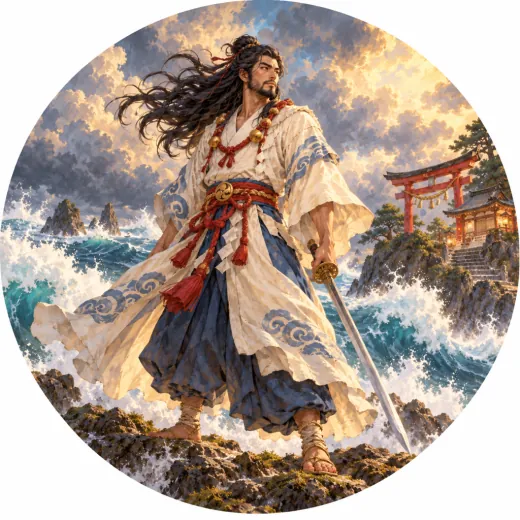
Susanoo
須佐之男, in Japanese
a little scary
Susanoo is Amaterasu's brother, the deity of storms and the sea, with a hot-headed character. Because of his misdeeds in heaven he was sent down to earth, to the region of Izumo. There he met an old couple who were weeping: a monstrous eight-headed serpent had already taken seven of their eight daughters, and was about to take the last. Susanoo promised to save her, defeated the serpent with a trick and found a marvellous sword in its tail, which he brought as a gift to his sister.
Did you know? That sword, called Kusanagi, is one of the three sacred treasures of the Japanese imperial family, together with a mirror and a jewel.
The story
In the days when the world was still fresh, there was a god who could not stop crying.
His name was Susanoo. His father, Izanagi, had given him the sea to rule, his sister Amaterasu the sky, and another brother the night. But Susanoo ruled nothing. He just stood on the beach and wailed. He wailed so loudly that the green mountains withered and the rivers dried up, and his beard, left uncared for, grew down to his chest. Meanwhile, dark forces crept out of the cracks and filled the world with noise.
“Why are you crying?” Izanagi asked him.
“I want to go to my mother's land,” sobbed Susanoo.
His father would not listen to a son who neglected his duty. He drove him out.
So Susanoo decided to say goodbye to his sister before he left. He climbed up to heaven, and the earth shook under his steps, and the seas boiled. Amaterasu heard him coming from far away. She thought he was coming to take her kingdom, and she got ready: she tied up her hair, put on her armour, drew her bow, and waited for him at the door.
“I don't want to hurt you,” he said. “I only want to say goodbye.”
To prove it, they held a contest, exchanging gifts and bringing new gods to life. Susanoo declared himself the winner and felt he had been proved right. That was his mistake. From that day on, nothing could hold him back.
He wrecked the banks of his sister's rice fields. He fouled the hall where the harvest festival was held. Then, one day, he threw a dead horse through the roof of the weaving hall, right among the weavers working on the gods' clothes. One of them, terrified, hurt herself on her shuttle and died of it.
Amaterasu could bear no more. She took refuge in a cave and blocked the entrance with a boulder, and the world was left in darkness. The gods managed to bring her out, but that is another story. When the sun came back, their sentence for Susanoo was already decided: they cut off his beard, pulled out his nails, and drove him out of heaven.
Susanoo came down to earth, in the land of Izumo, near the source of the river Hi, and for the first time he was truly alone.
He was walking along the bank, tired and with nowhere to go, when he saw something floating on the water. It was a pair of chopsticks.
“If there are chopsticks,” he thought, “there's someone further upstream.”
He followed the current up and found a hut. Inside were an old man, an old woman and a girl, and all three were crying.
“Who are you?”
“My name is Ashinazuchi,” said the old man. “This is my wife, Tenazuchi. And this is Kushinadahime, our last daughter. We had eight. Every year a serpent with eight heads comes and takes one of them away. It has taken seven. Today is the day it comes.”
Susanoo looked at the girl. She kept her head down and her hands clasped tight in her lap. He, who all his life had thought only of his own sorrows, for the first time looked at someone else's.
“Give her to me,” he said. “I am the brother of Amaterasu, and I have just come down from heaven. I will save her.”
The old couple knew who Amaterasu was, and they understood that this stranger, with his nails still aching and his beard cut off, was telling the truth. They hesitated. Then, because there was nothing else to be done, they said yes.
Susanoo turned Kushinadahime into a comb and slipped it into his hair. Then he gave his orders: “Brew a very strong sake, brewed eight times over. Build a fence with eight gates. Behind each gate put a platform, and on each platform a full vat.”
The old couple worked all night without speaking. The river ran low and black. In the end the fence was ready, eight gates in a row, eight brimming vats, and the smell of sake spread through the air like a sweet mist. Then there was nothing left to do but wait, and the waiting, as anyone knows who has waited for something terrible, was the longest part.
Then came the sound of branches snapping.
The serpent Yamata no Orochi, who came from the land of Koshi, rose out of the darkness, and for a moment the valleys seemed to shrink. It was as long as eight hills, with eight heads and eight tails, eyes as red as berries, and on its back grew moss, cypresses and cedars. It stopped in front of the fence. It sniffed.
The eight heads dipped down, each through a gate, each into a vat. They drank. They drank every drop. Then the serpent went limp, the heads sank to the ground, and a slow breath came out of its nostrils.
Susanoo leapt out with his long sword, a sword ten hand-breadths long, and struck. The river Hi ran red. But when the blade reached the middle tail, there was a clang. The edge had chipped. Susanoo looked more closely, opened the tail with the tip of his sword, and inside he found a shining blade.
He took it in his hand and looked at it for a long time. It was such a beautiful thing that it did not seem to belong to a monster. Then he took it up to heaven, despite his exile, and offered it to Amaterasu. That sword, which came to be called Kusanagi, is still one of the three treasures of the imperial family today.
Then Susanoo looked for a place to build a house for himself and for Kushinadahime, who had become a girl again. He travelled all over the land of Izumo, until he came to a place called Suga.
“Here,” he said, “my heart is at peace.”
It was from these words, the text says, that the place got its name: the word he used, sugasugashi, means clear and refreshed, like the air after a thunderstorm.
He built his palace there. And as he laid the first beam, it is said, he sang lines that many consider the first poem of Japan:
Where eight clouds rise, in the land of Izumo, I build an eightfold fence to keep my wife within. Ah, that eightfold fence.
The god who used to wail on the beach was now building a wall to protect someone.
All around him, clouds rose upon clouds. And from that day on, nobody ever heard him cry again.
A living tradition, told with respect: how we tell myths.
Relatives around the world
Listen / Read next
- Music to read by: Cinematic JourneyEpic film-style music, no lyrics, by Ciro Simone IrmiciSpotifyYouTube Music
Sources
- Kojiki (712)
