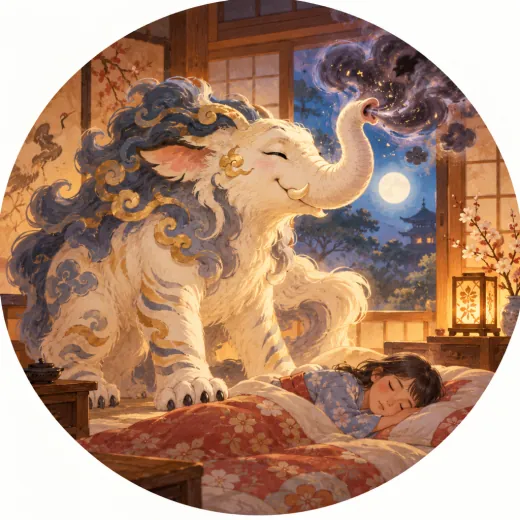
Baku
獏, in Japanese
not scary at all
The baku is a creature made of bits of different animals: an elephant's trunk, a rhinoceros's eyes, an ox's tail and a tiger's paws. It comes from China, but in Japan it became famous for one thing only: it eats bad dreams. Anyone who wakes from a nightmare can say three times “Baku, eat my dream!”, and the baku gobbles it up, turning it into good luck. People once put its picture under their pillow, especially on New Year's night, so they could sleep peacefully.
Did you know? In Japanese “baku” is also the name of the tapir, the real animal with a trunk-like nose.
The story
For two months, every night, the boy had the same dream.
It was a long corridor, with a wooden floor that creaked at every step. At the end there was a door standing ajar, and behind the door something was breathing. He walked slowly, his heart in his mouth, and every night the door was a little closer. He had never seen it open all the way. He always woke a second before, with the sheet clenched in his hands and his forehead wet.
It had started after the move. His parents had to work far away, and he had been sent to live with his grandmother, in a house in the country where the school was new, the classmates were new and even the evening silence was different from the one he was used to. He had told nobody. A twelve-year-old boy does not tell his grandmother he is scared of a corridor.
She had noticed anyway.
On the last evening of the year, while snow fell softly outside and the smell of broth drifted from the kitchen, his grandmother came into his room with a roll of yellowed paper.
“Keep this under your pillow,” she said.
The boy unrolled it. It was an ink drawing, made by someone who had never seen an animal like this and had invented the whole thing. It had the trunk of an elephant, the eyes of a rhinoceros, the tail of an ox and the paws of a tiger. As for the rest of its body, nobody could agree.
“What is it?”
“It's a baku. It eats bad dreams.” His grandmother plumped up the pillow. “They say it was made from the leftover pieces, when all the other animals were finished. Maybe that's why it's so kind to anyone who's been put together badly.” And she smiled. “You call it when you need it. You just have to tell it.”
“Tell it how?”
“When you wake up, call it out loud: baku, eat my dream.”
She turned off the lamp and left. The boy lay staring at the ceiling. He did not believe a word of it. Still, the roll of paper under his head felt warm.
That night the corridor came back.
The floor creaked. At the far end, the door was closer than usual: only a few steps away. From behind it came a long, damp breath, and now he could also hear claws scratching on wood. He took one step, then another. He reached out his hand. The door moved.
He woke with a jolt, a scream stuck in his throat. The room was dark. His heart was racing.
“Baku,” he said, his voice shaking. “Baku, eat my dream.”
Nothing happened. Then, in a corner, something sneezed.
An animal stepped out of the shadows, padding softly like a big cat. It was about the size of a medium dog. On its face was the trunk, swinging gently, and two round, slightly shiny eyes that did not know how to look unkind. Its tail swished from side to side like an ox's in a meadow. It looked like someone who had just woken up.
“Here I am,” it said. “Sorry I'm late. Was it a bad dream?”
The boy's mouth fell open. “You can talk?”
“When there's talking to be done, yes,” said the baku. It sat down on the rug, its tiger paws planted firmly. “Tell me what it's like.”
“A corridor. With a door. And behind the door there's something breathing.”
“Mmm.” The baku half-closed its eyes. “Interesting. A classic, but well made. And how does it end?”
“It doesn't. I wake up first.”
“That's the trouble.” The trunk lifted and sniffed the air, as if over a cooking pot. “A dream that doesn't end hangs around. It sticks to the room, you know? To the walls, to the pillow. And the next night it's stronger. Let's see.”
It closed its eyes. A cold light settled over the room, and the whole corridor appeared in the air, with its wooden floor and the door standing ajar. The baku stretched out its trunk towards it, and the corridor began to shrink, to fray, to slide into its mouth like a strand of spaghetti.
There was a sound of chewing, loud and satisfied. Then a long, noisy smack of the lips.
“Tastes of cellar,” said the baku. “And rotten apple. A hint of pepper at the end.” It opened one eye. “But it wasn't wicked. I've eaten worse.”
The boy burst out laughing, and realised it was the first time in two months that he had laughed in that room.
“What was behind the door?”
“Nothing terrible,” said the baku. “There was someone who was scared too. An old fear, the kind children carry with them when they move house.” It scratched its trunk with a paw. “The fear wasn't only yours. But now I've eaten it, and it won't come back.”
It got up, stretched like a cat and went to the window.
“A piece of advice,” it said. “Don't call me for everything. For a test that went badly, a barking dog, a friend who said something unkind, a good night's sleep is enough. Call me only when the dream is too big for you. The rest you have to chew on yourself.”
“And what if you ate the good dreams too?”
“Those I leave. They belong to you.” The baku smiled with its whole face. “Besides, you've got a new year starting. Make it a good one, your dream.”
A breath of wind stirred the curtain. When the boy turned round, the room was empty. On the windowsill, though, lay a little golden dust, which glittered for a moment and then vanished.
He slept until morning. He dreamed of nothing, and when he woke up his grandmother was already frying something in the kitchen.
“Sleep well?” she asked, without turning round.
“Yes.”
“I can tell. You've got a new face.”
By daylight the scroll was only a piece of paper. He rolled it up carefully and put it in the drawer. Then he went out to look at the snow, and for the first time since he had arrived, no door, in any corridor, followed him.
A living tradition, told with respect: how we tell myths.
Relatives around the world
Listen / Read next
- Music to read by: Cinematic JourneyEpic film-style music, no lyrics, by Ciro Simone IrmiciSpotifyYouTube Music
Sources
- Lafcadio Hearn, Kottō, the story “The Eater of Dreams” (1902)
- Michael Dylan Foster, The Book of Yōkai, University of California Press (2015)
