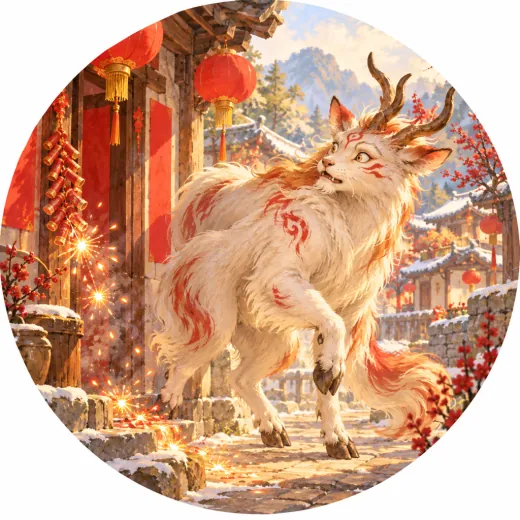
The Nian and the New Year
年, which also means “year”
a little scary
A folk legend tells that at the end of every winter the Nian came out of the sea or the mountains, a horned beast that entered the villages and frightened everyone. One day an old man discovered that the Nian was afraid of three things: the colour red, noise and lights. Since then, on New Year's Eve, families hang red decorations on their doors, light lanterns and set off firecrackers. The Nian has never come back.
Did you know? In Chinese, “guo nian” means “to pass the year”, that is, to celebrate the New Year; according to a popular explanation, not an established etymology, it can also be read as “to get past the Nian”.
The story
They say that at the end of winter, in the villages of China, there was one night when nobody wanted to be at home.
It was the last night of the year. And it had an ancient name, which children learned before they even learned to count: the Nian.
Nobody had ever seen the Nian clearly. Those who had seen it did not like to talk about it. Some said it came from the sea, others from the depths of the mountains, where the snow never melts. People said it had a long head with horns on its forehead, a mouth full of teeth, and a breath that froze the leaves. They said that on the last night of the year it came out of its lair, came down from the mountains and went from house to house, taking whatever it found. The hens. The pigs. The harvest put aside for the spring. Sometimes one of the smallest children, if they had not been hidden in time.
That is why, every year, when the sun set on the last day of winter, the same thing happened in every village.
Families shut their doors. They loaded blankets, rice and cooking pots onto their carts and climbed the mountain paths. They went to hide where the Nian would not find them. Mothers carried their children in their arms. The old were helped along. Nobody spoke; all you could hear was the creak of the wheels and people breathing.
Behind them the houses stood empty, their hearths cold, waiting.
That year, in a small village between two hills, things went differently.
It was already evening. The families were finishing loading their carts when an old man appeared on the path that came up from the bottom of the valley. He had a white beard and white hair, a cherry-wood staff and a sack over his shoulder. He walked slowly, like someone who has been walking all his life. He was dressed like a beggar.
He stopped in front of a widow who was tying up her last bundle.
“Good woman,” he said. “I'm hungry, and I've come a long way. Could you give me a little rice?”
All around her, the neighbours were shouting at her to hurry. The sun had almost set. The widow looked at the old man, then at her pot, then at the mountain growing dark. And instead of running, she opened her bundle and handed him a bowl.
“Eat,” she said. “But don't stay here, grandfather. Tonight the Nian is coming.”
The old man ate slowly, enjoying every mouthful, as if he were in no hurry at all. Then he smiled.
“Let me stay in your house tonight,” he said. “I promise you the Nian will not come in.”
The widow thought she had misheard. The others, already on the path, turned round and shook their heads: there was no time to waste. But she, who knows why, looked into the old man's eyes and saw that there was no fear in them. She put her bundle on the cart, took her little granddaughter by the hand, and climbed the mountain with the others. The old man stayed in the village alone.
Darkness fell.
The old man went from house to house. He took red paper, the kind used for celebrations, and pasted it on the doors, one by one. Then he hung lanterns from the roofs and lit as many as he could, until every window was full of warm light. In a small storeroom he found bundles of dry bamboo. He piled them up in the courtyard, near the door, and waited.
The wind dropped. Not a sound came from the mountains.
Then, far away, something began to move.
First came a rustling, like a sack being dragged across snow. Then the sound of huge, slow footsteps. Then breathing, heavy and wet, coming up the road.
The Nian entered the village. It was bigger than the stories said. Its eyes glowed like two red embers in the shadows. It walked sniffing the air, and wherever it passed you could already feel the cold in your bones. It came to the first house. It stopped. On the door there was a strip of red paper, and in the window a light.
The Nian gave a low growl. It took a step back. It did not like that red. It did not like that light.
It went to the second house. Red. Light. At the third, the same. For the first time, the village was not the way it remembered it, and the Nian, which had always felt like the master of the night, began to move less boldly.
At last it came to the very last house, the one at the far end, with a courtyard and a red door. There, standing in the light, waiting for it, was the old man.
The Nian lowered its head and got ready to spring.
At that very moment the old man set fire to the bamboo.
What a din! The bamboo, as it burned, cracked and banged with tremendous bursts, one after another, like a volley of drumbeats. Crackles, explosions, sparks leaping in the dark. The old man, suddenly dressed in a red robe, waved his arms and beat his staff against the wall.
The Nian, which had never heard anything like it, leapt backwards. It howled. It spun round and ran away, towards the sea or towards the mountain, tripping over its own shadow, and vanished into the darkness it had come from.
Silence fell over the village. The old man, his face black with soot, sat down on the doorstep. He waited for dawn, and dawn came.
In the morning the people came back, with hesitant steps, expecting to find ruins. They found their houses untouched, the hens alive, the doors red and the lanterns still burning. They looked for the old man, but on the doorstep there was only an empty bowl. Someone swore they had seen him rise up into the sky. Others simply said it had been a gift.
The widow lifted her granddaughter into her arms, and the little girl pointed at the red paper on the door.
“Why is it red, Grandma?”
“Because from today on, it always will be,” said the widow.
And so it was. Every year, when winter ends, the families in the villages hang red banners on their doors, light lanterns, set off bamboo and firecrackers, and they no longer go and hide in the mountains: they stay at home, all together, with the lights on, and celebrate.
They say the Nian never came back.
But on New Year's Eve, the old people still step just outside the door and look out into the dark. Just to be sure.
Relatives around the world
Listen / Read next
- Music to read by: Cinematic JourneyEpic film-style music, no lyrics, by Ciro Simone IrmiciSpotifyYouTube Music
Sources
- folk tale recorded in modern times (20th century), oral folklore
