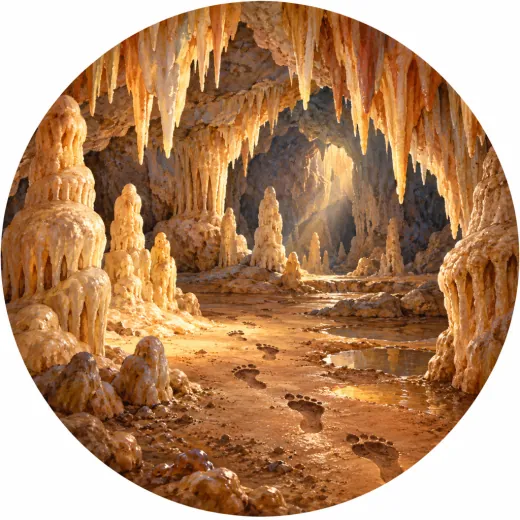
The Bàsura of the Grotte di Toirano
“bàsura”, witch in Ligurian
a little scary
In Ligurian “bàsura” means witch, and the most famous cave of Toirano is called the Witch's Cave. People said a witch lived inside: the wind going in and out of the cracks made strange whistles and sighs. Nobody ever wrote down a real story about the witch, though. What is inside is even more surprising: in 1950 some explorers found hundreds of footprints, handprints and knee prints left by people who lived about 14,000 years ago.
Did you know? A 2019 study found that the prints include those of children about 3 and 6 years old.
The story
In Ligurian, the word "bàsura" means witch. When the people of Toirano, a village between the hills and the sea, gave that name to a cave, they put a pinch of fear into it. Wind came out of the cracks in the rock, and the wind made strange sighs. "A witch lives there," they said.
Nobody ever wrote a story about that witch. But what was really there at the bottom of the cave was far more surprising.
In 1950, some explorers, curious as you are when you are discovering something, entered a narrow hole beneath the mountain. At the entrance there was a column of rock, a thick stalagmite, that blocked the way. They broke it. Behind it, a world opened.
A gallery almost nine hundred metres long, among stalactites, columns, enormous halls and very low corridors. Nobody had set foot there for centuries. In fact, for far longer. They understood this soon after, when a scholar, Virginia Chiappella, went in to study it: her work came out in 1952. She looked carefully at the muddy floor.
On the mud there were footprints.
Bare feet. Hands. Knees. Fingers that had drawn lines on the clay. Black marks of charcoal on the walls. And alongside, here and there, the paws of a bear and a dog.
Those prints were left, according to modern analyses, about fourteen thousand years ago.
It is not easy to imagine how long such a time is. Fourteen thousand years ago there were no wheat fields, no villages, no cities. It was the last phase of the Ice Age. Europe was a cold place, lived in by hunters and gatherers who lived on what they found.
But the scholars, when they measured those prints one by one, discovered something moving.
There were five. Five people, of different ages and heights, whom the researchers were able to tell apart one by one from the length of the feet and the strides.
The smallest was about three years old and eighty-eight centimetres tall, less than a metre. He walked barefoot on the cold mud of the cave. Then there was a child of about six, a metre and ten tall. A boy of eight or eleven, a metre and thirty-five. Another, older, almost grown, a metre and forty-eight. And an adult, a metre and sixty-seven.
In short: a family, or a small group, entering a dark cave.
What did they do in there?
We know because the mud remembered everything. They went in with torches, bundles of pine wood that burned and lit up the walls. They walked slowly. At a certain point, the ceiling came down. In one corridor, the vault dropped below eighty centimetres. Too low to walk.
So they got down on all fours. They crawled, partly on hands and knees, over the wet mud, holding the torch in one hand. The marks of knees, hands and fingers are still there. Scientists say that, in the study of human footprints, it is the first time prehistoric people have been documented crawling in a cave.
Further on they reached a hall that today is called the Hall of Mysteries. There they gathered wet clay and smeared it on a stalagmite. Why? Nobody knows. Perhaps it was a rite. Perhaps a game. Perhaps something important, which we cannot understand. On the ceiling, more than a metre and seventy up, there are prints of hands stained with charcoal, left by someone who had lifted themselves up, or been lifted.
Then they turned back. On the way out they did not take the low road they had come by. They chose the higher corridor, the more comfortable one, with a solid floor, where it is easier to walk. Perhaps because they had realised that with children, it was better so.
If you think about it, it is a story full of things we recognise. The fear of the dark. Curiosity. The warmth of a flame. An adult squeezing the smallest one's hand while crawling in the mud. A six-year-old looking at the black hands on the ceiling and thinking, perhaps: "Who put them there?"
Today the cave can be visited, as it has been since 1953, but the mud is fragile, and one step too many could wipe out what has survived fourteen thousand years. To protect it, the researchers have measured it with lasers, photographed it in detail, and made digital models of it.
And the witch? Perhaps, in the end, she never existed. Or perhaps she did. Perhaps, as in all caves, something does live inside, and it is not a ghost. It is time. Standing still, at the end of a corridor, waiting for someone to come and look at the children's footprints.
Listen / Read next
- Music to read by: Cinematic JourneyEpic film-style music, no lyrics, by Ciro Simone IrmiciSpotifyYouTube Music
- The words of the dialect: GenoeseNonnese, the dictionary of Italian dialects
