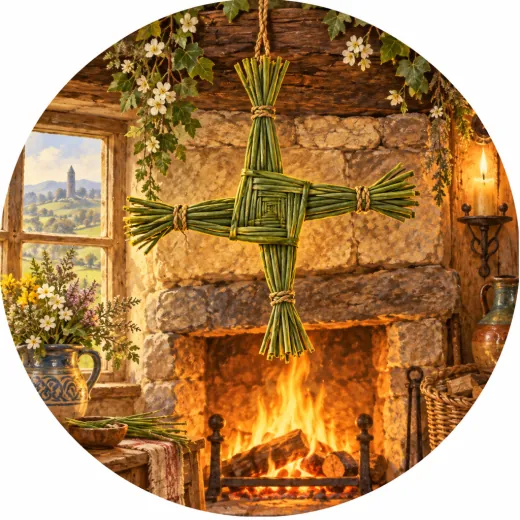
Brigid
Brigit, “the exalted one”
not scary at all
Brigid was the daughter of the Dagda and the goddess of poetry, healing and blacksmithing: three arts linked to fire, the fire of inspiration, of the hearth and of the forge. According to the tradition of Imbolc, she was celebrated at the beginning of February, when winter begins to loosen its grip and the first lambs are born. Later, in Ireland, her memory became intertwined with that of Saint Brigid of Kildare, where, according to tradition, women tended a fire that was never allowed to go out.
Did you know? According to Cormac's Glossary, Brigit had two sisters with the same name: a healer and a smith.
The story
In Ireland, they say, there was a fire that never went out.
It was at Kildare, inside a small enclosure, and for centuries nobody could remember ever seeing it go out. Rain, wind, long winters: nothing touched it. People called it Brigid's fire. And to understand why, we have to start much earlier.
We have to start with a woman who was a goddess. Or rather, with three.
In Cormac's Glossary, a book of ancient words written by a bishop and king called Cormac, there is a name that appears three times: Brigit. Cormac says she was the daughter of the Dagda, the good father of the Tuatha Dé Danann. She was a poet, a woman of wisdom. The poets of Ireland worshipped her and dedicated their finest verses to her, because her protection, the glossary says, was very great.
But there was more than one Brigit.
She had two sisters, and they were called Brigit too. One was the woman of healing, who cured wounds and illnesses. The other was the woman of the forge, who hammered iron and made it sing. Poetry, medicine, smithcraft: three very different arts, which still had something in common. All three needed fire.
The fire of inspiration, which brings words to life. The fire of the hearth, which warms the hands of the sick. The fire of the forge, which changes the shape of metal.
That is why, when the Irish said “Brigit”, they meant all three together.
The centuries passed. Ireland changed: alongside the poets came monks and nuns, with new beliefs, new books, new names. But at Kildare the name of Brigid remained, and the fire with it. That name now belonged to a Christian saint as well, St Brigid, and the two memories had become intertwined, until they were almost one. In any case, what the two Brigids had in common was clear: a flame that must not be allowed to die.
A traveller, Gerald of Wales, saw it with his own eyes. He wrote about it in a book on Ireland almost nine centuries ago. At Kildare, he said, there are holy women who keep a fire, the fire of St Brigid, and that fire, they say, has never gone out. There are nineteen women, and they take turns: one each night, one at a time, each keeps watch. On the twentieth night, when the round is complete, it is the saint's turn.
Let's try to imagine that night. Gerald doesn't describe it, but we can picture it.
It is autumn. The wind comes from the west, over the wet fields, and stops against the enclosure. It is a low, thick hedge that men may not enter: Gerald writes this, and adds that anyone who tried would regret it. Inside is the fire, as big as a family hearth, and beside it a young woman with a bundle of firewood on her knees.
It is the nineteenth night: the last one that falls to a woman, before the saint's. For her it is her first turn in this enclosure, and it has felt very long.
She has kept watch since sunset, as the others did before her. She has added a branch, then another, and listened to the crackle of the embers and the wind whistling through the leaves. Several times she has felt her eyelids grow heavy, and then she has sung softly to herself to stay awake. She has never let the flames sink low.
Now the sky is black and deep. Next comes the watch that belongs to none of them. The young woman knows it. She looks at the fire, and for a moment she is afraid.
What if it goes out? In all those years, in all that long history, no one has ever let it die. What if it happened to her?
Then she stands up. She takes the last pile of wood and lays it on the embers, carefully, the way you tuck a blanket around a child. The flames rise, hiss, spread.
Then she speaks, in a low voice, to the fire.
“Brigid, guard your fire. This night is yours.”
She doesn't know whether anyone is listening. She only hears the wind stop for a moment, as if out of respect. Then she slips quietly back to the little cell where the others are sleeping, and lies down on her bed with her eyes open. She listens to her companions breathing. She thinks of her mother, far away, who might be lighting her own fire at that very hour. She thinks that from this night on, something has changed for her: she has understood that keeping watch does not mean staying awake, but trusting that you are not alone.
Inside the enclosure, the fire is left by itself.
Nobody watches it. Nobody tends it. All night long the flames sink and rise, the sparks fly among the leaves, and the wind runs round outside without coming in. The sky fills with stars. And in the dark, something perhaps older than the stars sits down beside the embers and keeps watch.
When the bells ring at dawn, the young woman comes out of her cell, barefoot, her heart in her mouth.
She crosses the courtyard, where the grass is wet with dew and the air smells of smoke and cold earth. Behind her, one after another, her companions come out of their cells without speaking, and stop to watch. She reaches the hedge.
The fire is there.
Small, calm, red as a fruit, with the wood still whole and no ash in the hearth. It is burning as if it had only just been lit.
She kneels down. She stretches her hands towards the warmth, and cries a little, from relief.
When Gerald heard about it, he was struck. He wrote that in all those years the fire had never built up any ash, and that the local people saw it as a sign. Who could say? Perhaps Brigid was still listening.
Because every home needs a fire.
And every fire, to stay alive, needs someone to keep it.
Relatives around the world
Listen / Read next
- Music to read by: Cinematic JourneyEpic film-style music, no lyrics, by Ciro Simone IrmiciSpotifyYouTube Music
Sources
- Cormac mac Cuilennáin, Sanas Cormaic, Cormac’s Glossary (10th century)
- Gerald of Wales, Topographia Hibernica (12th century)
