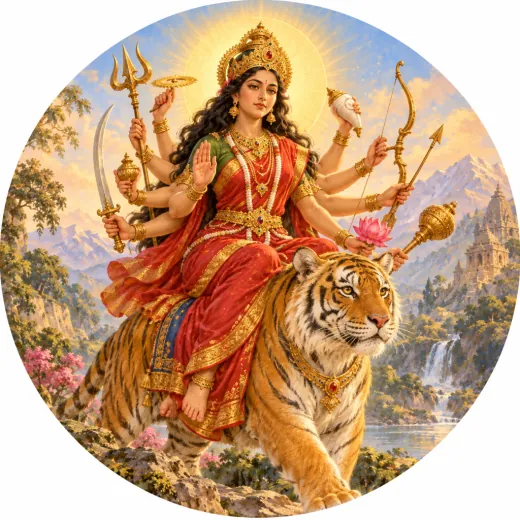
Durga
Durgā, “the unreachable one”
a little scary
Durga is a warrior goddess revered as strength and protection. Tradition tells that a buffalo demon, Mahishasura, had defeated the gods in war and driven them out of heaven. So the gods joined their energy together, and from that light Durga was born, with many arms, each holding a weapon given by a different god. Riding a lion or a tiger, she faced Mahishasura and defeated him after a long battle.
Did you know? Every autumn, especially in Kolkata, people celebrate Durga Puja: for days the city fills with statues and pavilions dedicated to her.
The story
There was a time when the gods lost heaven.
It was not a war of a single day. It was a long war, a hundred years long, between the gods and the demons, and in the end the demons won. Their leader was Mahishasura, who had the shape of a gigantic buffalo and could take human forms too, whenever he wished. He drove out Indra, the king of the gods. He sat down on his throne. And the gods, with no home left, found themselves wandering the earth like beggars, hiding in forests and caves.
After much wandering, they went to Brahma, and with Brahma to Shiva and Vishnu. They told them everything: that the demon had taken the place of the sun and the moon, of fire and wind, and that now he was the one in command.
Vishnu and Shiva listened in silence. Behind those words they could feel the whole weight of a hundred years of defeat: the empty palaces, the temples without offerings, the prayers that no one carried up to heaven any more. Then a shadow of anger crossed their faces. From the face of Vishnu, from the face of Shiva, from the face of Brahma, and from the bodies of all the other gods, came a light. An enormous light, a fire without flames, that rose and joined into a single mass, like a mountain ablaze.
The light took shape. It was a woman.
The gods looked at her without speaking. She resembled none of them and she resembled them all. Her gaze was calm, the gaze of someone who already knows how things will end, and in her silence there was a promise.
Her face was the light of Shiva. Her hair was that of Yama, the god of death. Her arms were Vishnu's. Her breast was the moon. Her waist was Indra. Her legs were Varuna, the god of the waters. In each of her hands the gods placed a weapon. Shiva gave her a trident. Vishnu, a discus. Varuna, a conch shell. Agni, a spear. Indra, a thunderbolt and a bell. Yama, a staff. Brahma, a string of beads and a water pot. Time gave her a sword and a shield. Vishvakarman, the craftsman of the gods, gave her an axe. Others gave her jewels, necklaces, a flower that never faded. The Himalaya gave her a lion, to carry her into battle.
When she was ready, the Goddess smiled. She laughed with a voice so mighty that the sky shook, the earth trembled and the seas rose up. And the gods cried out: “Victory!”
In Mahishasura's palace, the demons heard the noise. The king rose from his throne. “What is that sound?” And he went out with his whole army to see. He sent spies ahead, then warriors; not one of them came back able to say what they had seen, but they all came back quieter.
The world in front of him was full of light. On a roaring lion, surrounded by arms holding a thousand weapons, was a woman, alone. She was as tall as the sky. Her feet just touched the earth.
The demon generals, Chikshura and Chamara, charged forward with whole armies of elephants and chariots. The Goddess did not move. She breathed, and from her breath thousands of warriors were born, who stood around her like a divine army. One after another, the generals fell: Chamara, Chikshura and the others, until nothing was left on the field but dust and the sound of a distant drum. The lion leapt into the fray, shaking its mane like a wildfire. The battle was long and loud. Arrows, spears, axes, drums, the crackle of flames. To every blow from the demons the Goddess replied, without haste, without fear.
In the end, only Mahishasura was left.
The buffalo demon came forward. His horns were long and his breath was scalding, and at every step the ground groaned under his hooves and the mountains shook like trees in the wind. For a moment, even the bravest warriors thought of running. First he charged, like a real buffalo, and the Goddess's warriors were swept aside. The lion backed away. But the Goddess threw her noose over him and pulled it tight. Then the demon changed shape. He became a lion, and roared. He became a man with a sword, and his blade flashed. He became an elephant, and his trunk reached out to seize her. Each time, the Goddess stopped him.
Each time, Mahishasura turned back into a buffalo. Each time, he laughed.
The Goddess looked at him. She paused for a moment, like someone catching her breath. Then she sprang high into the air and came down on him with all her weight, pressing her foot onto the buffalo's neck. She struck him with her spear. The demon tried to get out of his own shape, half buffalo and half man, but he was too late. That was the end of his war.
The silence that followed was louder than the noise. A rain of flowers fell from the sky.
The demons who were left fled. One by one, the gods came out of their hiding places. They bowed. They sang a hymn, and they sing it still: “We salute you, Goddess, you who are the strength in all things, you who are the peace in all things. You took our light and made it strong. Because of you, we can go home.”
The Goddess listened to them gently. Then she said: “Ask for whatever you wish.”
“Just one thing,” they answered. “That you will come whenever we need you.”
She promised: whenever the world was in danger, whenever anyone called on her with a sincere heart, she would return.
Even today, in India, every autumn, for days on end the cities fill with statues and pavilions dedicated to her, above all in Kolkata: the Goddess stands on her lion and pins down a buffalo with her foot, and people bring her flowers, sing and light lamps. It is their way of telling her that her return, every year, is awaited.
A living tradition, told with respect: how we tell myths.
Relatives around the world
Listen / Read next
- Music to read by: Cinematic JourneyEpic film-style music, no lyrics, by Ciro Simone IrmiciSpotifyYouTube Music
Sources
- Devi Mahatmya, in the Markandeya Purana
