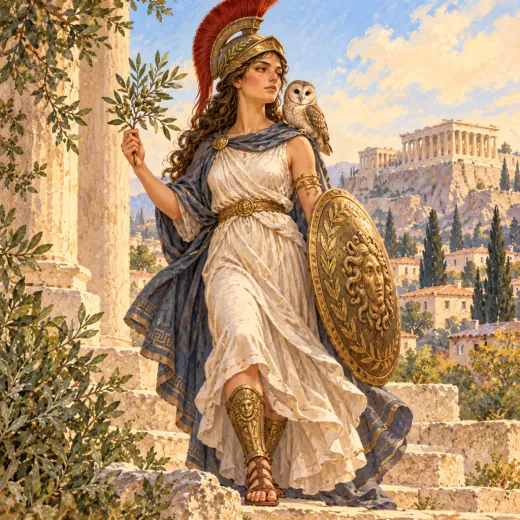
Athena
Athēnâ, in Ancient Greek
not scary at all
Athena is the goddess of wisdom, intelligence and the arts, but also of strategy in war. Her birth is one of the strangest in all the myths: she sprang fully grown and wearing armour from the head of Zeus. She competed with Poseidon to become the protector of a city: he made a spring of salt water gush out, and she grew the first olive tree. The gods chose the olive, and the city took her name: Athens. In the Odyssey she is the one who protects and advises Odysseus on his long journey.
Did you know? According to tradition, her animal is the owl, which can see even in the dark: that is why it became the symbol of people who study and know things.
The story
One morning on Olympus, Zeus woke up with a headache.
Not an ordinary one, the kind that goes away after a walk. This headache was knocking from the inside, loud and steady, as if someone were building a house in there. Zeus held his forehead in his hands, paced up and down, drank water, drank nectar. Nothing helped. The other gods watched him from a distance, not daring to say a word.
Because some time before, Zeus had done something strange. He had married Metis, the goddess of good counsel, the one who always knew what to do. And then, when she was expecting a child, he had swallowed her. Whole. He had been told that she would give birth to a child stronger than him, and Zeus, who had already beaten his own father, was not keen to see the same story played out the other way round.
The trouble was that Metis, inside him, had not disappeared.
“Hephaestus!” Zeus called at last, in the voice of someone who had had enough. “Fetch your axe. Split my head open.”
Hephaestus, the blacksmith god, stared at him. “Are you sure?”
“I have never been surer of anything.”
The other gods held their breath. Hephaestus raised the axe and brought it down with a sharp crack. And out of Zeus's head, in a cloud of light, sprang a young woman.
She was tall, with eyes as grey as the sea in autumn, and she wore a helmet and carried a shield and a spear. She was already dressed for battle. The moment she touched the ground, she let out a war cry so loud that the sky shook, the sea rose up, and Helios, the Sun, stopped his horses for an instant.
Then she looked around calmly and said, “Hello, everyone. What's all this noise about?”
Zeus laughed for the first time that morning. His headache was gone. “This,” he told them all, “is my daughter. Her name is Athena.”
Athena was different from all the others. She did not love war for its own sake, but for its strategy: she knew when to fight and when not to. She did not love noise; she loved plans. If there was a problem, she looked at it from every side, and sooner or later she found the way in.
One day she faced a problem bigger than any other. It happened in Attica, where a new city was about to be born. A city so beautiful that two gods wanted it for themselves.
The other one was Poseidon, lord of the sea.
“If he wins, we'll have storms,” said Cecrops, the first king of the place. “And if she wins?”
“We'll have something,” said an old woman. “But what, I don't know.”
The gods set up a contest. Each of them would give the city a gift. The more useful gift would win.
Poseidon went first. He climbed the high rock, the Acropolis, and struck it with his trident. The rock split open, and a spring gushed out. The people came closer, curious, and tasted it. They pulled a face. The water was salty, like the sea.
Then it was Athena's turn.
She made no noise. She used neither trident nor spear. She bent down, put a seed in the earth and waited. A thin shoot pushed up out of the rock. In a few moments it became a little trunk, then a tree, its silvery leaves stirring in the wind.
“It's an olive tree,” said Athena. “It gives oil for cooking, oil for lamps, wood for building, fruit to eat. Isn't it beautiful? Isn't it useful?”
Cecrops witnessed it all. Then the gods, all twelve of them, voted. Once the votes were counted, it was clear. Athena had won.
Poseidon did not take it well. He hurled himself on the nearby plain and flooded it, out of revenge. But the city belonged to Athena now, and it took her name: Athens.
Meanwhile, of course, Athena was still busy with another task, her favourite one: protecting a man who had more imagination than anyone else.
After twenty years of war and wandering, Odysseus was left asleep on the beach of Ithaca by the Phaeacians. He woke up in a mist. Athena had wrapped it around him so that no one would recognise him. Odysseus looked around and saw an unknown harbour, unknown rocks, unknown trees. He thought the sailors had tricked him. He began to cry.
“They've brought me to some faraway land,” he said to himself, “and stolen my treasure.”
A young shepherd came up to him, as elegant as a king's son, with a cloak on his shoulders and a spear in his hand.
“Good morning, stranger,” he said. “How did you get lost?”
“Where am I?” asked Odysseus.
“On Ithaca.”
Odysseus stopped himself from jumping for joy. He was far too clever for that. On the spot, he made up a long story full of pirates and escapes, just so as not to reveal who he was. The shepherd listened with shining eyes, and at a certain point burst out laughing.
And before Odysseus could say anything, the figure changed: now it was a woman, tall, with grey eyes.
“What a man!” said Athena, and pinched his cheek. “You lie even when you're telling the truth. That's what I like about you. You and I are made the same way: we both love the best plans.”
Then she cleared the mist, and slowly, like someone waking from a dream, Odysseus saw the mountains, the harbour, the olive tree by the cave. He really was home.
“Now,” said Athena, “we must think. I'll go to Sparta to call your son Telemachus, who still believes you're far away. You stay here, with a friend you can trust, and talk to no one. In your palace there are men who want to steal everything you have. Don't walk in like a king. Walk in like a beggar.”
With a touch of her hand she turned him into a shrivelled old man, with ragged clothes and wrinkled skin. Odysseus looked at his hands, and smiled.
It was a good plan. It was Athena's plan, and Odysseus, who knew a thing or two about plans, admitted that when a goddess is thinking, even the cleverest people would do well to listen.
Because that is how Athena is: she does not win with noise. She wins by thinking one step ahead of everyone else. It is no accident that the city which chose her olive tree still bears her name.
Relatives around the world
Listen / Read next
- Music to read by: Cinematic JourneyEpic film-style music, no lyrics, by Ciro Simone IrmiciSpotifyYouTube Music
Sources
- Hesiod, Theogony
- Homer, Odyssey
- Apollodorus, Library, Book III
