Aeneas
Aeneas, in Latin
a little scary
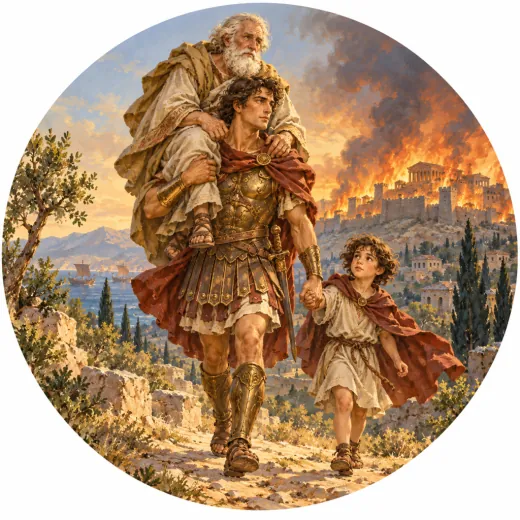
Aeneas was a Trojan prince, the son of the goddess Venus. When Troy was taken by the trick of the horse, he escaped from the burning city carrying his old father Anchises on his shoulders and holding his little son Ascanius by the hand. After a long sea voyage, a storm and an unhappy love with Queen Dido of Carthage, he reached Italy. At Cumae the Sibyl guided him into the kingdom of the dead, where his father showed him the glorious future of Rome. Virgil announces that in Italy he will found a new homeland for the Trojans, but the poem ends earlier, with the death of Turnus.
Did you know? According to the ancient biographies of the poet, Virgil worked on the Aeneid for about ten years and died before finishing it: he asked for it to be burned, but the emperor Augustus would not allow it.
The story
Troy fell at night, while it was sleeping.
Aeneas was asleep too, in his house, far from the walls. Suddenly, in his sleep, Hector appeared to him.
He was not the warrior he used to be. His face was caked with dust, his feet swollen, his eyes weary. He appeared just as he had looked after he was dragged around the city. In his dream, Aeneas wept.
“Run, son of a goddess,” said Hector. “Tear yourself away from the flames. The enemy is inside the walls, and Troy is falling from its height. If any hand could have defended it, it would have been mine. I entrust its holy gods to you. Take them, and seek for them the walls you will found, after wandering over the sea.”
Aeneas woke with a start. He climbed onto the roof and listened.
The crackling came from every side, like a fire in a cornfield when the south wind blows, or a mountain torrent sweeping away fields and crops. A shepherd standing on a rock hears that noise and cannot tell where it comes from.
Aeneas took up his weapons. As he ran he saw Panthus, a priest of Apollo, fleeing with the sacred objects and leading his little grandson by the hand. “Panthus, where is the fighting? Which place do we still hold?” he asked. The priest answered with a sigh: “The last day has come. We were Trojans. Troy was. The god has given everything to the Greeks.”
Aeneas fought for as long as he could. But in the middle of the battle, looking at the royal palace in flames, he thought of his father, his wife, his son. Then Venus, his mother, appeared to him, her face full of light.
“My son, why all this rage? Don't you think of your father, of Creusa, of little Ascanius?” And she touched his eyes. The mist that covers the eyes of mortals drew back.
On the walls, Aeneas saw the gods. Neptune was shaking the foundations with his trident. Juno held the gate, her sword raised. Athena stood on the citadel, shining in a cloud, with the Gorgon's head on her shield. And Jupiter was giving strength to the enemy. “Run,” said Venus. “I will never leave your side until I have brought you to your father's door.”
He went home. His father, Anchises, was old, and he would not leave.
“You are young: you run,” he said. “If the gods had wanted me to live, they would have spared this house for me. I have already seen Troy fall once and survived it: that is enough. Say goodbye to this old body and go. I will find my own death.”
Aeneas begged him. Anchises would not give in. So Aeneas seized his weapons again, determined to go back to the fighting and die.
Creusa clung to his feet. In her arms she held little Iulus. “If you are going to die, take us with you. But if you still have hope in your weapons, defend this house first. To whom are you leaving your son, your father, and me, the one you once called your wife?”
At that moment, above the child's head, a flame appeared. It was light, and it licked his hair without burning it. Aeneas and Creusa rushed over in fright, with water to put it out. But Anchises raised his eyes to the sky.
“Almighty Jupiter, if any prayer can move you, look upon us. And if we are worthy, give us a sign.”
The old man had barely finished speaking when thunder rumbled on the left. A star fell from the sky, trailing a long streak of light, glided over the roof and vanished into the woods of Mount Ida. Behind it, it left a glowing furrow and a smell of sulphur.
Anchises gave in. “I will wait no longer. I follow you, gods of our fathers. Save this house, save my grandson.”
“Father, climb onto my shoulders,” said Aeneas. “You won't be heavy. Whatever happens, we will share one danger, and one safety.” He threw a tawny lion skin over his shoulders and lifted the old man up. “You, father, carry the sacred objects and the Penates,” he added. “I have come from the battle, and it would be an offence to touch them before washing in running water.” Little Iulus held on to his right hand and followed with shorter steps. Creusa came behind, a little way back.
They walked through the shadows. Aeneas, who had not been afraid of spears or Greeks, now trembled at every breath of wind. He had two burdens to protect: the one he carried and the one he held by the hand.
They were near the gate, and he already felt they were safe, when he heard the sound of footsteps. Anchises peered into the dark. “Run, son! They're coming! I can see shields gleaming!”
Aeneas lost his head. He turned down a side street, away from the roads he knew. And that was the moment he lost his wife. No one ever knew whether she had stopped, or lost her way, or sat down from exhaustion. They never saw her again.
Aeneas did not look back. He did not think of it until they reached a hill where there stood an old, abandoned temple of Ceres, and a cypress tree. When everyone had gathered, she was missing.
So Aeneas put on his armour again and went back, through the burning streets, shouting her name. “Creusa! Creusa!” He called her for a long time. Until, in front of him, a ghost appeared, taller than she had been.
“Why give yourself up to such wild grief, my dear husband?” said the ghost. “None of this happens without the gods. It is not meant for you to take me with you. A long exile awaits you, and a wide sea to cross. You will come to a land, Hesperia, where the Tiber flows slowly through rich fields. There you will find a kingdom and a bride. Weep no more for Creusa. I will not go to serve Greek women, I, a daughter of Dardanus and daughter-in-law of the goddess Venus. The Great Mother of the gods keeps me on these shores. Now farewell, and keep your love for our son.”
Aeneas wanted to answer, but the ghost had already vanished. Three times he tried to throw his arms around her neck. Three times the image, clasped in vain, slipped through his hands, light as the wind, like a winged dream.
He went back to his companions. He found a huge crowd: men, women, young people, poor folk who had come from everywhere, ready to follow him anywhere.
On the peaks of Ida the morning star was rising. The Greeks held the city gates. There was no hope left.
Aeneas gave way. He lifted his father onto his shoulders, and climbed towards the mountain.
Relatives around the world
Listen / Read next
- Music to read by: Cinematic JourneyEpic film-style music, no lyrics, by Ciro Simone IrmiciSpotifyYouTube Music
Sources
- Virgil, Aeneid (29–19 BC)
