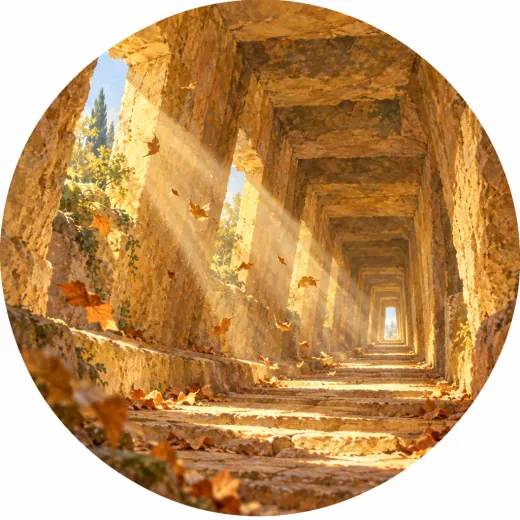
The Cumaean Sibyl
the prophetess of Cumae
a little scary
At Cumae, on the coast near Naples, lived the Sibyl, the prophetess of Apollo. The poet Virgil tells that the hero Aeneas went to her for help: the Sibyl foretold his future and guided him into the world of the dead, by way of nearby Lake Avernus. She was said to write her prophecies on palm leaves, which the wind then scattered. Another story tells that the god had given her a thousand years of life, but not youth: so she became tiny and terribly old.
Did you know? At Cumae there is a long corridor carved in the tufa that the archaeologist Amedeo Maiuri named the “Sibyl's Cave” in 1932; today many scholars think it was a military tunnel.
The story
There is a place, near Naples, where the earth has opened a mouth. It is a long, narrow gallery, dug into the tuff, with openings along the side that let the light in in stripes. When the wind blows, a lament echoes inside.
It was here that the Sibyl lived.
The ancients called her the Sibyl of Cumae, from the name of the Greek city that stood above. She was a woman, a prophetess. She did something nobody else could do: she sensed the future. When the god Apollo entered her, her voice changed, her eyes rolled back, and she said things that nobody understood at once, but which all came true.
She wrote her prophecies on leaves, one by one, in her nervous handwriting. She left them in a row inside the cave. But every time someone opened the door, the wind came in through the hundred openings, and the leaves flew into the air, mixed together, fell again like rain. Whoever came looking for an answer had to put the words back in order alone. And if they could not, it was their own fault.
That is why, even today, obscure words are called "sibylline".
But what few people know is how it all began.
One day, they say, Apollo looked at her and fell in love. He promised her anything. She bent down, took a fistful of sand in her hand, and said: "I want to live as many years as there are grains here."
The god granted it. There were thousands, so many that nobody could count them.
The Sibyl was happy. She had beaten time.
Only she had forgotten one thing. A small and terrible thing: she had not asked to stay young.
The years passed. One generation, then ten, then a hundred. The Sibyl watched her hair turn white, her skin dry up, her body shrink. She did not die. Time, for her, never ended. It only grew heavier.
One day Aeneas came to visit her. He was a hero from Troy, who had escaped from the burning city, looking for a land where he might found a new home. He wanted to descend into the kingdom of the dead to speak with his father. He knew that only the Sibyl could tell him how.
She received him in the cave, with the wind moaning around them. She looked at him, and the god seized her. Her voice grew vast, terrible. She foretold wars, toil, mourning. And then she told him what to do: he must search the wood for a golden bough, hidden among the trees, to bring as a gift to the queen of the dead. Without that bough, nobody enters. With that bough, nobody is stopped.
Aeneas found the bough. He entered the dark kingdom with the Sibyl at his side, the oldest guide one could have. And he came back.
This story is told by Virgil. But there is another episode, later, and it concerns Rome.
One day, in Rome, which then still had kings, a woman appeared. She was old, unknown, in a poor dress. She carried nine books. She told the king, Tarquin, that they were books of prophecies, and that she would sell them at a very high price.
Tarquin laughed. He refused. The price was too much.
The old woman did not get angry. She took three books and threw them into the fire, one after another. Then she said, calmly: "Six remain. At the same price."
The king laughed again. He thought she was mad.
The old woman burned another three. The fire roared. And she repeated: "Three remain. The price is still the same."
At that point Tarquin stopped laughing. Something had tightened his throat. He paid, for only three books, the price he had refused for nine. The woman vanished, and nobody ever saw her again.
Those three books were kept in the temple of Jupiter, in Rome, and for centuries, in the worst moments, the Romans opened them to understand what to do. The ancients say that the woman was she herself, the Sibyl of Cumae.
And then?
Then time went on passing. The Sibyl grew smaller and smaller, drier and drier, until her body had almost vanished. The voice remained. In Petronius's "Satyricon", a rich and talkative freedman, Trimalchio, swears he saw her with his own eyes, at Cumae, hanging inside a small jar. The children who passed asked her: "Sibyl, what do you want?"
And she answered one thing only, in the thin voice of someone who has forgotten what a body is like.
"I want to die."
So ends the story of the woman who had beaten time. She had asked for the greatest gift, and had discovered that time, too, is sometimes a sentence.
Today, at Cumae, there is a tuff gallery that since 1932 everyone calls the Sibyl's Cave, though nobody is sure it was really hers. You walk inside it, and the wind comes in through the openings. Now and then a dry leaf rises and settles again.
If you stop for a moment, in silence, you can hear something, at the far end. A distant voice, which is not the wind's.
Perhaps she is still asking to be allowed to sleep.
Relatives around the world
Listen / Read next
- Music to read by: Cinematic JourneyEpic film-style music, no lyrics, by Ciro Simone IrmiciSpotifyYouTube Music
- The words of the dialect: NeapolitanNonnese, the dictionary of Italian dialects
Sources
- Virgilio, «Eneide», libro VI
- Ovidio, «Metamorfosi», libro XIV
- Parco Archeologico dei Campi Flegrei, «Cuma»
