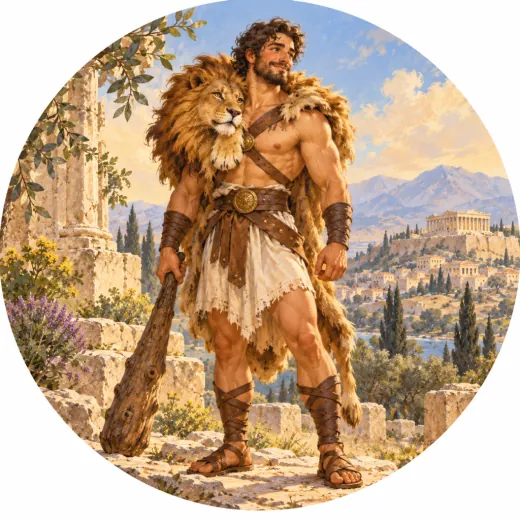
Heracles
Hēraklês, called Hercules by the Romans
a little scary
Heracles was the son of Zeus and a mortal woman, and he had incredible strength from the day he was born: in his cradle he strangled two snakes sent by jealous Hera. As a grown man he had to carry out twelve impossible tasks, the “twelve labours”. He defeated the Nemean lion, which no weapon could wound, and from then on he wore its skin; he faced the many-headed Hydra, caught the Erymanthian boar, and cleaned the stables of Augeas in a single day by turning two rivers through them. At the end of his life he was welcomed among the gods.
Did you know? The “Pillars of Hercules”, the Strait of Gibraltar, marked the edge of the known world for the ancients.
The story
The baby was eight months old when Hera, the queen of the gods, decided to kill him.
He was the son of Zeus and a mortal woman, Alcmene, and that was why Zeus’s wife hated him. One night, while his parents were asleep, two big snakes slid under the door and slithered up the side of the cradle. Their yellow eyes glittered in the dark.
His little brother, Iphicles, screamed. Baby Heracles, on the other hand, grabbed a snake in each hand and squeezed. When his parents arrived with their lanterns, they found the baby laughing, with the two dead snakes dangling from his fingers like two pieces of rope.
From then on, everyone understood that this boy was going to be different.
He grew up immensely strong, and kinder than people expected. But Hera had not forgotten him. One day, in a fit of madness she had sent him, Heracles killed his own children without knowing what he was doing. When he came to his senses and understood, the grief nearly killed him.
He went to Delphi to ask how he could make amends. The oracle answered, “Go and serve King Eurystheus of Mycenae. Serve him for twelve years and carry out the labours he orders. After that you will be free, and you will be immortal.”
Eurystheus was a cowardly king. When he saw Heracles, he hid inside a large bronze jar. He sent his orders up from the bottom of it, through a herald.
The first labour was the Nemean lion.
It was an enormous beast, a son of the monster Typhon, with a hide that no arrow, no spear and no sword could pierce. Heracles searched the woods for it for days. When he found it, he shot an arrow at it, and the arrow bounced off. He tried his club, and the club broke. In the end, he seized the lion in his arms and squeezed until it suffocated. Then he skinned it using its own claws, the only things hard enough to cut that hide, and from then on he wore it as a cloak.
When he came back to Mycenae with the lion over his shoulders, Eurystheus yelled from his jar, “Don’t come in! Leave your prey outside the walls!”
The second labour was the Hydra of Lerna.
It was a monster with nine heads, and every time you cut one off, two grew back. It lived in a swamp, and its breath alone was enough to kill a man. Heracles had an idea: he asked his nephew Iolaus to help him. As soon as a head fell, Iolaus burned the neck with a torch, and the wound never grew back. In the end only one head was left, the immortal one: Heracles buried it under a huge rock.
Every time, Eurystheus demanded a harder task, because he hoped the hero would not come back. But every time Heracles did come back, with dirty hands and an aching back, and without complaining. The king, in his jar, counted the labours on his fingers and always found there were too few.
Then came other labours, one after another. He caught the hind with golden antlers, swift as the wind, without hurting her. He brought a boar as big as a cart back to Mycenae alive. He cleaned out the stables of King Augeas, where thousands of oxen had been leaving their filth for years, by turning two rivers aside in a single day so that they washed the place out from top to bottom. He drove away the bronze birds of Stymphalus with rattles. He captured the bull of Crete and the mares of Diomedes, which ate human flesh. He travelled all the way to the land of the Amazons to fetch the belt of their queen, Hippolyta, who would almost have given it to him willingly: but Hera, in disguise, spread the rumour that the stranger wanted to kidnap her, and he had to fight. In the ancient stories of Heracles’ adventures, every labour always holds another one inside it. He crossed the sea to carry off the cattle of Geryon, a giant with three bodies.
And then there were the last two.
The golden apples of the Hesperides, which grew in a garden very far away, at the end of the world, guarded by a dragon. And finally, the most terrible of all.
“I want you to bring me Cerberus,” said Eurystheus, trembling in his jar. “The three-headed dog who guards the kingdom of the dead.”
Heracles went down into the dark. Before setting out, he had himself initiated into the Mysteries of Eleusis, the secret rites that taught the living not to fear the dead, and it is said that this helped him. No living person had ever managed it before. He found Hades, the king, and asked his permission. The god answered, “Take him. But you must tame him with your bare hands.”
Heracles grabbed the dog by the neck. The three heads snarled, and the snake on the end of its tail bit him. He squeezed and squeezed, without letting go, until the dog gave in. He brought it out into the sunlight, for the first time in its whole life, and the dog barked, and from its drool sprang poisonous plants.
When Eurystheus saw Cerberus, he climbed out of his jar and burst into tears of fright. He begged Heracles to take the dog back down there. Heracles did. The twelve labours were over.
He was free. But his story did not end there: he still had more adventures, loves and battles, and a painful death, tricked by a robe that burned. They say that when he died, Zeus took him up to Olympus and made him a god. And Hera, after so many years, made peace with him and gave him her daughter Hebe, the goddess of youth, as his wife.
Heracles was the best-loved hero in all of Greece: more than Achilles, more than Odysseus. He was not the cleverest, nor the most just. He was always the one who got back up.
After making the worst mistake of his life, he had not chosen to hide, nor to die. He had chosen to work. To serve. To take on the next labour, and then the next, until he was worthy to look at the light again.
Relatives around the world
Listen / Read next
- Music to read by: Cinematic JourneyEpic film-style music, no lyrics, by Ciro Simone IrmiciSpotifyYouTube Music
Sources
- Apollodorus, Library, Book II
- Ovid, Metamorphoses, Book IX
