The Hydra of Lerna
Hýdra, in Greek
scary
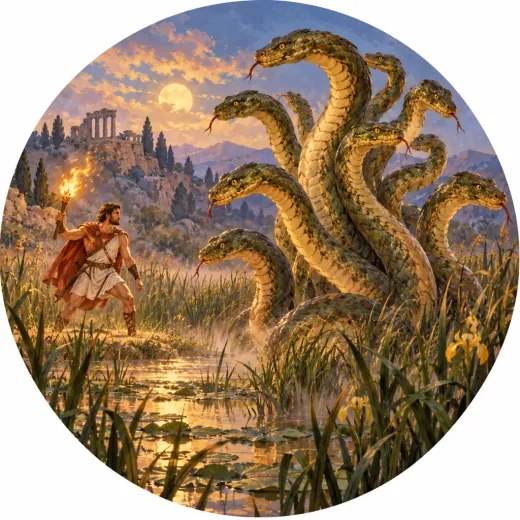
In the marshes of Lerna lived the Hydra, a gigantic serpent with many heads. Its breath was poisonous, and there was worse: for every head cut off, two more grew back. It was the second labour of Heracles. He could never have done it alone: his nephew Iolaus helped him, burning each neck with a lit torch as soon as Heracles cut off a head, so it could not grow again. The last head, which was immortal, Heracles buried under a great rock.
Did you know? In biology there is a tiny freshwater animal called a hydra: if you cut it, each piece can grow back.
The story
Nobody ever went into the marsh of Lerna, in Greece.
The shepherds took their sheep far away, up into the hills. The farmers left the fields in the valley to anyone who wanted them. People who had to pass that way did it by day, quickly, holding their breath and not looking at the water. Because in that dark water, among the reeds and rushes, lived something that had made more than one herd disappear. And more than one traveller.
At dawn a low mist rose from the marsh and never went away. It smelled of mud and rotten eggs. When the wind changed, people said, it carried a smell that made your head spin.
That something was called the Hydra. The children of the nearest village knew her name, even though nobody had ever seen her: you only had to whisper it, and they stopped playing near the water.
She had been born of two monsters, Typhon and Echidna, and raised by the goddess Hera, queen of the gods, who did not have good intentions. Hera had brought her up in that marsh for one reason only: to keep a challenge ready for Heracles, the son her husband Zeus had had with a mortal woman, and whom she could not stand.
Heracles arrived one morning on a chariot, with his young nephew Iolaus holding the reins. King Eurystheus, to punish him, had ordered him to perform twelve labours, and this was the second.
Iolaus stopped the horses at the edge of the marsh and would not go any further. “I can feel something,” he said. “The air is strange.”
“Stay here,” said Heracles. “I'll call you if I need you.”
He climbed down. The ground gave way under his feet. He walked for a while through the reeds, club in one hand and bow in the other, until he found a spring. By the spring stood a great plane tree, and under the plane tree was a black hole in the earth.
The lair.
Heracles stopped. There was not a sound. Not even a bird was singing. Then, from the hole, came a long, thin rustling, like a sheet being dragged across a floor.
It would not be wise to go in there. Heracles took an arrow, dipped it in the flame of a torch and shot it into the hole. Then another. Then another.
Something moved.
Out of the lair came a head, just above the water, as big as a calf. Then another. Then many, rising and twisting and swaying like stalks, each with yellow eyes and a flickering tongue. Beneath them rose the body, huge and covered in dark scales, and at the end the tail, lashing the water.
The Hydra lunged.
Heracles leapt back, but not far enough: a neck coiled round one of his feet and held him. Another wound round his waist. The weight was dragging him down into the mud. He raised his club and struck, and a head flew off and rolled away among the rushes.
“Got you!” he shouted.
But it was too soon to shout victory. On the broken neck, in a cloud of steam, something was swelling. A head grew out of it. Then, beside it, another. For every head that fell, two came back.
Heracles struck again. Two heads fewer. Four new ones. The Hydra hissed loudly, and there was a kind of laughter in that hiss.
And as if that were not enough, an enormous crab came out of the water. Hera had sent it to help the monster. Heracles felt its pincers close on his ankle. He crushed it with his heel, and the crab stopped. But by now the Hydra was everywhere: in front, behind, on every side, and every time he hit her, a new neck rose to replace the old one.
“Iolaus!” Heracles called.
The boy was already there. He did not need calling: he had seen everything from a distance. He had lit a torch, and now he was running through the reeds with the fire held high, his face as white as a sheet.
“What do I do?”
“When I cut off a head, burn the neck! Right away! Before it grows back!”
Heracles swung his club. A head fell. Iolaus held the flame to the stump, and look: the neck blackened, shrank back and went still. No new head. The Hydra let out a shriek that sent birds flying up from all over the marsh.
Another head fell, and Iolaus burned it. And another, and another. One after another, the necks smoked and sealed shut. The monster thrashed about, her tail slapping the water, her breath pouring out of her mouths in waves, heavy and hard to breathe. But little by little her hissing grew quieter. Her body was going limp.
In the end only one head was left. It was the biggest, the one in the middle, and it was not like the others: it was immortal. Heracles cut it off with his sword, and even though it had been severed it kept moving, biting the air and hissing.
It could not be killed. So he dug a deep pit beside the road and buried the head that would not die. Then he rolled a huge rock over the pit, one no man could ever move. For a moment, from underneath, came a rustling. Then nothing.
Then he dipped his arrows in the monster's venom. From that moment on, no wound from those arrows ever healed.
He went back to the chariot exhausted, covered in mud from head to toe, with Iolaus at his side, silent. When he told Eurystheus everything, the king said the labour did not count: he had won it with someone else's help. So he had to do one more.
People still say today that the marsh of Lerna is peaceful. That the water bothers no one, and that in the morning the mist rises and melts away just like anywhere else.
But the shepherds in the hills still do not take their sheep there. And if you ever find yourself near a big rock beside a road, and you think you hear, from underneath, a long, thin rustling, like a sheet dragged across a floor, keep walking.
Do not try to look. Do not stop.
Relatives around the world
In the trails
Listen / Read next
- Music to read by: Cinematic JourneyEpic film-style music, no lyrics, by Ciro Simone IrmiciSpotifyYouTube Music
Sources
- Hesiod, Theogony
- Apollodorus, Library, Book II
