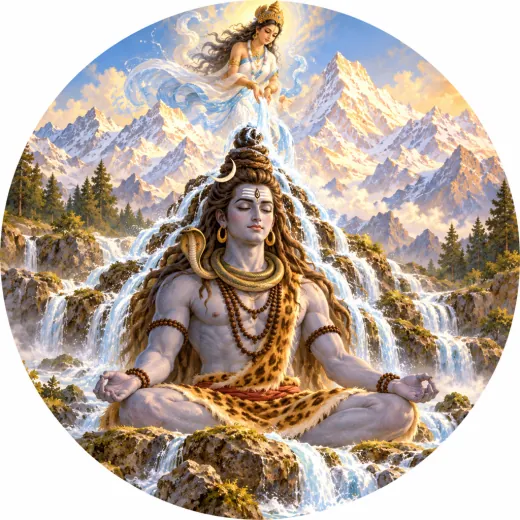
The descent of the Ganges
Gaṅgā, in Sanskrit
not scary at all
In the Hindu tradition the Ganges is a goddess, Ganga, and once she flowed only in the heavens. A king named Bhagiratha prayed for years for her to come down to earth and bring peace to the souls of his ancestors. Ganga agreed, but her fall was so powerful that it would have split the world apart. So Shiva caught her in his long matted hair and let her flow down gently, in many streams. Today millions of people still bathe in the river, and every evening lamps are lit for prayer along its banks.
Did you know? Near its source, in the Himalayas, the river is still called the Bhagirathi, in memory of the king who brought it down from the sky.
The story
In the beginning, the Ganges did not flow on the earth.
It flowed in the sky. Ganga, the daughter of the Himalaya, had been given to the gods, and in the sky she was a river of light, calm and pure, which no human had ever been able to touch. Down below, on the earth, there were only human troubles. And one of those troubles began with a horse.
King Sagara reigned in Ayodhya. He had sixty thousand sons, and he wished to perform the great horse sacrifice, a ceremony that brings glory and power. The horse, set free to roam for a year, was stolen. Indra had taken it, for fear of losing his throne.
Sagara's sons set out to find it. They searched the earth and did not find it. So, growing ever more furious, they dug. They dug everywhere, until the world shook and the frightened animals fled from their dens. They dug down to the lowest regions, where no human had ever been.
Down there, in a silent place, they found the horse. Beside it sat a sage, deep in meditation. It was Kapila.
They thought he was the thief. They accused him loudly and threatened him. The sage opened his eyes.
One look was enough. Sixty thousand brothers became sixty thousand heaps of ash, in the dark.
The news reached Ayodhya. For years, for generations, nobody knew what to do. Those souls had no peace. To free them, the waters of Ganga were needed, but Ganga was in the sky, and who could ask her to come down?
Time passed. Anshuman, Sagara's grandson, came and went, and so did his son Dilipa. At last the throne passed to Bhagiratha.
Bhagiratha was a just king. But he carried a weight in his heart that no power could lift: his ancestors, deep under the earth, in the dark, were waiting. One day he entrusted the kingdom to his ministers, left the palace and went up into the Himalaya.
He sat down in a cold, empty place and began to pray.
He prayed for years. He ate little and slept little. He stood motionless, his arms raised to the sky, while the wind froze his face and the snow settled on his shoulders. The seasons passed over him as over a rock. He asked for nothing for himself.
At last, one day, the god Brahma appeared.
“What do you wish for, Bhagiratha?”
“That Ganga may come down to earth, to free the souls of my ancestors.”
Brahma nodded. “Ganga will come down. But her fall will be so mighty that the earth could not bear it: it would split apart. Someone must hold her. Only Shiva is able.”
Bhagiratha did not lose heart. He went back to praying, this time to Shiva. For a whole year he stood on one foot, only his toes touching the ground, without moving, without complaining. At last Shiva appeared and said: “I am pleased with you. I will hold the river.”
Ganga, in the sky, heard the call.
She was a proud goddess. She believed that nobody in the world could stop her. She said to herself: I will come down with all my strength, and I will carry Shiva with me into the depths of the earth.
And she plunged.
The roar was heard across the universe. A whole river falling from the sky, with all its water and all its fury, in a single white mass. Bhagiratha looked up and saw the river coming down like a wall, and he did not dare to breathe.
Shiva was there, on top of a mountain. He did not move aside. He loosened his long matted locks, which he wore coiled high on his head, and let them receive Ganga.
The water vanished.
Ganga fell into that hair and did not come out. She wound round and round among the locks, in an endless maze, and for years she could not find the way. Her strength, her pride, everything was quenched in there, and what remained was a goddess who had learned how great the unseen can be.
Bhagiratha waited below, at the edge. He saw nothing coming down, not a single drop. So, without losing patience, he began to pray to Shiva again.
Shiva listened. He loosened one lock, and the river, gently this time, came down in many streams. Like a caress. The waters separated and took different paths. One of them followed Bhagiratha.
The king climbed into a chariot and set off, and the river followed behind him with a sound like bells. Wherever it passed, the earth softened and grass grew. They crossed mountains, plains and forests.
At one point Ganga, without meaning to, flooded a place where the sage Jahnu was performing a sacrifice. Jahnu, annoyed, drank the whole river in one gulp. Bhagiratha did not complain: he prayed to him too. After a while the sage let her out through his ear. That is why, they say, the river is also called Jahnavi, daughter of Jahnu.
And so, day after day, the chariot reached the sea. Ganga flowed into the ocean and went down to the very bottom, to the regions below.
There, in the dark, lay the ashes of Sagara's sons.
The water touched them, one by one, the way you touch the face of a sleeping child. And sixty thousand souls at last rose up, light, towards the sky.
Bhagiratha wept when he heard. He had stood on one foot for a year, he had endured the snow and the wind, and he had given his life to this. Brahma told him that from that day on the river would bear his name: Bhagirathi.
Still today, at the foot of the Himalaya, near its source, the river carries his name.
And further down, in Varanasi, every evening, on the steps that lead down into the water, thousands of lamps are lit. The faithful set them in little boats made of leaves and let them go, with a flower, on the current. One after another the small flames drift away into the dark, and the river carries them with it.
As it carries, they say, everything that is entrusted to it with love.
A living tradition, told with respect: how we tell myths.
Relatives around the world
Listen / Read next
- Music to read by: Cinematic JourneyEpic film-style music, no lyrics, by Ciro Simone IrmiciSpotifyYouTube Music
Sources
- Valmiki, Ramayana, Bala Kanda
- Bhagavata Purana, Book IX
