Nüwa
女媧, in Chinese
not scary at all
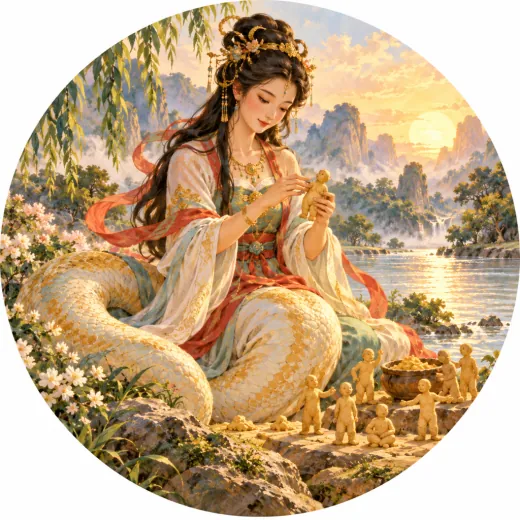
Nüwa is a very ancient goddess with the upper body of a woman and the tail of a snake. In the newborn world she took some yellow mud from a riverbank and shaped the first people. There were so many to make that at one point she dipped a rope in the mud and shook it: every drop that fell became a person. Another story tells that, when the four poles holding up the sky collapsed and the sky split open, Nüwa melted stones of five colours and patched the hole.
Did you know? According to a popular tradition, the colours of the rainbow and of the clouds at sunset recall the coloured stones Nüwa used to mend the sky, but this detail is not in the ancient sources.
The story
Before there were people, the earth was beautiful, and there was nobody to say so.
There were rivers, mountains, trees full of birds. There were animals of every kind, running, slithering, singing. But none of them knew what a word was.
The goddess Nüwa was strolling along the bank of a great river. Down to the waist her body was a woman's, and below that it went on like a snake's, very long and glossy, sliding over the pebbles without a sound. She moved slowly. She looked at the water, and the water looked back at her.
Perhaps it was on one of those long days, when the sun can't make up its mind to set, that Nüwa felt a little lonely. The ancient texts don't say this: the storytellers who came later added it, and perhaps they were right. Because a goddess who looks at so much beauty and has nobody to talk to about it is a goddess who, sooner or later, will look for something to do with her hands.
She bent down by the water. She scooped up a handful of yellow mud, the fine, soft kind you find where the river slows down. She kneaded it. She warmed it between her palms. And with her fingers she began to give it a shape: two arms, two legs, a round head, a face.
When she set the little mud figure on the ground, it opened its eyes. It looked at its hands. Then it smiled.
It was the first person.
Nüwa stayed and watched. The little one took a few unsteady steps, tripped on a stone, got up again and burst out laughing: a new sound, one that no animal on the riverbank could make. The goddess listened to it the way you listen to music you have never heard before, holding her breath so as not to drown it out.
Nüwa couldn't resist. She shaped another, and then another. Each one a little different: a longer nose, broader shoulders. She set them down on the bank, and up they got, laughing, running to the water, splashing each other. Soon the riverbank was full of voices.
But the world was big, and the mud never ran out, and a goddess's hands, however quick, were not enough. The sun moved across the sky, and there was still so much to do. Nüwa sat down for a moment, looked at the half-empty bank, and thought it would take a thousand years.
So she found another way. She took a rope, dipped it into the mud, and shook it hard.
Drops flew through the air in a long arc, heavy and yellow. Each one, as it touched the ground, stood up. And every drop was a man, or a woman, or a child. With a single movement the earth was filled with people, shouting, laughing, calling each other by name.
Nüwa looked at everything she had made, and for the first time the world seemed to her just as it should be.
Years went by, or perhaps centuries, because in the time of myths nobody kept count. People built huts, lit fires, learned to sow seeds.
Then, one night, the sky broke.
Nobody can say why. The sources only tell what happened: the four great poles that held up the sky gave way, and on one side the sky came down. The earth cracked in nine places. From the cracks rose fires that would not go out, and from the other side came water, a flood that would not go back. Wild beasts came out of their dens and ate people. Birds of prey swooped down on the old and the young.
From the darkness, people looked up, and what they saw was no longer the sky: it was a hole.
Mothers held their children tight against their chests. Old people sat on their doorsteps, with no strength left to run. You could hear the crackle of the fire coming closer, and beneath it, far away, the rumble of the water. Someone, in a low voice, spoke the name of the goddess who had made them, the way you call someone at home when there is a storm outside.
And Nüwa rose.
She was tired, perhaps. She was grieving, certainly, because those people had been made by her own hands. But a thing like this is not something you leave half done. She climbed a mountain, carefully chose stones of five colours, blue, red, yellow, white and black, and carried them to the furnace. She melted them in a fire so hot that the smoke could be seen from the sea. Then, with that glowing paste still warm, she climbed up to the hole and patched the sky, stitch by stitch, the way you mend a torn sail. It took her days. Her hands got burned, and she would plunge them into the cold air, and start again.
But a patched sky, with nothing to hold it up, will fall again.
From the sea Nüwa pulled out a giant turtle, the biggest there was, and with one sharp movement she cut off its four legs. She planted them at the corners of the world, standing straight, and on top of them she laid the sky. When she took her hands away, the sky stayed where it was.
There was still the black dragon, which brought the evil waters and was ravaging a whole province, the one called Ji. Nüwa faced it and killed it, and the people could breathe again. Then she gathered the ashes of a great many burnt reeds and heaped them up against the flood, like a bank. Slowly the water stopped rising. Then it stood still. Then it went down.
The sky was back in its place. The four poles stood straight. The fire had gone out, the water had dried up, the wild beasts were dead, and good people could live in peace.
The texts end like that, almost quietly. There is no feast, no throne, no thank-you. Nüwa asks for nothing. She goes away, lets the world carry on, and probably goes back to walking along her river.
They say that if you look at the coloured clouds on evenings at the end of summer, red and purple behind the mountains, you can still see the mending. They are seams of light, stitches of stone and fire, there where a goddess with a snake's tail took the trouble not to leave any holes in the sky.
And on the riverbank, on certain mornings, the yellow mud is so soft that you feel like picking up a handful, just to see what happens.
Relatives around the world
Listen / Read next
- Music to read by: Cinematic JourneyEpic film-style music, no lyrics, by Ciro Simone IrmiciSpotifyYouTube Music
Sources
- Huainanzi (2nd century BC)
- Ying Shao, Fengsu Tongyi (2nd century)
