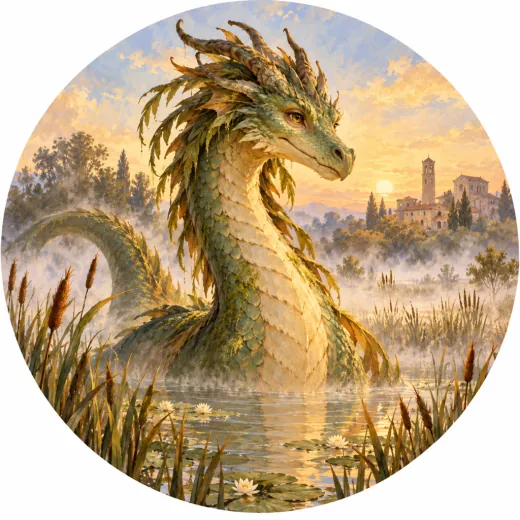
Tarantasio, the Dragon of Lake Gerundo
Tarantasio, also called Tarànto
scary
In the Middle Ages, between the rivers Adda and Serio, there was a wide area of still water and marshes that tradition calls Lake Gerundo. Down there, people said, lived the dragon Tarantasio, whose stinking breath made the villagers ill. Who defeated it? Every town has its own answer: a saint, the emperor Barbarossa, the first of the Visconti family. In another version the dragon died when the lake was drained. The dragon's breath was probably the malaria of the marshes, which disappeared with the land drainage.
Did you know? Until the time of Napoleon some churches kept “dragon's ribs”, which the sources describe as remains of prehistoric animals.
The story
If you fly into Milan and look down, on the plain between the Adda and the Serio, you see green fields cut straight by canals and roads. Nobody would ever say that, a thousand years ago, there was a lake there.
It was called Gerundo. It was not a lovely blue lake. It was a stretch of shallow water, still and grey, full of reeds and fog, with shores that disappeared into the mud and air that was always damp. Whoever spent the night there came home with a fever. Whoever lived there had yellow skin and tired eyes.
And then there was the dragon.
The chronicles tell of it. A monk, around the year 1100, described it like this: a creature like a snake, but enormous, with a big head full of horns, a long tail and webbed feet, like those of geese. It swam below the surface, and when it came up, smoke and fire poured from its mouth.
Its name was Tarantasio.
It ate children. It ate grown-ups too, when it found them. It overturned the fishermen's boats with a stroke of its tail, and then waited, under the water, for someone to fall in. But the most terrible thing was its breath. A dark puff that spread over the lake and the shores. Where it reached, the grass withered, the animals fell ill, and people died of fevers.
They say the villagers no longer dared to go near the water. They tried to send it away with prayers. They brought it lambs, hens, sometimes something worse. The dragon took everything and was hungry again.
Nobody knew where it came from. Some said it was born from the remains of a wicked man, Ezzelino da Romano, a lord from those parts, a tyrant whom Dante had placed in Hell, in the river of boiling blood. After his death, they said, his rotting body had turned into a dragon.
Who killed it?
To this question, in Lombardy, everyone answers in their own way. Some say it was a saint, Saint Christopher, who tamed the monster with prayer and the cross. Others prefer to think of the emperor Frederick Barbarossa, who passed that way with an army, and drove the dragon off with weapons. And others tell of the founder of the Visconti family, a brave knight, who challenged it alone and defeated it.
Of all of them, the story of the first Visconti, whom some call Uberto, is the one that left the strongest mark. It is said that to remember the deed, the Visconti family chose as their coat of arms a great serpent, the Biscione, with a child coming out of its mouth. You can still find it today, in Milan, on the fronts of buildings, on coins, even on the badges of cars.
But if the dragon was killed, where is the proof?
For centuries people believed they could see it. In the church of Sant'Andrea, in Lodi, they say a whole skeleton was kept for a long time. In other churches of the Lodi, Cremona and Bergamo areas, up to the days of Napoleon, enormous ribs were proudly displayed, hung from the ceiling or shut in cases, like relics of the monster. In one of these churches, at Sombreno, a scholar later recognised the rib of a mammoth. At Almenno San Salvatore, in the province of Bergamo, in the church of San Giorgio, a bone is still on show today beside a fourteenth-century fresco.
The scientists, when they looked at them, said something simple. Those bones are the remains of prehistoric animals, which have lain buried in that plain for thousands of years. For people who had never seen a fossil, they were the bones of a dragon.
And the poisonous breath? According to scholars, it was malaria. Lake Gerundo was a marsh, and from marshes, over the centuries, came mosquitoes and fevers. When, in time, monks and farmers dug canals and drained the waters, the malaria vanished. And with it, the dragon.
The story remained. The dragon, or a dragon very like it, appears in a fresco at Civate, in the cloister of San Marco in Milan. And a twentieth-century artist, Luigi Broggini, took inspiration from Tarantasio to draw an animal you now see at petrol stations: a black dog with six legs, spitting fire.
So if one day you find yourself on the Lombard plain, on a morning of thick fog, and you can no longer see the road, remember that under you there was a lake. And at the bottom of that lake, according to the old people, something swam that nobody has ever forgotten.
Relatives around the world
In the trails
Listen / Read next
- Music to read by: Cinematic JourneyEpic film-style music, no lyrics, by Ciro Simone IrmiciSpotifyYouTube Music
- The words of the dialect: MilaneseNonnese, the dictionary of Italian dialects
