The Menehune
menehune, in Hawaiian
not scary at all
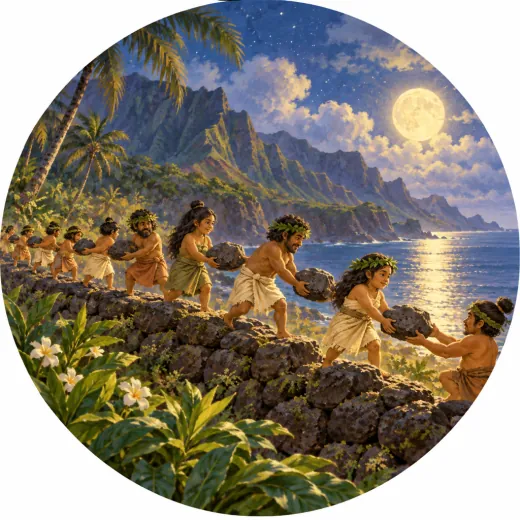
On the island of Kauaʻi, in Hawaii, people tell stories of the Menehune, a race of tiny, hard-working people who lived hidden in the woods and worked only at night. They were brilliant builders: in a single night they could put up a stone wall, a dam or a fishpond, passing the stones along a long chain of hands. If the work was not finished before dawn, they left it incomplete forever. In return they wanted only a feast of their favourite food.
Did you know? On Kauaʻi there is an ancient fishpond, Alekoko, which according to tradition the Menehune built in a single night; but the idea of the Menehune as a “little people” has a debated origin, and the scholar Katharine Luomala believed it arose partly after contact with Europeans.
The story
On Kauaʻi, the green island of Hawaii, there was a valley where the river made a bend, and at that bend a chief had a dream.
He wanted a great fishpond: a wide stone pool, with a long, solid wall to hold the water in, where fish could grow safely and his people would never go hungry. For years he had tried. He had called in the best builders, he had had stones carried in, he had watched the wall go up and then fall down at the first flood.
One evening, as the sun was going out behind the mountains, an old woman said to him: “You don't need your builders. You need the ones who work at night.”
“Nobody works at night,” the chief replied.
“Nobody you can see,” said the old woman.
Because in the forests of Kauaʻi lived a people no one had ever looked in the face: the Menehune. Small, very small, not much taller than a sitting child, but as strong as a landslide. By day they slept, hidden among the ferns and the roots. When the sun went down they woke, and then they started work.
That night the chief couldn't sleep. But he did what the old woman had advised: he prepared the food the Menehune love and laid it out under a tree, near the river. A great feast, with everything he had: roast fish, ripe bananas, sweet fruit. Then he put out the fire, sent everyone to bed and told his people: “Tomorrow morning we'll find whatever we find. But nobody leaves the house, nobody looks. Nobody.”
The valley went quiet. The stars came out. A night bird called once and fell silent.
Then, softly, there was a sound.
It was a rustling, like leaves. Straight after it came a light tapping, a click of stone on stone. Then another, and another. Anyone in the valley who slept lightly opened their eyes and lay staring into the dark, not moving.
Down by the river, a long line had formed.
There were hundreds of Menehune, maybe thousands. They stood side by side, from the quarry all the way to the bend in the river, in a chain that never ended. The first took a stone from the pile and handed it to the second. The second passed it to the third. One stone after another, from hand to hand, without a word, just the faint sound of rocks changing hands: click, click, click. Not one stone fell. Not one stone stopped. The line moved like the water of a stream.
At the head of the line was a Menehune shorter than the rest, with broad shoulders, who set every stone in the wall. He placed it, turned it, fitted it, and moved on to the next. Now and then he whispered something, a single word: “Here.” “Higher.” “Gently.” And the wall grew.
It was a beautiful thing to watch. But there was a boy in the valley who, that night, just couldn't keep still.
He was a boy like any other. He pushed aside the mat over the door. He took one single step outside. He stopped among the trees and looked. He saw the line, the wall rising, the feast under the tree with someone already having a taste. For a moment his breathing was too loud.
One Menehune lifted his head.
He said nothing. There was no sound at all. Only, for the blink of an eye, every one of them stopped moving, the stones frozen in mid-air, hundreds of small dark eyes turned towards the trees. The boy felt his heart leap into his throat. And then, just as calmly, the Menehune went back to work, as if they hadn't seen a thing.
The boy went home walking backwards, without a sound, and that night he didn't say a word to anyone.
The wall was finished as the stars began to fade. The last stone was laid in the last place. And the pool, in the bluish dark just before day, filled with water like a mirror. In a single night, something had been born that people had failed to build in years.
When the chief came out at dawn, he found the fishpond perfect. The wall was straight and solid. The water was clear. Under the tree the plates were empty, and not even a banana skin was left. There was no one there any more: just a few tiny footprints in the mud, and a faint smell of ferns.
People called it Alekoko. They say it still exists on Kauaʻi.
The chief, though, had an idea, and it was the wrong one.
“If they did this in one night,” he said, “they can do another. A dam, here, and a road up there.” So, a few weeks later, he prepared another feast, even bigger. Once again nobody left the house. Once again, in the dark, the click, click of stones began.
But this time the job was bigger and the night was shorter. The broad-shouldered Menehune whispered one extra word, “Quickly,” and the line moved faster. One long wall, then another. Stones flew. In the east, the sky was growing pale.
At the edge of the valley, a rooster crowed.
The Menehune all stopped at once, each with a stone in his hand. They set the stones down where they stood, one by one, in perfect silence, and one after another they vanished into the ferns, without a goodbye.
The work was left half done. The wall ended in nothing, with one stone balanced on the top row. From that day, nobody dared to finish it, and nobody dared to ask them again.
The old people of Kauaʻi say the Menehune don't take offence: they do what can be done between sunset and dawn, and what can't be done they leave as it is, as a reminder.
And they also say that if, on a moonlit night, you hear a click of stones from the woods, you mustn't go and look. Just leave a plate under a tree. And go to sleep with a smile.
A living tradition, told with respect: how we tell myths.
Relatives around the world
Listen / Read next
- Music to read by: Cinematic JourneyEpic film-style music, no lyrics, by Ciro Simone IrmiciSpotifyYouTube Music
Sources
- Martha Beckwith, Hawaiian Mythology (1940)
- Katharine Luomala, The Menehune of Polynesia (1951)
