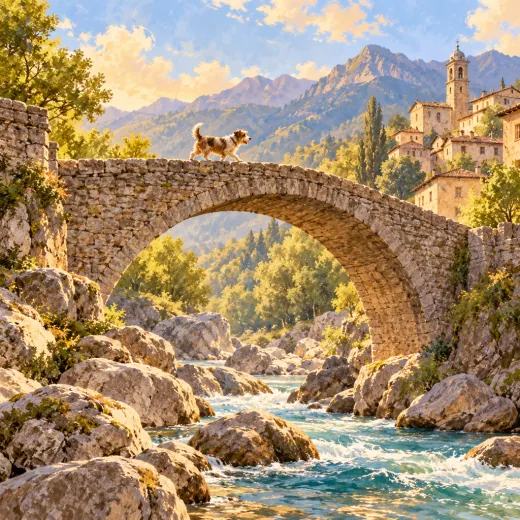
The Ponte del Diavolo of Lanzo
the Devil's Bridge, also called Ponte del Roch
a little scary
The people of Lanzo had tried twice to build a bridge over the river Stura, and twice the river had carried it away. Then the devil turned up: he would build an indestructible one, in exchange for the soul of the first living creature to cross it. The bridge was built, but the townsfolk sent a little dog across first. Furious at being tricked, the devil stamped his paws violently on the rocks all around, and that is how the “giants' kettles” were born. The real bridge, the Ponte del Diavolo (the Devil's Bridge), dates from 1378 and is still standing.
Did you know? According to another tradition, the giants' kettles are the big pots in which the devil cooked to feed his helpers while the bridge was being built.
The story
At Lanzo, even before there was a bridge, there was the river.
They called it the Stura, and for six months of the year it was a ribbon of green water, calm, almost gentle. Then the rains came, the snow melted on the mountains, and the Stura became something else. It came down from the valleys with a roar you could hear in the houses, and carried everything away: logs, planks, boats, hay left too near the bank.
The people of Lanzo wanted a bridge. On the other side of the river were the fields, the roads, the rest of the world. And they had already tried.
The first time they had built a fine bridge of wood and stone, and for one summer everyone crossed it with carts and cows. In autumn, with the flood, the bridge collapsed and the river carried it down to the sea.
The second time they used more stone, more effort, more hope. It lasted a little longer, and then that one collapsed too.
One evening, in the square, people were arguing.
"I won't build a third bridge," said one.
"Nor will I," said another. "The river is stronger than we are."
It was then that someone, at the back of the square, cleared his throat.
Nobody had heard him arrive. He was a man standing by a wall, dressed in dark clothes, with a steady smile and two eyes that seemed to reflect more light than there was. The people stopped talking, and understood who he was before he even opened his mouth.
"You need a bridge," said the devil. "I will build it. A bridge the Stura will never carry away."
Nobody answered. All that could be heard, far off, was the river.
"And in return?" asked a woman at last, her voice trembling a little.
"A small price." The smile widened. "The soul of the first living being to cross the bridge."
The square filled with murmurs. The first living being. A person, of course: an old man, a child, perhaps someone who was in that very square. Someone shook his head, someone looked at the ground. But the river roared, and the fields were on the other side.
In the end the people of Lanzo said yes. Or rather: they said yes with their faces, but not with all the rest.
The devil worked at night. Nobody saw him, but everybody heard him. From behind the closed windows came dull blows, sounds of stones fitting themselves into place, a kind of deep rumbling that came from the bottom of the gorge where the Stura flows. They say he had helpers, and that to feed them he cooked in enormous cauldrons, which boiled among the rocks with steam rising to the stars.
The people, behind their glass, did not sleep. They waited for dawn.
And at dawn the bridge was there.
It was an arch of stone, handsome and solid, that leaped from one bank to the other like a bent knee. It did not tremble, did not creak. Below, the Stura ran fast, and it almost seemed to look at it with respect.
The devil had sat down on the parapet, with the air of someone who has done a good job.
"There," he said. "Now it is your turn. Send the first one across."
The people of Lanzo looked at each other. Nobody stepped forward, naturally. But in the crowd, a man with folded arms looked at another person, and that person in turn looked at the dog that had slipped between everybody's legs, an ordinary little dog, the kind that follows people for no reason.
Someone whispered a word. Then another. A hidden smile passed from mouth to mouth.
The little dog was picked up, carried to the start of the bridge and set down. Then he was given a small nudge.
The little dog understood nothing. He looked around, sniffed a stone, and then began to trot along the bridge, wagging his tail, all the way to the other bank.
"There's the first," said a man of Lanzo. "A living being, isn't it? A pact is not to be argued with."
The devil stood still. His smile faded slowly, like a candle burning out. For a long moment nobody dared to breathe.
Then he exploded.
They say he screamed something nobody has ever repeated, and that he furiously stamped his paws on the surrounding rocks, one, two, ten, a hundred blows, until the stone opened into round holes, deep, smooth as bowls. The noise boomed through the whole valley. When the devil vanished, in a cloud that smelled of sulphur, the people of Lanzo stood looking at the holes, in silence.
Someone, though, began to laugh. Then another. Then everyone.
Those holes are still called the giants' kettles, marmitte dei giganti. Whoever stands on the bridge can still see them: great round hollows, like pots forgotten there by someone much bigger than us. In truth they were carved by the water of the Stura, which for thousands of years has swirled stones and sand in the rock.
The bridge, though, has remained. They call it the Ponte del Diavolo, the Devil's Bridge, and also the Ponte del Ròch, which in Piedmontese means "stone". It is said to date from 1378, and above it there is a gate, which bears the date of the fifteenth of July 1564. The Stura still passes beneath it, every spring, with all its strength.
And the little dog? Nobody remembers his name, but that day, in Lanzo, he had the best dinner of his life.
Relatives around the world
In the trails
Listen / Read next
- Music to read by: Cinematic JourneyEpic film-style music, no lyrics, by Ciro Simone IrmiciSpotifyYouTube Music
