Saturn and the Saturnalia
Saturnus and Saturnalia
not scary at all
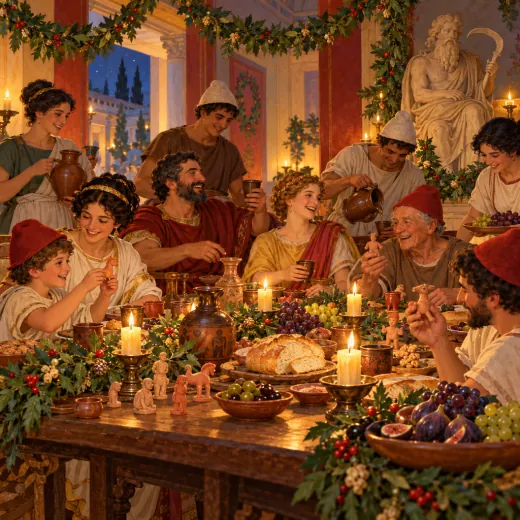
Saturn was a very ancient god of farming. The Romans told that, after being driven out of the sky, he took refuge in Lazio, where he ruled over a happy time, the golden age, when everyone was equal and the earth gave fruit without any effort. To remember it, every December the Romans celebrated the Saturnalia: for a few days work stopped, servants enjoyed great freedom, people exchanged small presents and candles, and everyone feasted together. It was the merriest festival of the year.
Did you know? According to Macrobius, the Saturnalia began on 17 December and the festival lasted a few days.
The story
All year long, in his temple, the statue of Saturn had its feet bound with a band of wool.
Nobody touched it. The god stood there, solemn, sickle in hand, motionless and tied up like a prisoner. Then December came, the day of the festival came, and the priests untied the wool.
Everyone in Rome knew it: when Saturn is free, we are all a little bit free.
The boy woke at dawn on the seventeenth of December and did not hear the cook bellowing his name, or the master's footsteps coming down to check the stores. He smelled warm bread. He opened one eye. In the doorway of the little room where he slept stood the master himself, holding a wooden board with a loaf on it, some honey and some dried figs.
“Wake up,” said the man. “It's the festival.”
The boy sat bolt upright, his heart thumping. He was sure he had done something wrong.
“Master, I didn't...”
“Eat it while it's warm.”
“But you're bringing food to me.”
“Once a year.” The master shrugged, a little embarrassed. “Those are the god's rules. Don't look at me, I just follow them.”
The boy ate very carefully, expecting any moment that someone would burst out laughing and say it was all a joke. Nobody did.
Out in the street, meanwhile, the city had gone happily mad. Laughter spilled from the doorways, out-of-tune songs from the windows, and in front of the shops stood rows of stalls with little figures of painted clay: tiny people, animals, gods no taller than a finger. They were called sigillaria, and they were given to children. Next to them, on the counters, were wax candles in bunches tied with string. Candles for everyone, from the cook to the scribe. Some said they were a reminder that in December the light starts climbing back out of the dark. Others said they were a gift that cost very little, and that was perfectly fine.
At midday everyone ate together, in one single room. The master, the mistress, the children, the cook with his face red from the stove, the woman who looked after the children, the old man who tended the vegetable garden. The boy was given a seat of honour, and the cook, for the first time in his life, found himself sitting at the table while the mistress went back and forth with the jugs.
“What are we supposed to do?” the boy whispered.
“Whatever you like,” said the old gardener. “For one day you can even tell the master his wine is too watered down.”
“And what if he punishes me afterwards?”
“Nobody is punished at Saturn's festival.”
The boy thought about this for a while. Then he cleared his throat and said, very loudly:
“Master, this wine tastes like a puddle.”
There was silence. The master put down his cup. Everyone held their breath.
“That's true,” he said at last, completely serious. “I'm the one who bought it.”
The room exploded. The cook laughed so hard he dropped his spoon, the mistress had to lean against a column, and the children banged their fists on the table. The boy understood that, for that day, he really had been promoted.
When the plates were empty, the children started tugging at the old man's tunic.
“Tell us why we do all this.”
The old man made himself comfortable, scratched his chin and began.
“Once, a long time ago, Saturn was a god of the sky. But there had been a war among the gods, and another god, Jupiter, had taken up arms against him. Saturn lost. He was driven out of the sky, out of Olympus, and he wandered like an exile, with no kingdom, looking for somewhere to hide.”
“And did he find one?”
“He did. A peaceful land, with hills and woods. He hid there so well that the land was named after it: Latium, from the word that means ‘to stay hidden’. Where we live now. There was a king there, Janus, who saw him arrive from the sea, on a ship, tired and with nothing at all, and opened his door to him. He didn't ask what he needed. He shared his kingdom with him, the way you share a loaf with a guest.”
The children stared at him, wide-eyed.
“In the hills lived wild people, scattered through the woods, with no laws. Saturn brought them together. He taught them to farm the land, to prune the vines, to sow seeds. And his reign was so peaceful that it was called the golden age. There was nobody giving orders and nobody obeying them. Everyone had enough, and the earth gave its fruit without too much toil.”
“And then?”
“Then one day Saturn vanished. Just like that, without a word. Janus, the one with two faces, one in front and one behind, realised he was gone. He searched the fields, the woods, the riverbanks, and didn't find so much as a footprint. He built him an altar. He decided that every year, in his honour, there would be a festival.”
“The Saturnalia,” said the boy.
“The Saturnalia,” said the old man. “For one day, or two, or three, we remember what it was like back then. When nobody belonged to anybody.”
The boy looked at the master. The master looked into his own cup, then, without a word, filled it and handed it to him.
In the evening the street was full of torches, singing and the smell of roasting meat. Inside the house the old man was counting the candles, the mistress was laying out the children's mats, and the cook was already asleep on the bench with his mouth open.
The boy went back to his little room. He had been given a wax candle, a real one, not tallow, with a faint scent of honey. He lit it and watched it burn.
Tomorrow, he thought, it would still be the festival. Then one day, soon, someone would tie the wool around the god's feet again, and he would go back to carrying water.
He pinched out the flame before it could burn down. He tucked the candle under his bedding, carefully.
That way, on ordinary days, he too would have something to light.
Relatives around the world
Listen / Read next
- Music to read by: Cinematic JourneyEpic film-style music, no lyrics, by Ciro Simone IrmiciSpotifyYouTube Music
Sources
- Macrobius, Saturnalia (5th century)
- Virgil, Aeneid, Book VIII
