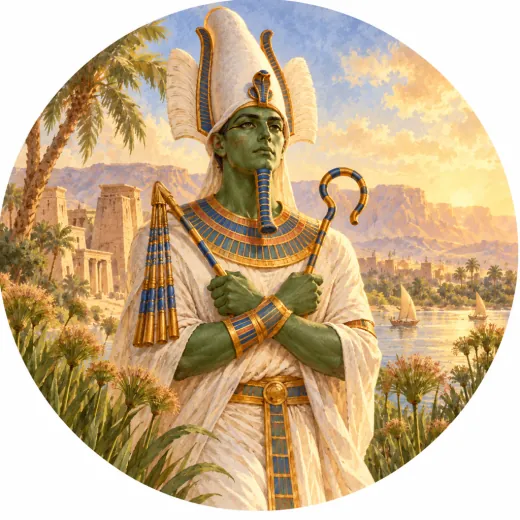
Osiris
Wsjr, in Egyptian
a little scary
Osiris was a good king who had taught people how to farm the land. His brother Set, who was jealous, tricked him: he had a beautiful chest made and promised to give it to whoever fitted inside perfectly. When Osiris lay down in it, Set shut the lid and threw it into the Nile. His wife Isis searched everywhere and found him, and with her magic she woke him; from them Horus was born. Since then Osiris has been the lord of the world of the dead.
Did you know? He was painted with green or black skin: green like plants that grow again, black like the rich soil left by the Nile floods.
The story
Once upon a time there was a king who taught people how to sow seeds.
His name was Osiris, and he ruled over Egypt. Before him, Plutarch tells us, people lived from one day to the next, with no laws and no harvests. Osiris showed them how to plough the land, how to cut the wheat and how to turn it into bread. He taught them to honour the gods. Then, when Egypt was in order, he set off into the world, with no weapons, with only his voice and his songs, to teach the same things to other peoples. He left the kingdom to his wife Isis, who ruled so well that no one noticed he was gone.
But in that family there was someone who lay awake at night. His brother Set, whom the Greeks called Typhon.
Set did not hate Osiris for anything Osiris had done to him. He hated him because everyone loved him: for the bread on their tables, for the laws, for the way he spoke, which made even small people feel great. And envy, like a woodworm, did its work at night. While the king was far away, Set gathered seventy-two companions, and waited.
When Osiris came home, there was a feast.
The palace was full of lamps and flowers, and the air smelled of warm bread and incense. People ate, drank and sang. At a certain point Set stood up and had a chest carried into the hall.
It was the most beautiful chest anyone had ever seen. Dark wood, carved, painted, studded with precious stones. The guests came closer and ran their hands over it, and bent down to look at the patterns. “Who is it for?” someone asked.
“For whoever fits inside it exactly,” Set answered with a smile. “It's a game. I'll give it to whoever fits it just right, not too big and not too small.”
One after another, they all tried. They lay down in it and got up again, laughing. This one was too tall, that one too broad. The chest stayed there, empty, waiting.
Then it was Osiris's turn.
He lay down in the chest and felt that it was perfect. He smiled. He did not see the look in his brother's eyes, or the companions closing in, all together, without a word.
The lid came down. He heard a blow, then another, then a shower of blows. Nails. Then a smell of hot metal: they had poured molten lead to seal the cracks. The chest was lifted and carried away into the dark, down to the river. The current took it. The Nile carried it all the way to the sea.
When Isis heard, she cut off a lock of her hair, dressed in mourning and set out.
She did not know where to go. She asked everyone she met, and nobody knew. So she began stopping the children who were playing along the river, and it was the children, Plutarch says, who told her what they had seen: a chest, carried by the current, all the way to the river mouth.
The sea had pushed it far away, as far as Byblos, on the coast of Phoenicia. There it had got stuck among the rocks, and a tamarisk tree had grown up around it, wrapping it in its trunk until it was hidden. The local king, who admired such a beautiful tree, had it cut down to make a pillar for his palace. Nobody knew there was a god inside the wood.
Isis arrived in Byblos. She sat down by a fountain, without saying who she was, and talked with the queen's maids; she braided their hair, and her perfume passed from the maids to the queen, who wanted her at the palace. Isis asked for the pillar. When she had it, she opened it, took out the chest and, leaning on the lid, wept so loudly that her voice could be heard all over the city.
Then she went back to Egypt with the chest and hid it in the middle of the marshes, certain that no one would find it.
But one night, under a full moon, Set went boar hunting. The dogs ran through the dark, the torches moved among the trees, and at a certain point one of the dogs stopped and began to bark. Set went closer. He saw the chest. He recognised it. He opened it.
This time there was no game. Set cut his brother's body into fourteen pieces and scattered them everywhere, so that no one could ever put them together again.
Isis found out at dawn.
She did not scream. She did not even cry. They say she sat down on the ground, among the reeds, and stayed still for a long time. Then she stood up, climbed into a papyrus boat and began searching all over again. She sailed the whole length of the Nile, through all the marshes, along all the canals. Wherever she found a piece, she gathered it up and built a tomb. That is why, they say, there are so many tombs of Osiris in Egypt. Only one piece she never found: the river had carried it away. So she made a new one, in its likeness. It took many days, and many nights spent on the water calling a name that no one could answer any more.
Her sister Nephthys, who had been weeping with her through those days, came to stand beside her. In the texts carved inside the pyramids, the two sisters watch over him like two kites, birds that cry out in the sky. “Wake up,” they say. “Rise. Your sister is here. Your sister has found you.”
And Osiris, through the magic of Isis, woke.
But he did not return to the living. His place was no longer on earth, but on the other side, where the dead go. It was there that he became king, and from there, every year, he protects the wheat, the flooding of the river, the return of life. Plutarch writes that for the Egyptians the Nile itself was Osiris, spreading out across the fields.
Then, the stories say, a son was born: Horus.
That is why, they say, Osiris was painted with a green face, like wheat sprouting, or a black one, like the rich mud the Nile leaves behind when it draws back. A dead king, but with life inside him.
He never came back to teach anyone to sow. But every time someone scattered a seed in the dark earth and waited for it to sprout, the Egyptians thought of him.
Relatives around the world
Listen / Read next
- Music to read by: Cinematic JourneyEpic film-style music, no lyrics, by Ciro Simone IrmiciSpotifyYouTube Music
Sources
- Plutarch, On Isis and Osiris (1st–2nd century)
- Pyramid Texts
