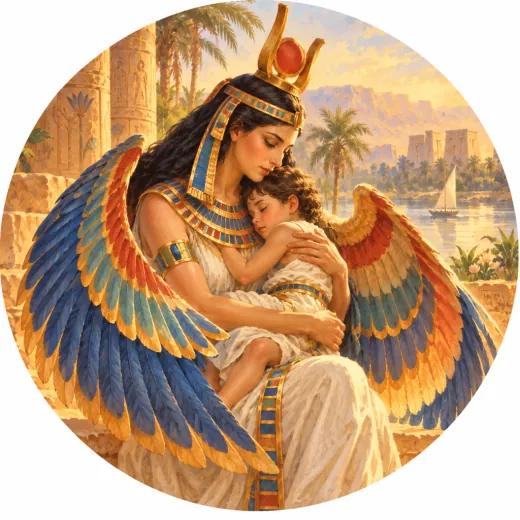
Isis
Ꜣst, “the throne”
not scary at all
Isis was the goddess of magic, protection and mothers, and she was the cleverest of all the gods. One tale says she even managed to make Ra reveal his secret name, which gave immense power. When her husband Osiris was killed by Set, she searched for him all along the Nile and brought him back to life with her spells. Then she hid her son Horus at Buto, in the marshes of the delta, to protect him until he was old enough to win back his father's throne.
Did you know? Her worship spread as far as Rome: in Pompeii there is still a well-preserved temple of Isis.
The story
Ra, the sun god, the king of all the gods, had grown old. Only a few had noticed.
It happens even to gods, if they wait long enough. Time spares no one. He walked more slowly. His lips trembled. Sometimes, as he spoke, a thread of spit dribbled from his mouth and fell to the ground without his noticing. Nobody noticed it either, or rather, everybody pretended not to. Everybody except one.
Isis was a clever woman, full of magic. She was not the strongest of the gods, nor the oldest. But she knew how to listen, and how to wait, and she had a wish she confessed to no one: she wanted to know Ra's true name. His secret name, the one he kept hidden in his chest. Whoever knew the true name of a thing had power over it. And Ra had the most powerful name in the world.
One day Isis gathered up the spit the god had let fall. She kneaded it with a little earth, shaped it between her fingers and made it into a serpent. A long, slender serpent, with the sacred shape. It had no life, but Isis knew how to give it some. She laid it on the path where Ra walked every day to look over his two lands.
Ra walked along, as always, with his train of gods.
The serpent raised its head. It bit him, without a sound.
His cry was heard all the way up in the sky. The god stopped, his face white. The poison raced through his veins, faster than the Nile in flood, and burned like fire. His legs gave way. His teeth chattered. He could not even speak. All the gods came running.
“What was it?” Ra kept saying. “Something has hurt me, and I did not make it. I did not see it. I have never known it. It is not fire, it is not water, and yet I am burning and shaking.”
The gods did not know what to say. Then Isis stepped forward, with the calm air of someone who already knows how things will end.
“What is wrong, my father?” she said. “Has a serpent bitten you? Has a creature you made yourself raised its head against you? I will defeat it with my magic. I will drive it from your sight.”
“A serpent… yes,” groaned Ra. “I burn more than water, more than fire. I am cold and I am hot. I am sweating.”
“Father,” said Isis, “tell me your name. Your true name. Because whoever is called by their name lives.”
Ra looked at his children. Then he began to list his names, slowly, his voice breaking.
“I am the one who made the sky and the earth, who spread out the mountains, who created all that is. I am the one who opens his eyes, and there is light, and closes them, and there is darkness. I am Khepri in the morning, Ra at midday, Atum in the evening.”
The poison did not stop. Ra trembled even more.
“Those are not the names I am looking for,” Isis said softly. “Your hidden name, father. Say it, and I will heal you.”
There was a long silence. This was the moment Isis had been waiting for for so long. But she knew she must not hurry.
In the end Ra, worn out, gave in. He told the other gods to leave, to leave him alone with her. When they were alone, his name passed from Ra's chest into Isis's, without anyone hearing it, like a breath moving house.
Then Isis spoke the spell: “Flee, poison, leave Ra. Come out, and let him live.”
The poison obeyed. Ra breathed, sat up straight, and the colour came back to his cheeks. From that day on, Isis was the most powerful goddess after him. She had managed to beat the greatest of the gods without ever raising her voice.
But Isis had other trials to face.
Her husband Osiris had been killed by his brother Set, shut in a chest and thrown into the river. Isis searched for him all over Egypt and beyond the sea, as far as the coast of Byblos, where the chest had become trapped inside the trunk of a tree, and she brought it home. But Set found it one night, while he was out hunting, and cut the body into fourteen pieces and scattered them along the Nile. Isis searched for them one by one, in a papyrus boat, and with her magic, the Egyptian texts say, she woke him, so that he could become king of the dead.
But there was no time to weep. She was expecting a child.
The child she was expecting, Horus, would be the only one who could avenge his father, and Set knew it. If he found the baby, he would kill him. So Isis hid in the most remote and watery place she knew: Buto, in the delta, where the Nile splits into a hundred branches and the water loses itself among the reeds. No one went in there without a boat and a guide. The birds flew low. The sunlight filtered through the stems, and the nights were full of the sounds of water.
She gave birth alone. To protect the child, Isis never left him, not even for an hour. She sang him little songs, ancient spells, the names of gods. When the baby cried, she always knew why. When he fell ill, she knew how to heal him. All her life she had done everything with only two weapons: cleverness and patience.
The boy grew up among the reeds and the waters, fed on fish and stories, far from the world. He learned to swim, to run, to fight. Every evening Isis told him who his father was, and that one day he would have to win back his throne.
Set, meanwhile, never stopped searching. But he never found that place.
Isis knew the most powerful name in the world and kept it to herself, in silence, like a breath no one could take from her. But to protect her son she would need something much simpler: time. And there among the reeds, day after day, time was working for him.
Relatives around the world
Listen / Read next
- Music to read by: Cinematic JourneyEpic film-style music, no lyrics, by Ciro Simone IrmiciSpotifyYouTube Music
Sources
- Plutarch, On Isis and Osiris
- Turin Papyrus, The Secret Name of Ra
