La Santa Casa di Loreto
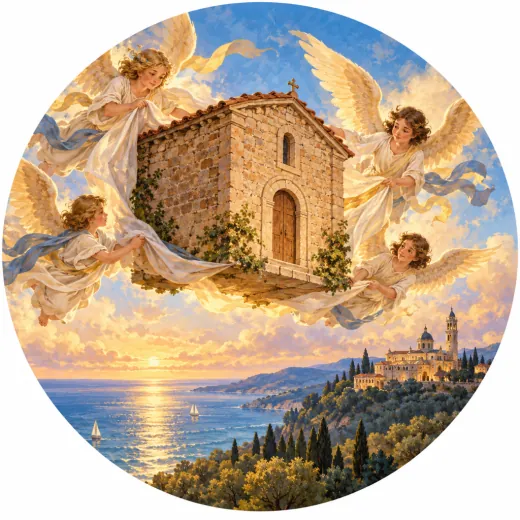
the Holy House, carried through the air
not scary at all
Inside the great basilica of Loreto there is a small stone house, the Santa Casa (the Holy House). Tradition says it is the house in Nazareth where Mary lived, and that angels carried it through the air across the sea: first to Illyria, on the other side of the Adriatic, then to the lands of Recanati, until they set it down on the hill of Loreto on the night between 9 and 10 December 1294. Some scholars think the stones arrived by ship, carried by Christians of the age of the Crusades. The two explanations have lived side by side for centuries.
Did you know? On the night of 9 December the Marche light the “fires of the Coming”, bonfires that according to tradition light the way for the flying house.
The story
When you enter the basilica of Loreto, the first thing you feel is silence. Then you raise your eyes and see the dome, the marbles, the chapels, and it seems you are inside a great church like many others.
Then you realise that in the middle of the church there is something else. A small building, shut like a jewel inside a casket of marble. Inside, plain, dark walls, of stone and brick. A few steps from one wall to the other.
It is the Santa Casa, the Holy House. According to tradition, the house in Nazareth where Mary lived.
And tradition tells that those walls came here in a way that no house has ever travelled.
In Nazareth, the House did not stand alone. It stood in front of a grotto, the Grotto that is still venerated today in the Basilica of the Annunciation. Over and around the House, in time, a church had been built, then a Byzantine basilica, then a great basilica of the crusaders. It was as if someone, generation after generation, had wanted to protect it.
But in 1291 the crusaders had to leave the Holy Land for ever, pressed by the Muslim army. And then, tradition tells, the House was carried to safety.
Carried by whom? That is the point of the story. According to the ancient devotional tradition, it was the angels. They lifted it and carried it over the sea.
The first stage, again according to the tale, was in ancient Illyria, on the other shore of the Adriatic, in a place that cannot be pinpointed. The Marian sanctuary of Tersatto, near Fiume, in Croatia, still remembers that stop.
Imagine those stones travelling in the dark, above the black water of the Adriatic, while below there was nobody to see them. No boat, no lighthouse, only the wind and the stars.
Then, three years later, comes the night that Loreto does not forget. It is the night between 9 and 10 December 1294. The House, says tradition, comes down in the territory of ancient Recanati: first near its port, then on the hill where Loreto stands today. And here it stops.
A precise date, a precise place. For those who believe, this is the beauty of it: not a timeless fairy tale, but a night with its day on the calendar.
In history, however, there is another explanation, and the Sanctuary's page tells it with the same seriousness. Many scholars think that the transfer was the work of men, the Christians of the time of the crusades, and that the "angels" of tradition are the sign of help that came from heaven. Pius IX, for his part, preferred to say that the House was carried "by divine will", without going into the how.
Two names from those years also appear in the account. The first is Celestine V, the pope who was in office in that December of 1294: on 13 December, a few days after the night of the Coming, he resigned the papacy, and never went to Rome. The second is Salvo, bishop of Recanati. In those years, with the popes far from Rome, there was a "Vicar of the City" who dealt with indulgences and relics, and from 1291 to 1295 that post belonged to Bishop Salvo himself. Those who follow the historical hypothesis think it was he who had the stones brought to his diocese, in the pope's name.
Two ways of telling the same night. At Loreto, for centuries, they have lived side by side.
And what do the stones say? The Sanctuary recalls the excavations made in the mid-twentieth century. In 1962-1965 it was discovered that the House has no foundations of its own: it rests directly on a public road, and from the start it was protected by a brick wall, called "of the people of Recanati", a sign that someone wanted to preserve the three original walls.
The three walls, seen up close, have a story to tell. The lower part is of stone, a kind of stone found in Nazareth but not in Loreto. The upper part is of brick, the kind found in Loreto but not in Nazareth. Many stones bear a herringbone dressing, typical of the Nabataean style, found in Palestine. On about sixty of them there are graffiti: writings and signs of the first Christians, similar to those left by Jewish Christians in the Holy Land.
Even the door and the window have their little mystery. The door is on the north, the window on the west, contrary to the building rules of this region. But if you imagine the House put back in Nazareth, in front of the Grotto, door and window return exactly to their place.
For this reason the Sanctuary maintains that the stones have a true Nazarene "mark of origin". These are, it must be said, the Sanctuary's own theses: everyone is free to weigh them. But certainly, looking at them, nobody remains indifferent.
In the sixteenth century, around the House, the great marble Casing was built, the one you see today as you enter. Saint Thérèse of Lisieux compared it to a casket that guards a pearl.
And so let us return to that visitor who enters the basilica. The others speak in low voices, some pray, some only look. The visitor passes a hand, slowly, near the dark stones, feeling that worn surface beneath the fingers.
Whether it came on the wings of angels, or on the ship of brave men, or by a road that no book can explain, the Santa Casa is there. After more than seven hundred years, every day someone crosses the sea, the plain or the hills of the Marche to see it.
And everyone, at some point, lowers their voice.
Listen / Read next
- Music to read by: Cinematic JourneyEpic film-style music, no lyrics, by Ciro Simone IrmiciSpotifyYouTube Music
