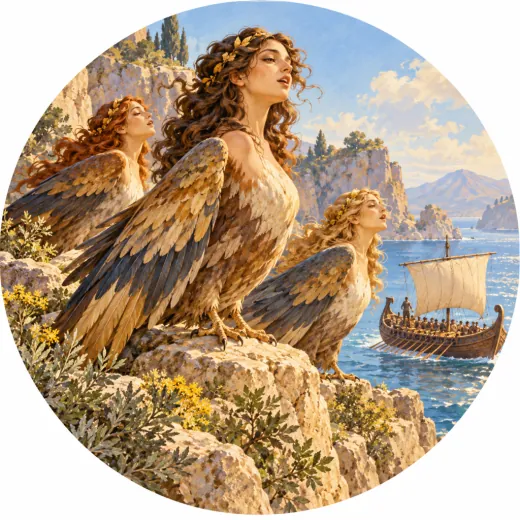
The Sirens
Seirênes, in Greek
scary
The Sirens lived on an island and sang with voices so beautiful that sailors, to hear them, steered their ships onto the rocks and never came home. Odysseus wanted to hear their song without dying: he had his companions block their ears with wax and had himself tied to the ship's mast, ordering them not to untie him whatever he said. So he was the only one to hear them and survive. Another story tells that Orpheus beat them by singing louder and more beautifully than they did.
Did you know? The Greek Sirens were half woman and half bird; the fish tail arrived only in the Middle Ages.
The story
Circe, the sorceress with hair like fire, had one single piece of advice for Odysseus.
“After my island, you will have to sail past the Sirens,” she told him, while the wind filled the sails. “There are two of them, but they sing like a hundred. Anyone who listens to them forgets his home, his family, his very own name. He goes towards the song, and never comes back. On that beach there are so many human bones that they look like a field of dry wheat.”
“And how can we get past?” asked Odysseus.
“You must stop your companions’ ears with wax. But if you want to listen, have yourself tied to the ship’s mast, hand and foot, and order them not to untie you for any reason. The more you beg to be set free, the tighter they must pull the knots.”
Odysseus nodded.
Everyone in the Greek islands knew that the Sirens existed. Not the way they are drawn today, with fish tails and long hair, sitting on the rocks: on ancient vases they were women with wings and the bodies of birds. In Homer, nobody describes them. Because the people who had seen them had never come back to tell the tale.
Odysseus thanked her, and that evening, on the ship, he did not speak to anyone. He stared at the black sea and thought about that song he had not heard yet, which already frightened him, because he knew very well which things a man cannot resist hearing.
Three days at sea went by.
On the fourth day, at dawn, the wind suddenly dropped.
The sails went slack. The sea became as smooth as a mirror. There was not a wave, not a seagull. Only a heavy silence that seemed to be listening.
“This is it,” said Odysseus.
He took a large ball of beeswax and softened it in the sun. He broke it into little pieces and put them in the rowers’ ears, one by one, until they could hear nothing at all. Then he had himself tied to the mast with strong ropes, his wrists behind his back and his feet at its base. “Don’t untie me,” he said again. “Whatever I say. Even if I beg you. Even if I order you.”
His companions nodded, without hearing him. The rowers looked at one another without speaking, the wax in their ears, took up the oars and rowed harder than ever.
The ship slid forward, slowly. Ahead of the bow they could see a green island, covered in meadows and flowers. In the meadow, among the flowers, there were bones. White bones, picked clean, in heaps, with scraps of cloth stirring in the wind.
And then, from far away, came a sound.
At first it was a thread. Then a river. Then a voice, so beautiful, so sweet, that for a moment Odysseus forgot he was tied up. It was the voice of a woman calling. No: of two women, answering each other in turn.
“Come here, Odysseus, glorious one, flower of the Achaeans. Stop your ship and listen to us. No one has ever sailed past this place without stopping to hear our voice, sweet as honey, and leaving wiser than before. We know everything. We know all that you suffered at Troy, you Greeks and the Trojans, by the will of the gods. We know everything that happens on the earth.”
Odysseus struggled against the ropes.
That voice knew him. It knew his name, it knew Troy, it knew his ten years of war. It promised him what people want most of all: to know. To understand. To have an answer to every question that had been burning inside him since the day he left.
“Untie me!” he shouted to the rowers. “Untie me, I tell you! I have to go to them!”
The rowers could not hear. They saw only a man screaming and thrashing, his face transformed, and they did what they had promised. Two of them, Perimedes and Eurylochus, stood up, and instead of untying him, they pulled the knots even tighter.
“Untie me, curse you!” The song was rising. Now it was everywhere: in the air, on the sea, inside his head. “Untie me, I order you! I’ll give you gold! I’ll give you ships!”
The song promised him the names of his dead companions, his father’s face, the reason for everything. The ropes cut into his wrists. Sweat ran into his eyes. He felt himself being torn in two. One part of him wanted to stay. Another, smaller part remembered his wife, who for twenty years had lit a lamp at the window every evening.
And the ship sailed on past.
Little by little, the voice grew fainter. Then a thread. Then a whisper. Then the wind came back to fill the sails, the waves began to move again, and the island fell behind, small as a green smudge.
When they were far away, Odysseus stopped screaming. He raised his head. He gave his companions a sign with his eyes, just once. At last they took the wax out of their ears and untied him. His wrists were marked by the ropes, and there were tears on his face.
He was the only one of his crew whom Circe had allowed to hear the Sirens, and he had come back alive. For the rest of the voyage, they say, whenever the wind carried a distant sound, his head would jerk up, and his companions pretended not to notice.
Some stories say that the Sirens, seeing that someone had escaped their song, threw themselves into the sea out of shame. Others tell that Orpheus, on the Argonauts’ ship, beat them with his lyre, singing more beautifully than they did. Nobody can know.
But one thing is certain: their song was not a wicked spell, not in the way we imagine. It did not promise riches, or love, or power. It promised the most dangerous thing of all: the whole truth.
And when people hear the word “everything”, they cannot resist.
That is why, so the old sailors say, you should never listen to anyone who promises to tell you everything.
Especially if they sing it well.
Relatives around the world
In the trails
Listen / Read next
- Music to read by: Cinematic JourneyEpic film-style music, no lyrics, by Ciro Simone IrmiciSpotifyYouTube Music
Sources
- Homer, Odyssey, Book XII
- Apollonius of Rhodes, Argonautica, Book IV
