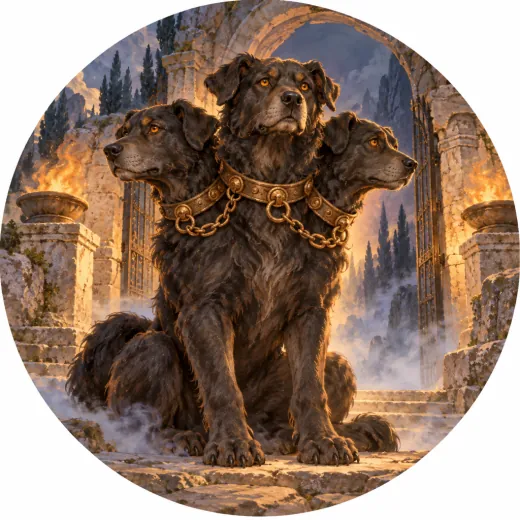
Cerberus
Kérberos, in Greek
scary
Cerberus is the gigantic dog that guards the entrance to the kingdom of Hades. He has three heads, a snake for a tail and, in some versions, snakes along his back. His job is simple: let the souls of the dead in and let none of them out. Only a few heroes managed to get past him: Heracles, in the last of his twelve labours, seized him with his bare arms and carried him up into the sunlight for a moment.
Did you know? In the Aeneid the Sibyl of Cumae puts him to sleep by giving him a cake made of honey and sleepy herbs.
The story
They say there is nothing to fear in the kingdom of the dead. That the souls walk slowly, as if in a dream, and that everything is grey and quiet.
Whoever says that has never heard the dog.
Aeneas heard it from far away, long before he saw it. He had already come all that way down with the Cumaean Sibyl, the woman who knew the road. They had walked through the dark for a time no one could measure, because down there there is no day and no night. They had crossed a wood where no wind blew. Then they had reached a black, slow river, and an old man with a filthy beard and burning eyes had pushed his boat towards them. His name was Charon, and he ferried the souls across the water.
He had not wanted to take a living man. When Aeneas climbed aboard, the boat sagged and groaned, and water began to seep in through the bottom. The old man had given in only at the sight of the golden bough that Aeneas held in his hand. Nobody spoke during the crossing. The only sound was the oar, dipping into the water and rising out of it, in and out, in and out.
On the far bank the ground was soft and the mist hung low.
That was when they heard the first bark.
It was not an ordinary bark. It was a sound coming from three throats at once, a booming of bronze that made the earth shake underfoot. Hesiod the poet had described it like this, many centuries earlier: a metal voice, a dog that knows no shame and no pity. His name was Cerberus. He had been born of two monsters, Typhon and Echidna, and just remembering his family was frightening enough.
Hesiod says Cerberus had fifty heads. Virgil, who wrote much later, counted three. Perhaps three were enough.
Aeneas stopped. The Sibyl laid a hand on his arm, but it made no difference: his feet had already stopped on their own.
In front of them was the mouth of a cave, and in the cave was the dog.
He lay on his side, as big as a house, filling almost the whole cavern. He had three heads, and each one had a throat wide enough to swallow a man. Snakes stuck out from his neck and back, dozens of them, curling and hissing softly, like living hair. His paws twitched in his sleep, and his eyes, all six of them, were half closed.
But he was not asleep.
Aeneas knew it when one of the heads rose. Its eyes opened, two red slits in the dark, and stared straight at him. Its lip drew back over its teeth. Then, from deep in its throat, came a low rumble, so low that Aeneas felt it in his stomach before he heard it with his ears.
He knew what this dog was like. Everyone among the living knew. Cerberus did not stop those who arrived. When the souls of the dead came past, he wagged his tail and let them in, calm, almost friendly. It was afterwards, when someone tried to go back, that his jaws never let go. Getting into the kingdom of Hades is easy. You can only get out with a permission that no one has.
Aeneas had no permission. He had a golden bough and a woman who knew the road.
“Don't move,” the Sibyl whispered. “And don't look him in the eyes.”
But the other eyes were already open. The three heads rose together, the three throats gaped, and the barking filled the whole cave and the wood and the river. The souls waiting on the bank huddled together and covered their faces. The snakes on his neck stood up like a mane. Aeneas felt the dog's breath, hot and heavy, smelling of freshly dug earth.
The Sibyl was not afraid. Perhaps she had made this journey more than once. She reached into a bag and took out a cake, well baked, sweet as honey, soaked in herbs that bring sleep. She held it on her palm for a moment, so the dog could see it.
Then she threw it.
The cake fell into the dark, close to the jaws, and for a moment nothing happened. The dog looked at it. One head sniffed. The other two turned, uncertain.
Then the middle throat opened wide, and the cake vanished in a single gulp.
The rumbling died away. One head sank down. Then another. One by one, the snakes on his neck stopped writhing and slid limply down his side. His paws stretched out, the huge body relaxed and sprawled on the ground, and the cave filled with slow, deep, steady breathing.
Now Cerberus really was asleep.
“Quickly,” said the Sibyl.
Aeneas went past. He went past just a few steps from the three heads, on tiptoe, holding his breath, and with every step he felt the heat coming off that enormous body. One of the heads stirred in its sleep and snorted, and a snake brushed his ankle, cold. He did not turn round. He did not turn round until he was beyond the cave, until the dog's breathing was only a distant sound behind him.
And yet he never stopped hearing it. For the rest of his journey through that kingdom of shadows, he had the feeling that somewhere behind him, a slow breath was counting his steps.
Over the centuries, the Greeks said that other heroes had managed to get past. That someone had calmed him with song, and that Heracles, just once, had dragged him all the way up into the sunlight, where the dog had howled as no one had ever heard a dog howl before.
But on the bank of that river, on that day, the cake was enough.
And even today, when a dog sleeps in front of the door of a house, and you hear it sigh in the dark, and you wonder whether it is really asleep, it is worth doing what Aeneas did. Walk past it in silence, without looking back. And never trust a dog that guards a door.
Relatives around the world
Listen / Read next
- Music to read by: Cinematic JourneyEpic film-style music, no lyrics, by Ciro Simone IrmiciSpotifyYouTube Music
- And in our homes: the dogBestiepedia, guides for people who live with a pet
Sources
- Hesiod, Theogony
- Virgil, Aeneid, Book VI
