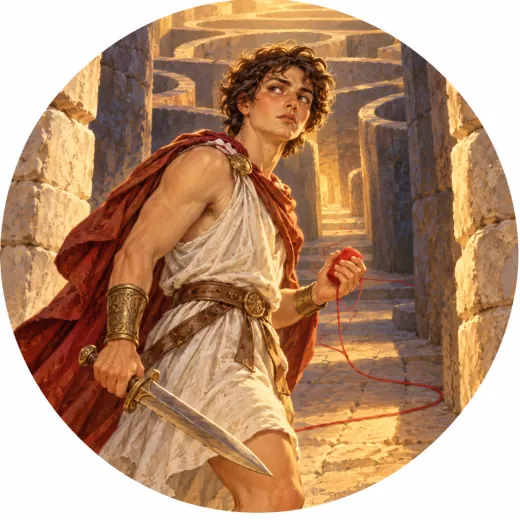
Theseus and the Minotaur
Thēseús and Mīnṓtauros
scary
On the island of Crete, King Minos kept the Minotaur locked up, a monster with a man's body and a bull's head, in a labyrinth built by the brilliant Daedalus. Every nine years Athens had to send seven young men and seven young women to be fed to the monster. The young prince Theseus set off with them. Ariadne, the king's daughter, fell in love with him and gave him a ball of thread: Theseus unwound it as he entered the labyrinth, defeated the Minotaur and found his way out again by following the thread.
Did you know? At Knossos, on Crete, archaeologists found an enormous palace with hundreds of rooms: perhaps that is where the idea of the labyrinth was born.
The story
In Athens, every nine years, the mothers closed their windows.
There was no festival that day, and no market. Only a long line of boys and girls walking down to the harbour in silence, with their hair loose and their hands empty. There were fourteen of them: seven boys and seven girls, chosen by lot from all the families of the city. A ship with black sails was waiting for them. And after the ship, a monster.
This was the price Athens paid to Minos, the king of Crete. Years before, in Attica, his son had died, and Minos had sworn revenge. He had won the war and forced a terrible peace on the city: every nine years, fourteen young Athenians would be sent to the island, and there they would go into the Labyrinth.
The Labyrinth was a palace with no way out, built by Daedalus, the most brilliant architect in the world. Corridors that turned back on themselves, walls that all looked the same, doors that always led to the same room. And in the middle, at its deepest point, lived the Minotaur: a man as big as a giant, with the head of a bull, who ate human flesh.
That year, on the quay, there was also a prince.
His name was Theseus. He was the son of Aegeus, the king of Athens, and nobody had ever seen him afraid. He stepped forward in front of all the people and said, “Don’t draw lots for my name. I’ll go, as one of the fourteen. And I’ll come back.”
His father, old Aegeus, hugged him with trembling hands. He gave him just one piece of advice. “The sails are black, because they are in mourning. If you come back alive, change them. Put up white ones. Then, from far away, from the cliff, I’ll know straight away.”
“I’ll change them,” Theseus promised.
The voyage took days. On Crete they were led before Minos, and among all the courtiers watching, one girl looked at Theseus longer than the others. It was Ariadne, the king’s daughter. That night, while everyone slept, she went to him in secret.
“Tomorrow you’ll go into the Labyrinth,” she whispered. “Nobody has ever managed to get out. But I’ve spoken to Daedalus, who built that place, and he gave me this advice.” She opened her hand. In it was a ball of thread. “Tie one end of the thread to the door, at the entrance. And unwind it as you walk. If you get lost, you only have to follow it back.” Then, lowering her voice: “Promise me you’ll take me away from here.”
Theseus promised.
At dawn, the fourteen were pushed through a great bronze door, which slammed shut behind them with a thud.
Inside, the darkness smelled of mould and of animal. The floor was damp. Footsteps echoed on and on, and you could never tell where the echo was coming back from. Theseus knotted the thread to a ring on the door, took the ball in his hand and said to the others, “Stay here, close together. I’ll come back for you.”
He began to walk.
Every corner was just like the one before. Right, left, left, right. The thread ran through his fingers like a thin river, and at every turn he felt it pull a little tighter, like a voice saying, “I’m here, I won’t let you go.”
After an hour, he heard a noise. Far away at first, then nearer. A huge breath, slow and heaving. Then the sound of hooves scraping on stone.
Theseus stopped. His heart was pounding in his ears.
Round the corner, a shape filled the whole corridor. It was two heads taller than he was. It had shoulders as wide as a doorway, hands as big as shovels, and on top of those shoulders, the head of a bull, with smoking nostrils and two black horns, curved and shiny. Its eyes, small and red, were staring at him.
The Minotaur did not speak. It lowered its head and charged.
Theseus threw himself to one side. The horns grazed the wall, and a chunk of it broke away in a cloud of dust. He got up again, unarmed, because he had refused to bring weapons: but he had his hands and his head. The monster was strong, but it was blind with rage, and when it ran it always went straight ahead. Theseus saw that at once. He made it go round a pillar twice, until the bull grew tired and slowed down. Then he grabbed it by one horn, dragged it to the ground and struck it with all his strength, until the huge breathing stopped.
Silence returned to the Labyrinth.
Theseus sat down for a moment, his back against the wall, shaking. Then he stood up, found the thread he had dropped and gripped it in his fist.
He went back, turn after turn, following it as he had promised. When he appeared again in front of the thirteen young people, nobody said a word. Then, one after another, they began to cry and to hug him. Together they followed the thread to the bronze door, and out into the light.
That night, in secret, they all set sail, with Ariadne on board.
Here the stories say different things. Some tell that they stopped on an island, Naxos, and that while Ariadne was asleep Theseus sailed away without her, forgetting his promise; and that there a god, Dionysus, found her in tears and married her. Others say that Ariadne died. All of them agree on one thing: from that moment on, Theseus’s mind was somewhere else.
And that was when he forgot the other promise.
The ship sailed back towards Athens, and the sails were still black. Nobody had thought of them.
On the cliff above the harbour, Aegeus had been waiting for days. He watched the sea from dawn to dusk. Then, one morning, he saw a speck on the horizon. A ship. Black sails.
He saw nothing else. He did not wait to see anything else.
He threw himself from the cliff. And from that day on, that sea has been called the Aegean Sea.
Theseus reached the harbour, happy, with his thirteen companions, and found silence. He understood everything before anyone even told him.
He had become a hero. He had killed the monster, he had saved fourteen lives. On that very day he had also become king of Athens, without wanting to.
But when the Greeks told this story, they never ended it with the victory. They ended it with the sails. Because they knew something that young people sometimes forget: you can defeat a monster at the bottom of a labyrinth, and lose everything over a promise that seemed small.
Relatives around the world
In real history
Listen / Read next
- Music to read by: Cinematic JourneyEpic film-style music, no lyrics, by Ciro Simone IrmiciSpotifyYouTube Music
Sources
- Plutarch, Life of Theseus
- Ovid, Metamorphoses, Book VIII
