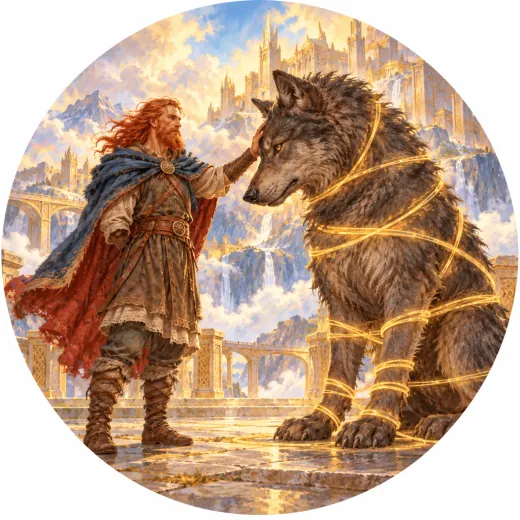
Tyr
Týr, in Old Norse
a little scary
Tyr was the bravest of the gods, the one who decides victory in battle. When the gods decided to bind the wolf Fenrir, who grew bigger and more dangerous every day, the wolf agreed to wear the magic chain on one condition only: that one of them put a hand in his mouth as a guarantee. Only Tyr was brave enough to do it. When Fenrir realised he had been tricked and could not break free, he closed his jaws: Tyr lost his hand, and the wolf stayed bound until Ragnarök.
Did you know? In English, Tuesday is “Tyr's day”, just as in Italian it is the day of Mars.
The story
Tyr was the only one brave enough to feed the wolf.
The cub had come to Asgard while he was still small, one of the children of Loki and a giantess. The gods, who knew many things about the future, also knew how much harm that cub could do. But they kept him with them, because it is hard to kill a creature that looks you in the eye. His name was Fenrir.
He grew every day. Every day Tyr brought him meat, and every day the wolf was taller, stronger, heavier. The other gods stopped at a safe distance and said nothing.
Tyr, instead, would sit beside him on the straw and watch him eat. Sometimes the wolf lifted his muzzle and rested his chin on Tyr's knees, and Tyr ran his hand between his ears. It was something nobody had ever seen anyone do, and he never told a soul.
Until one evening the gods gathered and decided to bind him.
“We'll give him a test,” said Odin. “A contest of strength. We'll make it look like a game.”
They forged a chain, the strongest they knew how to make, and called it Leyding. They brought the wolf before them and said: “Try to break it. If you can, it will be a victory that makes you famous.”
Fenrir looked at them calmly. He let them bind him. Then he stretched just once, and the chain burst into pieces.
They made another, twice as strong, and called it Dromi. “This one is even tougher. If you break it, everyone will know how strong you are.”
The wolf was suspicious, but he stayed calm. “If it's too strong for me, there's no shame in that,” he said. “But if I break it, there's glory.” And once again he let them bind him. He pushed with his paws, he rolled over, he smashed the chain against the rock, and Dromi broke too, flew far away and was lost in the grass.
That was the moment the gods became truly afraid.
They sent a messenger, Skírnir, to the land of the dwarves, whose craftsmen have the most skilful hands of all. They asked them for a cord that no one could break. The dwarves made it from six things that no longer exist: the sound of a cat's footsteps, a woman's beard, the roots of a mountain, a bear's sinews, a fish's breath and a bird's spittle. They called it Gleipnir. When the gods saw it, they could not believe their eyes. It was as smooth and light as a silk ribbon.
They took the wolf to an island called Lyngvi, in the middle of a black lake, still and covered in heather. The water around it reflected nothing. There they showed him the ribbon.
“Try this one too,” they said. “It looks thin, but it's stronger than it seems.”
Fenrir took it in his paws and looked at it for a long time.
“I don't see much glory in breaking a ribbon like this,” he said. “But if it was made with craft and trickery, then thin as it is, it is not going on my legs.”
“But you've broken the strongest chains,” the gods replied, “so this is nothing to you. And if you can't break it, that will mean you're no longer dangerous, and we'll let you go.”
The wolf was silent.
“If you bind me so that I can't free myself,” he said at last, “you'll take your time before you help me. I don't want this ribbon on me. But if one of you puts a hand in my mouth, as a pledge that there's no trick, then I'll agree.”
The gods looked at one another. Nobody moved. Each of them waited for someone else to step forward, and each of them knew what it meant.
Tyr took a step.
He had thought about this moment many times, on those evenings on the straw, with the wolf's muzzle on his knees. He knew the pledge was a lie. He knew that if the wolf could not break the ribbon, he would close his jaws. He also knew that if nobody did anything, one day that wolf would be so big that nothing at all could stop him.
He knelt down. He held out his right hand. He laid it, open, between the teeth. He felt the wolf's warm breath on his wrist, and for a moment his heart beat far too hard.
“Trust me,” he said softly.
The wolf did not answer. He looked at him.
The gods tied the ribbon around Fenrir's legs. When they had finished, he pushed. The ribbon went taut and did not give. He pushed harder. The harder he pushed, the tighter the ribbon pulled. He tried biting, kicking, twisting round and round. Nothing. It held fast, like a locked door.
The gods laughed. They all laughed, partly from relief and partly from the fear that had passed.
All except Tyr, who had understood that the wolf would never look at him the same way again.
Fenrir closed his jaws.
It was not a cruel act. It was what any tricked animal would have done. Tyr did not scream. He pulled back, clutching the arm that no longer had a hand, and said not a word.
Then the gods took a cord called Gelgja, passed it through a slab of rock called Gjöll and fastened it to an enormous stone, driven deep into the earth. Then they took a sword and wedged it between the wolf's jaws, with the hilt resting below and the point against the roof of his mouth, so that he could never close them again. Drool began to pour from his gaping mouth, and it became a river, which is called Vón.
The wolf howled. The gods walked away in silence.
He will stay there, they say, until the day of Ragnarök, the end of the world, when the chains will break.
Tyr lived. He lived for a long time without his right hand. At night, sometimes, he would go down to the shore of the lake and sit far off, just far enough to be sure he could not be seen, and gaze at the island.
Of them all, he was the only one who had ever kept the wolf company.
Relatives around the world
Listen / Read next
- Music to read by: Cinematic JourneyEpic film-style music, no lyrics, by Ciro Simone IrmiciSpotifyYouTube Music
Sources
- Snorri Sturluson, Prose Edda, Gylfaginning
