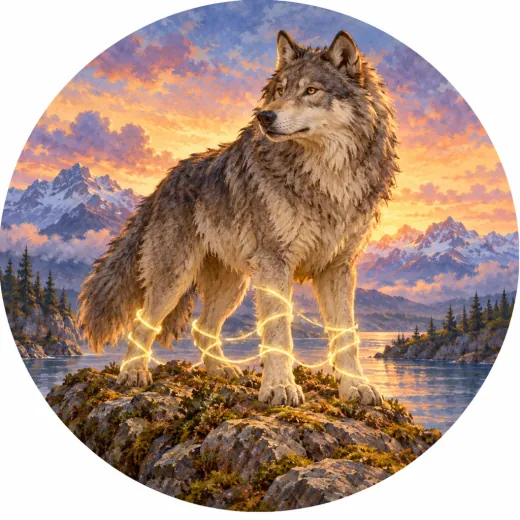
Fenrir
Fenrisúlfr, the wolf Fenrir
scary
Fenrir is a wolf, a son of Loki, whom the gods raised from a cub in Asgard. But he grew so fast and became so strong that prophecies warned he would be extremely dangerous. The gods tried to bind him with heavier and heavier chains, and he broke them all. So they asked the dwarves for a magic fetter, Gleipnir, as thin as a silk ribbon and made from things that do not exist, such as the sound of a cat's footsteps and the beard of a woman. That one Fenrir could not break.
Did you know? According to the prophecies, Fenrir will only break free at the end of the world, Ragnarök.
The story
Nobody is afraid of a wolf cub.
When Fenrir arrived in Asgard, the city of the gods, his paws were too big for his body and he had a clumsy way of tripping over the dogs' tails. The gods looked at him and smiled. He was the son of Loki, the god of a thousand tricks, and of the giantess Angrboða. His brother and sister, the serpent Jörmungandr and the girl Hel, had already been sent far away by Odin, the father of the gods: the serpent thrown into the deep sea, Hel into the kingdom of the dead. The wolf, though, they kept at home.
But the wolf grew.
He grew every day, and not the way dogs grow, little by little. He grew like the tide, a bit more with every dawn, never stopping. After a month his paws were no longer clumsy. After a year his growl made the cups rattle on the tables. The gods stopped smiling. They stopped going near him too, all except one: Tyr, the bravest of them, the only one who dared to bring him meat every day. He did it without ever taking his eyes off him.
Meanwhile, the prophecies all said the same thing. A great evil would come from that family, and the wolf would be the ruin of the gods. And yet nobody raised a sword. Asgard was a holy place, and the gods did not want to stain it with anyone's blood, not even the blood of a beast who, the prophecies said, would one day kill Odin himself.
They decided to tie him up.
They had a very strong chain forged, called Leding, and they brought it to the wolf with an almost genuine smile.
“They say whoever breaks a chain like this wins great fame,” said one of them. “Why don't you try?”
Fenrir looked at them, one by one. He let himself be bound. The gods took a step back, then another. The wolf barely stretched, like someone waking up in the morning, and the chain burst. The links rolled away with a sound like broken bells.
No one spoke. Then the gods made another chain, twice as strong, and called it Dromi.
“This one's even better,” they said. “If you can break it, no one in the nine worlds will be as strong as you.”
Fenrir studied the chain for a long time. He suspected it hid a trick. But he also thought that he had grown even more since breaking the first one, and that anyone who wants to make a name for himself has to take a few risks. He let himself be bound again. This time, when he shook himself, the floor trembled. Dromi snapped in two, and the pieces flew far away.
That night, in Asgard, the gods did not sleep.
Odin called Skírnir, Freyr's messenger, and sent him down into the depths of the earth, to the land of the dwarves. The dwarves set to work in their forges, where the sun never reaches, and when Skírnir came back up he was holding a ribbon.
A plain ribbon, smooth and soft as silk.
It was called Gleipnir, and it was not made of iron. The dwarves had woven it from six things: the sound of a cat's footsteps, the beard of a woman, the roots of a mountain, the sinews of a bear, the breath of a fish and the spit of a bird. These are things that do not exist, and indeed, the story says, they no longer exist today, because they all went into the ribbon. That is why cats walk without a sound and women have no beards.
The test took place somewhere far from everything: an island called Lyngvi, in the middle of a black lake, Amsvartnir. There was nothing around it, only the wind in the reeds and water so still it looked like stone. The gods brought Fenrir there and showed him the ribbon.
“Try to break it,” they said, and they pulled it between their hands to show how flimsy it was. “It doesn't look like much, we know. But it's stronger than you think.”
The wolf did not move.
“It doesn't look like much to me,” he said quietly. “There's no glory in snapping a ribbon like that. But if it was made with cunning, even if it looks thin, you won't put it on me.”
“You broke iron,” the gods replied. “What's a strip of silk to you? And if you can't do it, that means you're nothing to fear, and we'll let you go.”
Fenrir stared at them. For the first time, perhaps, he was afraid too.
“If you bind me so that I can't free myself,” he said, “you'll leave me here, and a long time will pass before anyone helps me. I don't want to be bound. But so that no one can call me a coward, I'll do it on one condition: one of you puts his hand in my mouth. That will be the pledge that there's no trick.”
The gods looked at one another.
No one moved. No one spoke. A breath of wind passed over the lake and the reeds shivered. Each of them had understood, at the very same moment, what would happen to that hand, and no one wanted to be the pledge.
Then Tyr stepped forward and put his right hand between the wolf's teeth.
The gods wound Gleipnir round Fenrir's body. The wolf strained, pushed and pulled with all his strength, and the ribbon that looked like silk did not give. In fact, the more he struggled, the tighter Gleipnir became.
The gods laughed. They all laughed, except Tyr. Because when the wolf understood there was nothing more he could do, he snapped his jaws shut, and Tyr no longer had a right hand.
Then they took a cord called Gelgja and threaded it through the ribbon. They tied it to an enormous slab of rock, Gjöll, and sank the slab deep into the earth. On top of the slab they placed an even bigger boulder, Thviti, and drove it even further down.
Fenrir opened his jaws wide, to bite again. So one of the gods jammed a sword between them: the hilt resting against the lower jaw, the point against the roof of his mouth, so that he could never close it again. A river of slobber poured from his throat. It was named Ván, and it has never stopped flowing.
The gods went back to Asgard without a word. Far away, on an island in a lake, a wolf waited in the dark with his mouth wedged open and a ribbon thinner than a finger around his body.
There he will stay, the songs say, until the day the world ends.
Relatives around the world
Listen / Read next
- Music to read by: Cinematic JourneyEpic film-style music, no lyrics, by Ciro Simone IrmiciSpotifyYouTube Music
- And in our homes: the dogBestiepedia, guides for people who live with a pet
Sources
- Snorri Sturluson, Prose Edda, Gylfaginning
