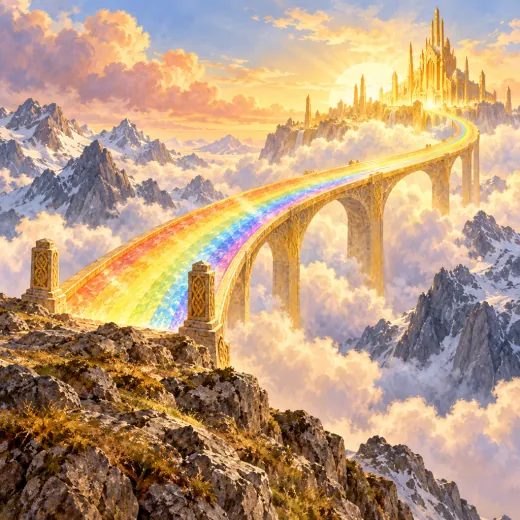
Asgard and the Bifröst bridge
Ásgarðr and Bifröst, in Old Norse
not scary at all
Asgard was the stronghold of the Æsir, the Norse gods, full of golden halls: among them Odin's Valhalla. One day an unknown builder promised to raise a towering wall around it in a single winter, asking in return for the goddess Freyja, the sun and the moon. He worked with an enormously strong horse and was about to succeed; then Loki, turned into a mare, lured the horse away and the builder failed to finish in time. Asgard is reached by Bifröst, a rainbow bridge: the red we see, said Snorri, is burning fire.
Did you know? According to the Edda, the Bifröst bridge will collapse during Ragnarök, when the fire giants ride across it.
The story
Sometimes, after a storm, the sky opens and a coloured bridge appears. We call it a rainbow. The peoples of the North called it Bifröst, and they knew it was no trick of the light. It was a road. The only one that led from the land of humans to Asgard, the fortress of the gods.
In Asgard the halls were made of gold. The most famous was Odin's, Valhalla, which you could recognise from far away: its rafters were spears, its roof was made of shields, and its benches were covered with coats of mail. But around all this there was no wall. For a while the gods lived like that, in the sky, and none of the giants had ever come to bother them.
Then one day a stranger arrived.
He introduced himself as a builder, and said he knew how to defend Asgard. “I can raise you a wall,” he said, “so high and so strong that no mountain giant and no frost giant will ever get past it. But I want a reward.”
“What reward?” asked Odin.
“I want Freyja as my wife. And the sun and the moon as well.”
The gods looked at one another. Freyja was one of them, the most beloved goddess, and the sun and the moon were the light of the world. There was a long silence, and everyone understood the price was too high. But they also understood that nobody else would ever build that wall.
It was Loki, who was cunning and always talked too much, who found a way out. “Let’s say yes,” he said, “but on one condition. He must finish it all in a single winter. If even one stone is missing on the first day of summer, he gets nothing. And he must do it alone, with no help.”
The stranger thought for a moment. “Agreed,” he said. “I ask only to use my horse.”
Loki persuaded the gods to accept, and they all swore to it with solemn words.
The work began on the first day of winter. The horse was called Svaðilfari, and it was an animal like none ever seen: at night, in the frost, it dragged boulders as big as houses without ever stopping. By day the builder piled them one on top of another. The gods watched from their halls, and every dawn the wall was higher than they had hoped.
At night, from Asgard, you could hear the boulders scraping over the snow, and the horse’s breath steaming in the dark. Nobody talked about it any more. In those last days the gods had begun to avoid one another, and nobody could look Freyja in the eye.
With three days to go before summer, the fortress was almost finished. Only the gateway was left.
The gods gathered at their seats of judgement, and every face was dark. “Whose bright idea was it,” they asked, “to promise Freyja to a giant, and let the sun and the moon vanish down a hole?”
Everyone knew whose.
“Loki,” they said. “It was you. And if you don’t find a way to stop this man from succeeding, we will kill you.”
Loki swore he would find one. He had the face of someone really thinking, and for once he was not smiling. He went off alone, far from the halls, and spent the day staring at the wood below the walls, as if he were counting the trees.
That night the builder went out with his horse as usual, to fetch the last stone. Suddenly a mare leapt out of the wood. She was beautiful, with a glossy mane, and she whinnied softly, as if she were calling him.
Svaðilfari stopped. Then all at once he snapped his reins and ran into the wood after her. The mare galloped faster and led him further and further away among the trees, and the builder chased them, shouting, all night long. When the sun rose, the horse had not come back. That night, no work had been done.
The builder realised he had been tricked. He was furious, and in his fury he was seen for what he really was: a giant, as tall as a mountain. The gods no longer had to remember their oaths. They called Thor, who had been far away in the east fighting trolls, and he came rushing back. His hammer did the rest. The giant never saw the summer.
As for Loki, he kept out of sight for a while. Then he came back, and in his arms he held not a horse but a grey foal. It had eight legs. It was the son of Svaðilfari, born of a mare who had been Loki. Its name was Sleipnir, and Odin took it for himself: it became the fastest horse among gods and humans.
The wall was never finished.
Asgard was left with a wall that was not quite whole, and at the last stretch, where the gate should have been, there remained a gap between the stones. No giant ever managed to get in that way, because the gods had someone keeping watch for them.
His name was Heimdall, and he lived at the top of the bridge, where the bridge touches the sky. He needed less sleep than a bird. He could see a hundred leagues away, by day and by night. He could hear the grass growing on the earth and the wool growing on the backs of sheep. He had a horn, the Gjallarhorn, and if anyone really came close, a single blast would wake the worlds.
The red you see on the bridge, the old people said, is not a colour: it is fire. It burns for ever. That is why the giants cannot climb into the sky even if they want to, and why even Thor, every day, on his way to the gods’ meetings, would rather wade through rivers than set foot on the bridge.
But the bridge will not last for ever. When the last battle comes, the sons of Muspell, the fire giants, will ride across the sky over Bifröst, and the bridge will break beneath them. Heimdall will blow his horn.
Until that day the rainbow burns and Heimdall keeps watch. And in Asgard there is still that gap with no gate, which nobody has ever closed.
Relatives around the world
Listen / Read next
- Music to read by: Cinematic JourneyEpic film-style music, no lyrics, by Ciro Simone IrmiciSpotifyYouTube Music
Sources
- Snorri Sturluson, Prose Edda, Gylfaginning (about 1220)
- Poetic Edda, Grímnismál
