The Kraken
kraken, in Norwegian
scary
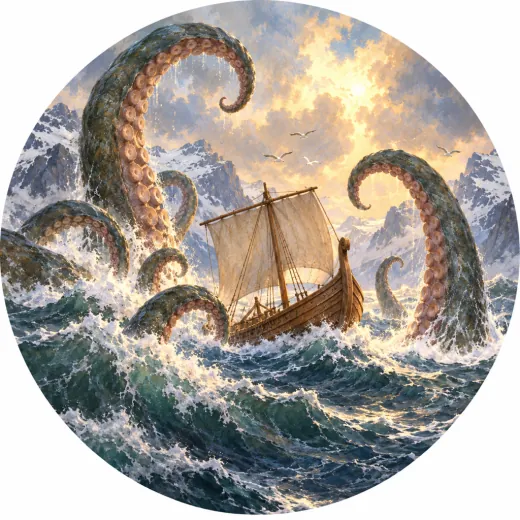
The Kraken does not come from the ancient Eddas but from the tales of Norwegian sailors. It was a sea monster so big that, when it came to the surface, it looked like an island: fishermen found huge numbers of fish around it, but they had to get away before it dived, because the whirlpool could pull the boat down. In the eighteenth century a Norwegian bishop, Erik Pontoppidan, wrote about it as if it were a real animal. Today we know the sailors had probably seen a giant squid.
Did you know? The giant squid really exists, can grow longer than ten metres, and was photographed alive in its own habitat for the first time only in 2004.
The story
The Norwegian fishermen of long ago had a rule. They never wrote it down anywhere; they taught it to their children in the boat.
When the sea gives you too much, don't stop to say thank you. Run.
It was a summer morning, one of those without a breath of wind. The water was as flat as a mirror, and the sky above seemed to be resting on the waves. The old man and his grandson had rowed for hours, out from the coast, to a spot where there was usually an abyss beneath the keel. They let down their lines. They waited.
The boy was twelve, and that summer was the first time he had gone so far out.
The first fish bit almost at once. Then another. Then another. The lines went taut, the fish leapt into the boat, big and silver, one after another, and the boy laughed.
“Grandad, I've never seen so many!”
His grandfather didn't answer.
He had stopped pulling in. He had picked up the sounding lead, the weight you drop to measure the depth, and thrown it into the water. The lead hit the bottom too soon. He pulled it up and dropped it again. Too soon the second time as well.
Here the bottom should have been eighty fathoms down, or more. The lead stopped at twenty.
“What is it?” asked the boy.
“Put your line away.”
“But they're biting…”
“Put your line away,” said his grandfather quietly. “Take an oar.”
He wasn't shouting. That was worse. It was the voice of someone who doesn't want to make a sound.
The boy took the oar. And at that moment, for the first time, he noticed how silent the sea was. Not a single gull was crying. Not a single wave slapped against the hull. There wasn't even the usual murmur of the water, as if everything beneath them was holding its breath.
“Row,” said his grandfather. “Gently. Don't splash.”
They rowed. The water around the boat was changing colour: from blue it had turned murky and dark, and it seemed to have a skin. The fish were still leaping, but not to take the bait any more. They were fleeing, or perhaps gathering, all in the same place, in the middle of the calm sea.
And that place was rising.
The boy turned round for a moment, and he shouldn't have. Where there had been open water, there was now a dark mass coming slowly to the surface, without a ripple. It looked like a sandbank. Then a small island. Then a cluster of islands, all black and slimy, covered in something that looked like seaweed. From those islands, very high up, rose thin, curved shapes, like the masts of a ship.
“Don't look,” said his grandfather. “Row.”
They rowed, and the boy felt his arms burning. Behind him the island kept growing, and the sea ran down its sides in long threads of water. That was when he caught the smell: heavy, like the bottom of the sea, like things that have lain down there for longer than anyone knows.
A minute passed. Then two. Then, behind them, the silence ended.
It was a rumble, low, like a heavy cart crossing a wooden bridge. The island was starting to go down. It sank slowly, with immense force, and where it went under, the water drew back and opened into a round hole, wider and deeper all the time, spinning on itself. A whirlpool. From the whirlpool came a pull that dragged everything towards it: the foam, the fish, the planks, everything that floated.
The boat slid backwards.
“Row!” yelled his grandfather, and this time he held nothing back. “Row with all your strength!”
They both rowed, their muscles on fire, until the last turn of the whirlpool let the boat go. Then the water closed up again and went flat. The sea turned blue once more, with the sky resting on it, and somewhere a gull cried, as if nothing had happened.
The boy couldn't speak. His hands were still clenched on the oar, and his heart was thumping in slow, heavy beats, like a drum.
“Was that him?” he said at last.
“Yes,” said his grandfather. With his hand still shaking, he picked up one of the fish from the bottom of the boat and looked at it. “He's the one who calls the fish. Wherever he is, the sea is full of food. That's why fishermen sometimes go there without knowing it. And that's why you have to leave before he moves.”
They had no wish to fish any more, or even to look back. They went home with a full boat, without a word. That evening the boy didn't touch his supper. In the dark of his room he still seemed to feel that wide silence under his bed, and the floor slowly rising and falling, like breathing.
This is the story the fishermen of Norway passed down, and its name was the Kraken. Everyone along the coast knew about it, even if nobody could say what it really looked like. They knew it was the biggest animal in the world. They knew that when it rises it looks like an island. And they knew that when it goes down, the sea opens.
In the eighteenth century, a bishop called Erik Pontoppidan wrote down what the fishermen told him. He didn't treat it as a fairy tale: he put it in his Natural History of Norway, among the real animals, next to the fish and the birds. Seafaring men, he wrote, knew the signs well: the bottom that rises, the fishing that becomes too good.
Long before that, in the thirteenth century, a Norwegian book, the King's Mirror, already spoke of monsters in the far seas towards Greenland so huge that sailors mistook them for islands. Nobody could say what they were, or whether anyone had ever seen one up close.
Today people think the Kraken was really the giant squid, a real animal that lives in the depths, and that nobody photographed alive in its own home until 2004.
But the old sea dogs of Norway used to say that if the sea gives you too much, something is rising from below.
And it's best not to stay and find out what.
Relatives around the world
In the trails
Listen / Read next
- Music to read by: Cinematic JourneyEpic film-style music, no lyrics, by Ciro Simone IrmiciSpotifyYouTube Music
Sources
- Erik Pontoppidan, The Natural History of Norway (1752–1753)
- Konungs skuggsjá, The King’s Mirror (13th century)
