Sleipnir
Sleipnir, “the slippery one”
not scary at all
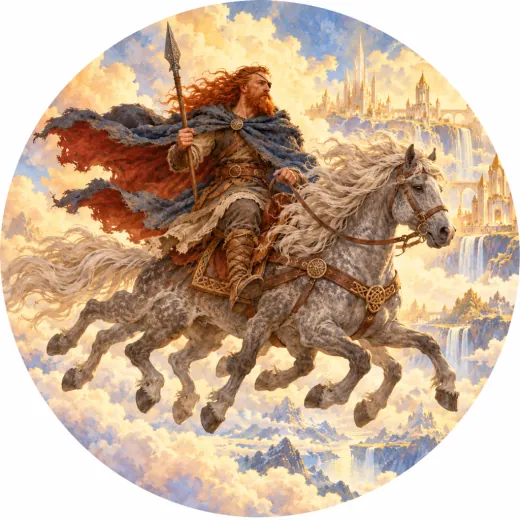
Sleipnir is Odin's horse, grey and incredibly fast, with eight legs. He gallops over land, through the air and across the sea, and he can even reach the kingdom of the dead. His birth is a funny story. A builder had promised to raise the walls of Asgard in a single winter, helped by his very strong stallion; the gods, who had agreed to the deal thinking it impossible to win, asked Loki to do something. Loki turned himself into a mare and distracted the builder's horse. From that meeting Sleipnir was born.
Did you know? The builder's horse was called Svaðilfari, and he is Sleipnir's father.
The story
In the beginning, Asgard had no walls.
The gods had already set the land of humans in order and built their own halls, but the city at the top of the world stood open, like a house without a door. And in that part of the world, the wind usually brought giants.
One day a builder arrived.
They watched him climb the path on foot, with a big horse walking behind him. He was a stranger, and nobody knew where he came from. He stopped in front of the gathered gods and spoke plainly.
“I can build you a fortress that no giant will ever climb. High walls, a solid gate. Three seasons is all I need.”
“And in return?” asked Odin.
“I want Freyja as my wife. And I want the Sun and the Moon.”
A long silence fell. Freyja was the best-loved goddess in Asgard. The Sun and the Moon were the light of the whole world.
The gods went off to talk it over. In the end they told the stranger, “Not three seasons. One winter. If the walls aren't finished on the first day of summer, you get nothing. And you'll work alone: no man will lend you a hand.”
They thought they were being clever. Nobody, working alone, could ever finish something like that in one winter.
The builder thought for a moment.
“At least let my horse help me. His name is Svaðilfari.”
The gods couldn't make up their minds. It was Loki who talked them into it. “What harm can it do? It's only a horse.” They all swore, hands on the bargain. On the first day of winter, the work began.
That was when the gods realised they had made a mistake.
At night, while the builder slept, the horse worked. Svaðilfari dragged stones as big as houses up the mountain, with a slow step, never stopping. In the dark you could hear his heavy breathing, the creak of the ropes, the thud of a boulder settling into place. By morning the wall had grown by a whole storey. The builder would run his hand over the stone, pleased, and say nothing.
The winter went by. The snow melted along the edges of the walls, and the walls kept rising.
The gods climbed up to look at them every morning, at first hoping, then counting. A month before the end, the wall reached their shoulders. A few weeks later it towered high above them. With a week to go before summer, nobody dared to joke any more. The builder greeted them with a polite nod, like someone who has already won and doesn't want to rub it in.
Three days before summer, only the gate was missing.
The gods met on their thrones. Nobody spoke. Some looked at Freyja, some at the sky, where the Sun and the Moon were still calmly going round, with no idea they were about to be given away.
“Whose advice was this?” asked a voice. “Who said to let him have the horse?”
Everyone turned towards Loki.
“I didn't…”
“You will find a way to make this man fail,” said the gods, “or you will pay dearly for it.”
Loki had done plenty of strange things in his life. That night he did a new one: he changed his shape.
The builder was leading Svaðilfari to the boulders, as he did every evening, when a mare came out of the woods. She was beautiful. She trotted past the stallion, neighed softly, and stopped to look at him.
Svaðilfari stopped.
He dropped the ropes. He raised his head. He neighed. The mare galloped away through the trees, and he went after her, snapping his harness as if it were thread.
“Stop!” shouted the builder. “Stop, Svaðilfari!”
He chased after them, and the mare ran, and ran, and kept on running. You could hear hooves among the branches, the stallion's breathing, the shouts of a man who could no longer keep up. They ran all night. When the sun came up, the builder was still in the forest, calling a horse that did not come back, and the stones had not been hauled.
The next day was the same. The gateway stayed open.
Then the builder changed. His shoulders broadened, his head rose above the trees, and his voice became like an avalanche. He was no man. He was a giant, and the gods saw him for what he was.
“You tricked me!”
But the gods were no longer afraid. They called Thor, who came in an instant with his hammer Mjöllnir, and the giant spoke no more of bargains or wages. That giant never went home. He never went anywhere again.
As for Loki, he kept out of sight for a while.
Time passed. Then one day Loki reappeared, and he was not alone.
Behind him, on four slender legs and four more, walked a foal. He was grey and thin, with very long legs that were still working out where to go. He had eight legs, four on each side, and he moved them all together without ever stumbling.
“This,” said Loki, “is my son, mine and Svaðilfari's.”
The gods stared at him. Then someone laughed, and then they all did.
Odin came closer, slowly, and laid his hand on the foal's neck. The foal didn't move away.
“His name will be Sleipnir,” he said. “And he will be mine.”
Snorri writes that he was the best of all horses, among gods and among humans. Once grown, he galloped over the earth and through the air. When young Baldr died and went to the kingdom of the dead, it was on Sleipnir that the messenger Hermóðr rode down, for nine nights, through valleys so dark you could no longer make out the bottom, all the way to the bridge over the river and the gate of the dead. Sleipnir jumped the gate as if it were nothing, and carried him back again.
The walls of Asgard stayed standing, tall, with nobody left to pay. And in the courtyard, every morning, you could hear the beat of eight hooves, one after another, like a drum that had learned to walk.
They say the gods never again trusted a stranger who asked for three seasons.
Or Loki.
Relatives around the world
Listen / Read next
- Music to read by: Cinematic JourneyEpic film-style music, no lyrics, by Ciro Simone IrmiciSpotifyYouTube Music
Sources
- Snorri Sturluson, Prose Edda, Gylfaginning
