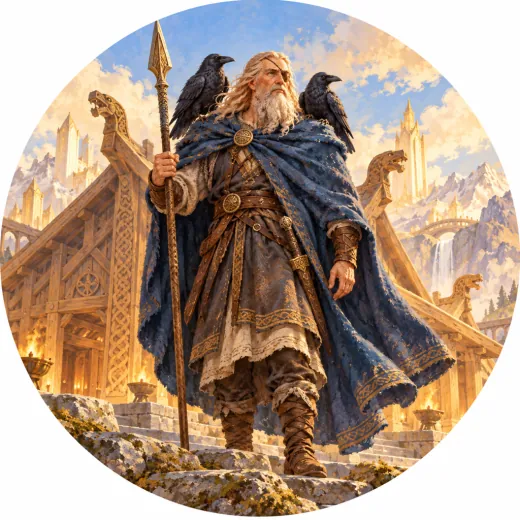
Odin
Óðinn, in Old Norse
a little scary
The king of the Norse gods has only one eye: he gave the other in exchange for a sip from the well of wisdom. He has two ravens, Thought and Memory (Huginn and Muninn), who fly over the world and tell him everything; he rides Sleipnir, a horse with eight legs. To learn the runes he hung for nine nights from a windswept tree, which tradition identifies with Yggdrasil, the world tree. In his great hall, Valhalla, he welcomes the bravest warriors fallen in battle, who are getting ready for the end of the world.
Did you know? The English word Wednesday means “Woden's day”, the day of Odin.
The story
They say that Odin, the king of the gods of the North, had only one eye.
He had not lost it in battle. He had given it away.
Odin already had a great deal: the throne, the spear, the hall of warriors. But he wanted more. He wanted to know. He wanted to know everything that had happened and everything that would happen, even the things that are only ever said in a whisper. So he went in search of the water of wisdom.
Under the roots of the greatest tree in the world there was a well. It was guarded by a giant, Mímir, who drank from the spring every morning and so knew everything. Odin came on foot, after many days of walking, with no companions, his cloak pulled down over his eyes. Around the roots of the tree the air was damp and still, and you could hear water dripping in the dark.
“I want to drink,” he said.
Mímir looked at him for a long time. “Every sip has its price.”
“Tell me.”
“Your eye.”
Down in the well, something glittered, like a fallen star. Odin did not move. He said nothing. Then, with a steady hand, he took out his eye and let it slip into the well, where they say it still shines at the bottom today.
He drank. And he knew.
From that day on he had only one eye. But he could see further than before.
It was not enough for him. There were signs, shapes, lines that the gods could not read: the runes. They were ancient letters, and each one had a power. But no one, not even Odin, knew where they came from.
To find out, Odin did something no god had ever done.
He climbed a tree. He let himself be wounded by a spear. And he hung himself from the branches, offered to himself, like a sacrifice. For nine nights he stayed up there.
“I know that I hung on a wind-swept tree, for nine long nights, wounded by a spear, given to Odin, myself to myself.” That is how he tells it, in an ancient song that people used to repeat in low voices.
Nine nights in the wind. The sky turned black, then grey, then black again. The cold bit his hands. The wind swung his body like a cloth hung out to dry. Nobody brought him bread, nobody offered him a horn to drink from. He looked down at the earth and saw nothing.
Then, one night, he saw.
Down at the foot of the tree there were shapes. Signs carved into the ground, like the footprints of birds. They moved. They rearranged themselves. They made sense.
“The runes,” said Odin. He had no voice left, and it came out as a breath.
He leaned out. The spear burned in his side, but he stretched down, and with a scream, with all the breath he had left, he took them up. Then he fell.
When he hit the ground, he knew. He knew the runes. He knew how to heal sickness, stop enemy weapons, break chains, speak with the dead. From his wounded body a new kind of knowledge had been born, and a single step was enough for him to understand that there was no going back.
From then on, Odin was no longer just the king. He was the Allfather, the god who asks and gives, who sees and does not tell. And when people thought of him, they lowered their voices.
He had two ravens. Their names were Huginn and Muninn, which in the old language mean Thought and Memory. Every morning at dawn, Odin let them fly. They crossed the whole world, over mountains and seas, over fields and towns, and at midday they came back, landed on his shoulders and whispered in his ear everything they had seen.
“What did you see?” Odin would ask.
“A king who lies. A river that rises. A child crying in an empty house.”
Odin listened and said nothing. But once, an ancient song tells us, in his silence he admitted that he feared for his ravens: he feared that Huginn might not come back. But he feared even more for Muninn.
Because you can lose a thought and think a new one. Memory, once it is lost, can never be found again.
He rode a grey horse, Sleipnir, who had eight legs and galloped over land, over sea, through the air, and even down to the kingdom of the dead. He was the fastest of all horses. When Odin rode him, the earth shook.
And he had a hall: Valhalla, the “hall of the fallen”. It was huge, with a roof made of shields, and inside it were tables as long as a valley. The Valkyries, Odin's maidens, went to battles to choose among the fallen, and brought the bravest here. Here Odin welcomed the most courageous warriors, those who fell in battle. They ate, they drank, they trained, and every evening they sat down together again, without a single wound.
Because Odin knew something he had learned from the well and from the runes, and that he had told no one: one day, the world would end.
It is called Ragnarök. A winter will come that lasts three years, with no summer in between. The wolf Fenrir will break free of his chains. The great serpent will rise out of the sea. And the gods and the warriors of Valhalla will ride out to fight the last battle.
Odin will ride at the front, with his golden helmet and his spear in his fist. He will face Fenrir. And it will be the wolf, they say, who wins. His son Víðarr will avenge him, but Odin will not see it.
The song of the “Völuspá” does not end there. It says that after the battle the sea swallows the earth, and then the earth rises again, green, and the fields bear fruit without being sown.
Odin had always known. He had given an eye to know it. He had hung for nine nights to understand how to face it. And he would ride out all the same, head held high, into the storm, because some fates cannot be escaped, but you can choose how to meet them.
When, one evening, the wind blows the clouds away and only two black ravens are left on the roof of a house, the old people of the North still say, “Look, they're watching us.”
And they keep the door shut.
Relatives around the world
In real history
Listen / Read next
- Music to read by: Cinematic JourneyEpic film-style music, no lyrics, by Ciro Simone IrmiciSpotifyYouTube Music
Sources
- Poetic Edda, Hávamál and Völuspá
- Snorri Sturluson, Prose Edda (13th century)
