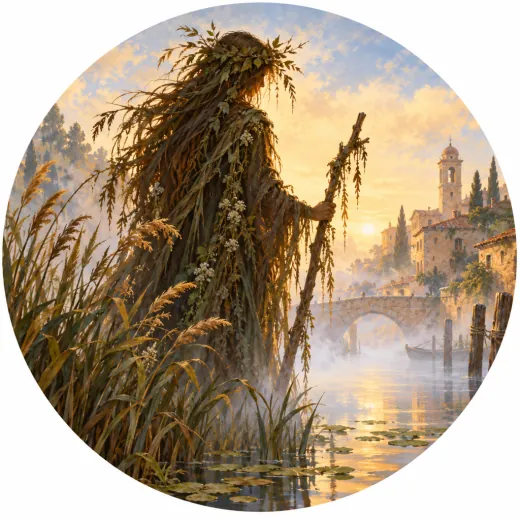
The Borda
the fog witch
scary
In the plain, when the thick fog rises and you cannot see a thing, people said the Borda came out: a horrible-looking witch, always blindfolded, by day and by night, living in the marshlands. Meeting her was the worst thing that could happen: people said there was no escape from her. Children feared her most of all, and in Romagna there were even lullabies with her name. Scholars see her as the fear of marshes and fog turned into a person.
Did you know? The name Borda may come from “bor”, a root linked to Borvo, the Celtic god of springs, the same root found in Bormio and the Bormida river.
The story
If you have ever been on the plain in November, you know what the thick fog is. Not that gentle mist that dresses the fields in the morning. The real thing. A dense, white fog that eats the landscape, that gets into your clothes, that makes you feel as if you were inside a cloud fallen to earth.
When the thick fog comes, you cannot see the road. You cannot see the ditch. You cannot even see your own hand, if you hold it out. Sounds become strange: a creak seems like a footstep, the water seems like a voice. And you feel like staying at home.
For this reason, once upon a time, in the Po Valley, people told of the Borda.
She was a witch. A horrible witch, they said, with an appearance that nobody could describe without lowering their voice. But there was one thing that everybody knew about her: she wore a blindfold. A blindfold over her eyes, by day and by night. The Borda could not see. And yet she found her way all the same.
She lived where the earth is wet and the ground turns soft. In the marshes, near the swamps, where water stagnates and the reeds grow tall. In those places the fog rises sooner and lifts later. There, the old people said, she was at home.
Whoever met her did not come back.
What did she do? They never said it in full. It was one of those stories in which the frightening part is left to be guessed. It was enough to say: "If you meet her, you are finished." And the children understood.
In Romagna, then, there was a custom which today may make you smile, or shiver. Mothers, to get their children to sleep, sang lullabies with the Borda in them. They were not sweet songs. They were gloomy rhymes, a little disquieting, that spoke of children and dangers. But they served one precise purpose: to make little ones understand, before it was too late, that certain places are not for children.
Because the Borda, in truth, was never only a witch. She was a kind of road sign, told as a story. A way of saying: "Do not go near the marsh." "Do not go out in the fog." "Do not stray from the house when you can no longer see anything."
Scholars, when they looked into her, did a curious piece of work. They looked at her name. In Milanese, "borda" means the vapour that condenses on the ground, that is, low fog. And even further back in time, some say, there is an ancient root, "bor", found in the name of a Celtic god, Borvo, the god of the hot waters that bubble up from the earth. From that same root come names like Bormio and the river Bormida.
It may be that the Borda was born that way: from a very old fear, that of a place where water hides under the ground and where vapour rises to cover everything. A fear which, at a certain point, took on a face.
The face of a blindfolded woman.
Today the plain is full of roads, lights, real signs. The ditches are fenced, the canals marked. And yet, when the thick fog comes down and the countryside disappears, something still stirs.
Maybe it is only the instinct to keep children close. Not to lean too far over the edge.
When it happens, the mother calls the little one and says, in the calmest voice in the world:
"Come here, the Borda is coming."
And the child, without knowing why, runs.
Relatives around the world
In the trails
Listen / Read next
- Music to read by: Cinematic JourneyEpic film-style music, no lyrics, by Ciro Simone IrmiciSpotifyYouTube Music
Sources
- MilanoFree, «Personaggi del folclore italiano: Borda, Maskinganna e Munaciello»
- Eraldo Baldini, «Gotico rurale»
