The Mazapégul
mazapégul, in the Romagna dialect · Emilia-Romagna
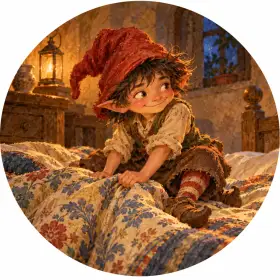
The Mazapégul is the night elf of Romagna: small, hairy, somewhat cat-like, with a red cap on his head. At night he jumps onto the chest of a sleeper and sits there, giving bad dreams and shortness of breath. He makes things disappear, unsettles the animals and plaits horses' tails. If he grows fond of a girl, he plays tricks on her sweetheart. To get rid of him, say the people of Romagna, you must steal his cap: without it, he loses all his powers.
Did you know? The Mazapégul has many names from village to village: mazapigur, calcarel, fuletà.
Sources: Agenzia Dire, «Italia di mostri, creature e leggende: dal serpegatto al mazapegul» (2024); Eraldo Baldini, studi sul folklore romagnolo
The Borda
the fog witch · Emilia-Romagna
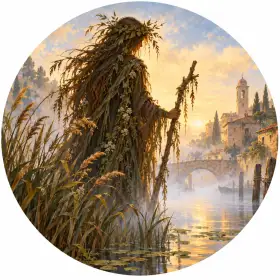
In the plain, when the thick fog rises and you cannot see a thing, people said the Borda came out: a horrible-looking witch, always blindfolded, by day and by night, living in the marshlands. Meeting her was the worst thing that could happen: people said there was no escape from her. Children feared her most of all, and in Romagna there were even lullabies with her name. Scholars see her as the fear of marshes and fog turned into a person.
Did you know? The name Borda may come from “bor”, a root linked to Borvo, the Celtic god of springs, the same root found in Bormio and the Bormida river.
Sources: MilanoFree, «Personaggi del folclore italiano: Borda, Maskinganna e Munaciello»; Eraldo Baldini, «Gotico rurale»
The Legend of the Due Torri
the Two Towers: the Torre degli Asinelli and the Garisenda · Emilia-Romagna
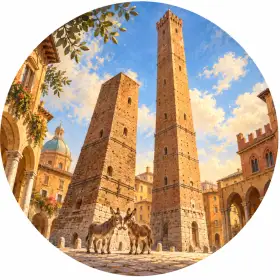
The Due Torri (the Two Towers) of Bologna are real: the taller one is the Torre degli Asinelli, almost a hundred metres high, and beside it stands the Garisenda, shorter and very crooked. The legend says a poor farmer, thanks to his two little donkeys digging in the field, found a chest full of gold. His son fell in love with a noble girl, and her father demanded a test: build the tallest tower in the city. The donkeys' gold paid for the tower, which took their name. Another story says the towers were born from a contest between two rival families.
Did you know? Dante saw the Garisenda and put it in the Divine Comedy, in canto XXXI of the Inferno.
Sources: Bologna Welcome, «Le torri tra leggende e curiosità»; Dante Alighieri, «Inferno», canto XXXI
The Legend of the Tortellino
“turtlèin”, in Bolognese · Emilia-Romagna
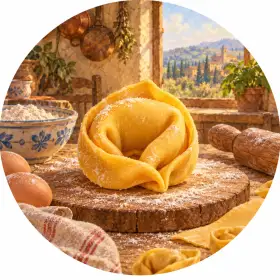
During a war between Bologna and Modena, the legend says, some gods of Olympus stopped for the night at an inn in Castelfranco, exactly halfway between the two cities. The curious innkeeper peeked through the keyhole into the room of the goddess Venus and saw her navel. He was so struck that he ran into the kitchen and copied it in pasta: the tortellino was born. It is a joking story, told by Giuseppe Ceri in a poem that mimics Tassoni's mock-epic “La secchia rapita” (The Stolen Bucket). The filled pasta of those lands, though, really is ancient.
Did you know? Castelfranco Emilia calls itself the “home of the tortellino” and every year celebrates with a festival and a re-enactment of the legend.
Sources: Gambero Rosso, «Le tante vite del tortellino: origini e storia»; Giuseppe Ceri, «L'ombelico di Venere» (poemetto scherzoso, fine Ottocento)
The Ghost of Azzurrina
Guendalina, known as Azzurrina · Emilia-Romagna
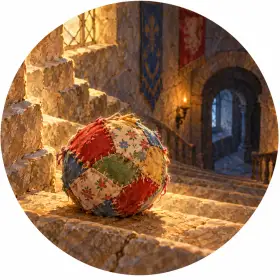
In the castle of Montebello, in the hills near Rimini, people tell of Guendalina, the lord's daughter, who lived in the fourteenth century. She was albino, with very white hair, and in those days some feared it was a sign of witchcraft: so her mother dyed her hair black with herbs, and the colour turned blue. That is why they called her Azzurrina, “little blue”. One stormy day she was playing with a rag ball; the ball rolled down the cellar stairs and she followed it. Nobody ever found her again.
Did you know? Albinism is a genetic condition: skin and hair have little colour, and it has nothing to do with magic.
Sources: APT Emilia-Romagna, «Castelli e fantasmi»; SiViaggia, «A Montebello il castello con il fantasma di una bambina»