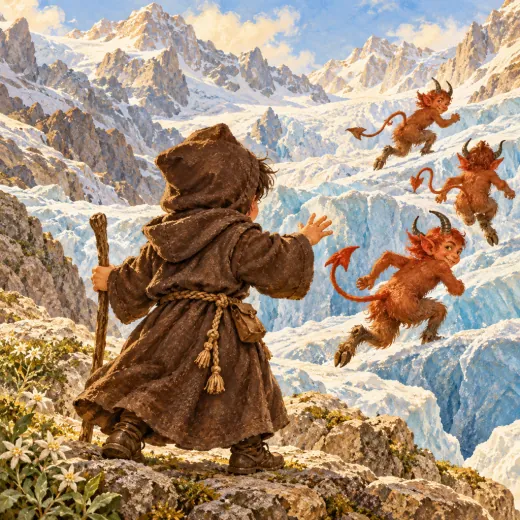
The Devils of Val Veny
Val Veny, at the foot of Mont Blanc
a little scary
Saint Bernard, the saint of the Alpine passes, had driven the devils out of the mountains. But they kept coming back to Val Veny, beneath the glaciers of Mont Blanc, for their rowdy night-time parties. Priests, canons and important churchmen tried to send them away with exorcisms, but the devils only grew bolder. In the end a humble Franciscan friar managed it, and the devils had to go back where they came from. The moral is simple: where pride fails, humility wins.
Did you know? The devils accused the friar of taking grass for his sandals and a grape from a vineyard, but he had an answer for both charges.
The story
Saint Bernard, the one of the great Alpine passes, was a patient man. But when he had to drive the devils out of the mountains, he put all the strength he had into it. And he succeeded. He drove them out of the valleys, the passes, the paths. The devils went away grumbling and took refuge on Mont Maudit, the Cursed Mountain, in the middle of the ice.
Up there, though, they were bored.
Ice is silent. And devils, as everyone knows, cannot live on silence. So every now and then one of them would say: "Why don't we pop over to the Val Veny?" And the others would answer: "What if someone sees us?"
"We will go by night."
That is why, every so often, when the sun went down behind the glaciers and the wood turned black, something began to stir up there. First a rustle, then a beat of footsteps, then a din that sounded neither of men nor of beasts. The devils were arriving. And with them came the witches and the evil spirits, who did not want to miss it, and they gathered in the meadows for their party. In the language of the valley that party is called seun-goga, and it is the word they use for the witches' sabbath.
They sang, they yelled, they danced stamping on the ground. When they left at dawn, the meadow was gone. The hay was trampled, the fields ruined, the harvest lost.
The farmers, in the morning, crossed themselves and looked at the stretch of mud.
"We cannot go on like this," they said. "Soon there will be nothing left to eat."
So they called the priests. Priests came, canons, prelates in their fine vestments, with candles, with big books. They planted themselves in the meadows and declaimed, in the most solemn voices they had, all the formulas for driving out devils.
The devils listened. Then they laughed.
Not only did they not go away: from that day they were even cheekier. They made more noise. They imitated the chants, from the woods. One evening, they very nearly applauded.
The farmers began to despair.
One night, however, during the party, one of the devils got hurt. He fell, while dancing, and twisted a leg. He was a lame devil, and the trouble was that at the first light of dawn devils have to go. The others vanished in a flash. He, hopping on one leg, could not manage it.
Just at that moment, in the meadow, there was a farmer who had got up early.
"Hey, you," said the devil, so as not to be seen in difficulty. "What are you looking around for?"
"I am looking for the damage you do," answered the farmer.
The devil sighed. He was tired, and had no time left. "I will tell you why nothing works," he said. "Your priests are not bad. But they do not have a pure heart. If you want one who will really frighten us, look for someone simple."
And he vanished, limping, with the sun coming up behind him.
The farmer ran to tell everyone. In the valley a long discussion began. Not a bishop, not a canon, but a humble person. Where could one be found?
One was found in Aosta, in a convent of Franciscans. The prior, when they asked him, was not very convinced. He called an ordinary friar, one of those who count for nothing: simple, gentle, who went begging for alms and did small things. Sending him against the devils seemed a joke.
"Me?" said the friar. "But I am not worthy."
"Go, and that is all," replied the prior.
The friar reached the Val Veny on foot, following the valley people who had come to fetch him, with his sack and a quiet voice. He sat down on the meadow and waited for night.
Night came, with its stars and its cold. From the glacier came down the usual wind. Then, far away, the first din was heard: hooves, laughter, a drum that nobody had ever made. The friar did not move. He counted the stars softly, the way you count a rosary.
When the devils saw him, they looked at one another.
"Who is this?" "A friar." "A friar? Him?" "He looks like nothing." "Then let us play tricks on him."
They began to prod him, as you do with someone who seems defenceless. And, since they could not find anything, they brought out the smallest accusations they had.
"One day you pulled up a bit of grass to make yourself sandals," they said. "It was not yours." But the friar had left that grass to dry in the meadow, and used it only afterwards.
The friar did not get flustered. He had an answer for that too, and gave it calmly.
"And a grape," they pressed. "You took it from a vineyard. Thief!"
"Yes," said the friar. "I took it. But I left money to pay for it, and I took it to a sick brother."
The devils fell silent.
They tried again, a bit to the right, a bit to the left. But everything they found was as clear as glacier water. There was not a shadow.
One after another, the devils began to yawn. Then to step back. Then to run away, first in small groups, then all together, grumbling, without turning round. They went back to hell, from where they should never have come out.
The Val Veny, that night, was silent. And so it was the night after, and the one after that.
The friar got up from the meadow, settled his sack on his shoulder and went back to Aosta, to his vegetable garden.
Relatives around the world
In the trails
Listen / Read next
- Music to read by: Cinematic JourneyEpic film-style music, no lyrics, by Ciro Simone IrmiciSpotifyYouTube Music
