The Legend of the Lago Blu
the Blue Lake: Lac Bleu, also called Lake Layet · Aosta Valley
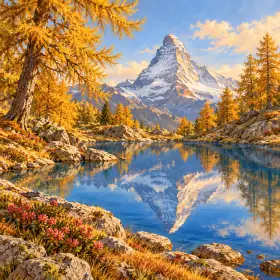
Where a bright blue pond lies today, there once stood the house of a rich but stingy family of shepherds. One day a hungry traveller knocked at the door, and the mistress of the house laughed and chased him away. Only the youngest son secretly brought him a bowl of milk, and as a punishment he was sent into the woods to gather firewood. When he came back, the house was gone: the water had covered everything. Why the water is so blue is explained in different ways: a mineral on the bottom, or algae. It is one of many “punished village” stories of the Alps.
Did you know? On still days the Matterhorn is reflected in the water of the Lago Blu as in a mirror.
Sources: Regione Autonoma Valle d'Aosta, turismo, «La leggenda del Lago Blu»; Tersilla Gatto Chanu, «Leggende e racconti popolari della Valle d'Aosta»
The Torre di Bramafam
“Brama fam”, meaning “cries of hunger” · Aosta Valley
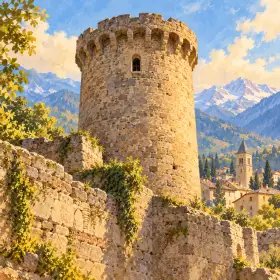
In Aosta, on top of the ancient Roman walls, stands a medieval tower with a strange name: the Torre di Bramafam (the Bramafam Tower). The legend says that a jealous lord of the Challant family locked his wife inside, and that she died of hunger lamenting her sufferings. Another tradition gives the name a calmer explanation: the tower was a granary, and during a famine people gathered beneath it to beg for bread. Nobody knows which story is true, but the tower is real and really did belong to the Challant family.
Did you know? The tower stands on a Roman base, next to the Porta Principalis Dextera of the ancient walls of Aosta.
Sources: Regione Autonoma Valle d'Aosta, turismo, «Torre di Bramafam»; ENIT, italia.it (portale turistico nazionale), «Aosta, cosa vedere nella città ai piedi delle Alpi»
The Devils of Val Veny
Val Veny, at the foot of Mont Blanc · Aosta Valley
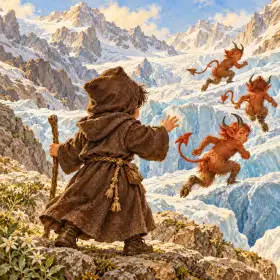
Saint Bernard, the saint of the Alpine passes, had driven the devils out of the mountains. But they kept coming back to Val Veny, beneath the glaciers of Mont Blanc, for their rowdy night-time parties. Priests, canons and important churchmen tried to send them away with exorcisms, but the devils only grew bolder. In the end a humble Franciscan friar managed it, and the devils had to go back where they came from. The moral is simple: where pride fails, humility wins.
Did you know? The devils accused the friar of taking grass for his sandals and a grape from a vineyard, but he had an answer for both charges.
Sources: Regione Autonoma Valle d'Aosta, turismo, «I diavoli della Val Veny»
The Lost Valley of the Walser
“Das verlorene Tal”, in the Walser language · Aosta Valley
The Walser, mountain people who settled in Gressoney centuries ago, told of a green and happy valley hidden beyond the glaciers of Monte Rosa: the homeland of their ancestors. In 1778 seven young men from the village decided to go and see it. They climbed the glaciers, driven by curiosity more than by glory, until they passed 4,000 metres. From a spur of rock they finally saw below them the green pastures of the Riffelberg and the Riffelalp and the Zmutt valley. The expedition is true history; the lost valley was a dream.
Did you know? That rock is now called the “Rock of Discovery”, and the seven young men are remembered among the first climbers of Monte Rosa.
Sources: Henri Armand, «Le notaire Bastrenta, Walser et citoyen du monde», Nouvelles du Centre d'études francoprovençales n. 49 (2004), con il racconto di Umberto Monterin sulla salita del 1778; Walser Kulturzentrum / Centro Culturale Walser, «Walser Kulturzeitung» n. 8 (2018); Regione Autonoma Valle d'Aosta, turismo, «I Walser»
Gargantua of the Alps
Gargantua, the giant of Alpine and French legends · Aosta Valley
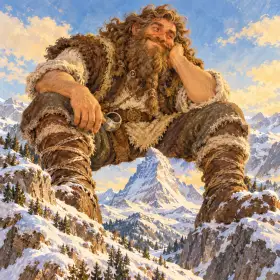
Gargantua is a huge and slightly clumsy giant who appears in tales from France, Switzerland and the Aosta Valley, long before the writer Rabelais made him famous. In Breuil, where once there were only summer-pasture huts, they say he fell in love with a girl of extraordinary beauty and carried her off, hiding her in the mountains; the villagers joined forces to look for her and he, giving up, brought her back on a sledge. In Courmayeur the Giant's Tooth on Mont Blanc is said to be one of his teeth. Every year the carnival of Breuil brings this story back to life.
Did you know? Every carnival in Breuil-Cervinia, Gargantua and the White Lady come down into the village with music and fireworks.
Sources: Regione Autonoma Valle d'Aosta, turismo, «Il Dente del Gigante»; Regione Autonoma Valle d'Aosta, turismo, «Il ritorno della Dama Bianca»