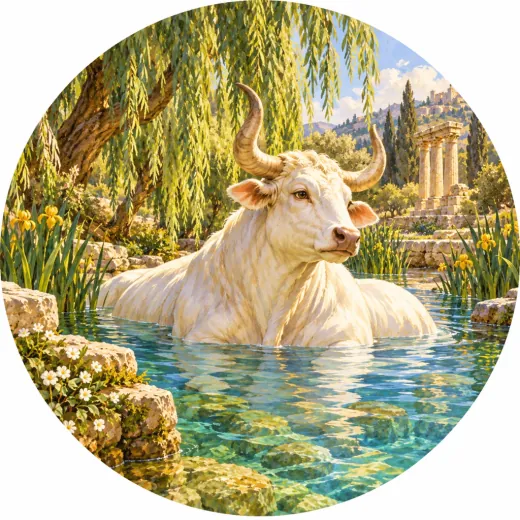
The God Clitumnus and the White Oxen
Clitumnus, in Latin
not scary at all
The springs of the Clitunno are a pool of crystal-clear water among willow trees. For the ancient Umbrians and for the Romans the river was a god, Clitumnus, who gave answers to those who consulted him. The poet Virgil recalls the white flocks and the bull that, bathed in his sacred river, led the Romans' triumphs to the temples. The writer Pliny the Younger, in a letter, described the springs, the god's temple and many little shrines around it.
Did you know? Nearby stands the Tempietto del Clitunno, a small church built like an ancient temple, a UNESCO World Heritage Site since 2011.
The story
Imagine you are a traveller, two thousand years ago. You come from Rome along the road that climbs north, between olive trees and fields of wheat, and at a certain point someone says to you: stop here, there is something you must see.
You step down from the cart. An old man points to a hill covered with very tall trees, black and dense. They are cypresses, so old that they seem older than the place itself. At their feet there is no house, no wall. There is only a silence unlike any other.
You come closer. And you see the water.
Pliny the Younger, the Roman writer, saw it just like this, and told a friend about it in a letter. He began with a question: "Have you ever seen the spring of the Clitumnus?" And if you have not, he wrote, go and see it.
The water comes out of the earth from many springs at once and gathers in a pool so clear that you can count the stones on the bottom. You can count the coins too, thrown there by visitors for the god, one by one, bright as silver fish. There is no dark bed, no reflection to deceive you. You look down and you see everything, right to the bottom.
Then the water gathers strength. From the pool a river is born, and a river wide enough to carry boats. Pliny found it so lively that boats could even go up it against the current. On the banks grow ash trees and poplars, and the water copies them so perfectly that they seem to be planted underwater, like a second forest turned upside down.
Here, for the ancient Umbrians and then for the Romans, a god lived.
His name was Clitumnus, like the river itself. He was not a distant god, one who lives in the sky and does not care about men. He was the god of the spring, a god you could touch with your hands. Beside the spring stood an ancient temple, and inside it the statue of Clitumnus, wrapped in the toga with the purple border, the one worn by magistrates. All around were many small shrines, one for each god who had a little spring of his own near him.
On the columns and on the walls people wrote: verses, prayers, thanks. Some inscriptions were kind, others playful. Whoever passed left a mark, just as today we leave a name on a wall, or a greeting in the guest book of a mountain hut.
It was said that Clitumnus knew how to give answers. Whoever stopped to question him did not go back empty-handed. And for this reason, near the springs, there were inns and public baths. Anyone who came from afar to listen to the god needed a bed, a dinner and a bath. Every year, too, there were festival days, between the end of April and the first days of May, with boat races against the current, archery, chariot races and shows.
Those who know how to read names say that "Clitumnus" might mean "river of oracles", or perhaps "famous river". Nobody is sure, and this is part of its charm. In the earliest times no animals were brought to the god. Flowers and fragrant herbs were thrown into the river. Later, when Clitumnus came to be identified with Jupiter, the white bull arrived. And they said that the priests, after the ceremonies, offered the pilgrims a dinner of grilled meat and trout, with a shower of truffle.
But there was another thing for which the Clitumnus was famous all over Rome, and this concerns animals.
Imagine, on the banks, white oxen, white as snow: the poets tell that the Romans bathed the white victims of their triumphs in the sacred river. One day, in the peace of dawn, the shepherd leads them to the water. You see them enter the river one after another, with their muzzles low, and drink, and stand still with their hooves in the current, while the mist rises slowly from the water.
The poet Virgil, in his "Georgics", was thinking of them. He wrote of the white flocks of the Clitumnus and of the biggest bull, bathed in its sacred waters. They were the noblest victims, the ones the Romans led to the temples of the gods when a general came home victorious from war and paraded in triumph through the city. For this reason the river was famous as far as Rome. Its oxen accompanied the most important moments in history.
An ox bathed by Clitumnus was an ox ready for the gods.
You stay there, on the bank, in no hurry. Nobody, in this place, is in a hurry. The water makes no sound, the branches make no sound, and even people speak in low voices, as in a house where someone is asleep. The sun rises, the wood smells of resin, and a boy points out to you that upstream you may only sail, while a little further down you are allowed to bathe. You do so. The water is cold and takes your breath away. Then, while you dry yourself, a slanting light crosses the cypresses and lights up the statue of the god inside the temple.
For a moment it seems to you that the statue is looking at you.
Of course it is not. But everyone who has passed that way, in two thousand years, has had the same feeling. The spring has remained. The water still runs down clear among the willows, and everyone who arrives there today sees, more or less, what Pliny saw.
Drink a sip before you leave. And leave a coin, for the god.
Relatives around the world
Listen / Read next
- Music to read by: Cinematic JourneyEpic film-style music, no lyrics, by Ciro Simone IrmiciSpotifyYouTube Music
Sources
- Virgilio, «Georgiche», libro II
- Plinio il Giovane, «Lettere», libro VIII, 8
