The Dragon of Terni (Thyrus)
Thyrus, the dragon of the coat of arms · Umbria
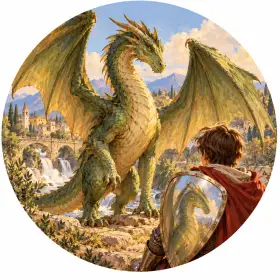
Thyrus is the green winged dragon on the coat of arms of Terni. The legend says it lived in a lair in the woods, attacked the gates of the city when it was hungry and terrified everyone, so much that people no longer left their homes. The council of elders looked for a hero, but many found an excuse not to go. In the end a young knight faced it: a ray of sunlight, reflected by his shiny armour, blinded the dragon, which was defeated. The dragon, scholars say, stands for the unhealthy marshes that were drained so the city could grow.
Did you know? In Terni the dragon is everywhere: on flags, on banners and carved on the lintels of doors and windows.
Sources: Exploring Umbria, «La leggenda di Thyrus, il drago di Terni»; Fonte Cesia, «La leggenda del drago di Terni»
Agilla and Trasimeno
the legend of Lake Trasimeno · Umbria
Trasimeno was a prince, son of the Etruscan king Tyrrhenus. One day he reached the shores of a great lake with his father, and the nymph who lived there, Agilla, fell in love with him and drew him in with her song. They married, but the day after the wedding the prince went swimming and vanished among the waves. Agilla searched for him day after day until, exhausted, she died. People say that on summer evenings the wind in the branches and the waves is still her voice calling him. The lake is said to have taken his name.
Did you know? Trasimeno is the largest lake in central Italy, but it is very shallow: in only a few spots is it deeper than six metres.
Sources: Il Giornale, «Lago Trasimeno, la leggenda della ninfa e del principe»; Fonte Cesia, «La leggenda della ninfa Agilla e del principe Trasimeno»
The Wolf of Gubbio
“brother wolf” · Umbria
A big, hungry wolf was frightening the people of Gubbio, who no longer dared to leave the city walls. Saint Francis went to meet it alone, called it “brother wolf” and spoke to it calmly. They made a pact: the town would feed the wolf every day, and it would never hurt anyone again. The wolf, the story says, placed its paw in the saint's hand to promise. It lived in town for two more years, going from door to door, and when it died everyone mourned it.
Did you know? The story of the wolf was written more than a hundred years after Saint Francis died, in the “Little Flowers”: it is not in his earliest biographies.
Sources: Anonimo, «I Fioretti di San Francesco», capitolo XXI (XIV secolo); Avvenire, «Gubbio, sulle orme di Frate Lupo»
The God Clitumnus and the White Oxen
Clitumnus, in Latin · Umbria
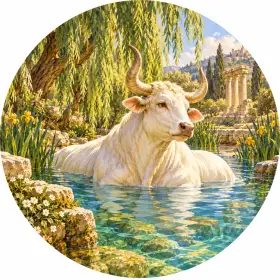
The springs of the Clitunno are a pool of crystal-clear water among willow trees. For the ancient Umbrians and for the Romans the river was a god, Clitumnus, who gave answers to those who consulted him. The poet Virgil recalls the white flocks and the bull that, bathed in his sacred river, led the Romans' triumphs to the temples. The writer Pliny the Younger, in a letter, described the springs, the god's temple and many little shrines around it.
Did you know? Nearby stands the Tempietto del Clitunno, a small church built like an ancient temple, a UNESCO World Heritage Site since 2011.
Sources: Virgilio, «Georgiche», libro II; Plinio il Giovane, «Lettere», libro VIII, 8
Nera and Velino, the Cascata delle Marmore
the nymph Nera and the shepherd Velino · Umbria
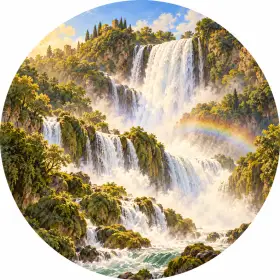
The nymph Nera fell in love with a shepherd, Velino. But the goddess Juno did not want that love, and to part them she turned Nera into a river flowing at the bottom of the valley. Velino, desperate because he thought she had drowned, leapt from the cliff to reach her. In one version Jupiter, moved, turned him into water too: so the Velino falls for ever into the arms of the Nera, and the waterfall was born. The real story is different: the falls, the Cascata delle Marmore, were made by the Romans, with a canal that carries the Velino to the edge of the cliff.
Did you know? In 271 BC the consul Manius Curius Dentatus had the Cavo Curiano dug, a canal that drained the still waters of Lake Velino down the cliff: that is how the falls were born. Since 1929 the same water has driven the Galleto power plant.
Sources: Regione Umbria, Umbriatourism, «La Cascata delle Marmore»; Virgilio Sapere (sito di divulgazione), «Perché fu costruita la Cascata delle Marmore»