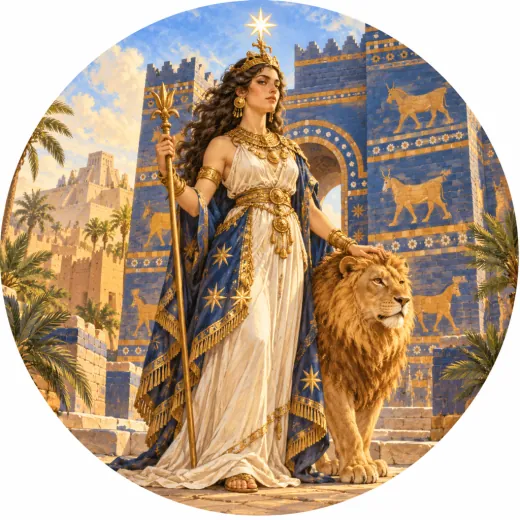
Inanna (Ishtar)
Inanna in Sumerian, Ishtar in Akkadian
a little scary
Inanna, whom the Babylonians called Ishtar, was the goddess of love, of war and of the morning and evening star. Her most famous myth is her descent into the underworld: to enter the realm of her sister Ereshkigal she had to pass through seven gates, and at each gate a jewel or a garment was taken from her, until she arrived with nothing at all. Ereshkigal fixed her with the eye of death and left her a prisoner, hanging from a hook like a corpse. Only with the help of the god Enki was she able to return, but she had to leave someone in her place.
Did you know? The magnificent Ishtar Gate of Babylon, covered in blue bricks with dragons and bulls, now stands in a museum in Berlin.
The story
Inanna, Queen of Heaven, had everything. And she wanted more.
She had a city, Uruk, and a great temple, and a crown. But one night she turned her gaze downwards, towards the kingdom that lay beneath the earth, where her sister Ereshkigal ruled. It was the place from which no one came back. And yet Inanna decided to go there.
She called her trusted minister, Ninshubur, and gave her orders.
“If I have not come back in three days and three nights, go into mourning for me. Beat the drum among the ruins, tear your clothes, scratch your face. Go to the temple of Enlil, the father of the gods, and beg for his help. If he refuses, go to Nanna. If he refuses too, go to Enki, the god of water and of cunning. He knows how to bring back those who cannot come back.”
Then she put on all the most beautiful things she owned. The tall crown on her head. The lapis lazuli beads at her throat. The double necklace. The breastplate. The gold ring on her finger. The lapis lazuli rod. And over everything, the royal robe.
She went down. With every step the light grew lower and the air grew colder.
She came to the first gate and knocked.
“Who is there?” asked a voice. It was Neti, the gatekeeper.
“I am Inanna, Queen of Heaven.”
“And what are you looking for, Queen of Heaven, in the land from which no one returns?”
“I have come for the funeral of my brother-in-law, the Bull of Heaven.” It was an excuse, and perhaps Ereshkigal knew it.
Neti went to his mistress. “There is a woman at your gates, and she brings all the light of the sky with her.”
Ereshkigal bit her lip and turned pale, but she said, “Let her in. But at every gate, strip something from her. That is the law of the world below.”
The gatekeeper came back and opened the first gate. He said, “Come in, Inanna. But leave your crown here.”
“Why?”
“Quiet, Inanna. The laws of the world below are perfect. They are not to be questioned.”
Inanna took off her crown and left it on the threshold.
She passed through the second gate. They took her lapis lazuli beads. At the third, the double necklace. At the fourth, the breastplate. At the fifth, the gold ring. At the sixth, the lapis lazuli rod. At every gate Inanna asked why, and at every gate the answer was the same: “Quiet, Inanna. The laws of the world below are not to be questioned.”
At the seventh gate they took her robe.
Inanna walked into the throne room with nothing. She was alone, with nothing left of all that had made her a queen, and the silence was so deep she could hear the sound of her own breathing.
On the throne sat Ereshkigal. Around her knelt the seven judges of the Underworld, the Anunna. Ereshkigal raised her eyes.
It was the eye of death. Inanna felt it on her face like a blast of icy wind. Her legs gave way. Her voice died in her throat. Her body went limp, turned grey, and fell to the ground like an empty sack.
The Anunna lifted it up and hung it on a hook in the wall, like a cloth.
Up in the world above, the three days and three nights went by.
Ninshubur, the faithful, did everything she had been told. She beat the drum among the ruins and went into mourning. She went to the temple of Enlil, who would not listen: “She wanted the world below, and the world below is keeping her.” She went to Nanna, who gave her the same answer.
She went to Enki.
Enki listened in silence. Then he did something no other god would have done. He scraped a little dirt from under his fingernails, and from it he made two tiny beings, neither male nor female, who needed nothing at all. To one he gave the food of life, and to the other the water of life.
“Go down to the world below,” he said. “Slip through the gates like flies. When you find the queen, you will see her in pain: she is groaning like a woman giving birth. Groan with her. Say: Ah, your heart! If she thanks you and offers you a gift, take nothing. Ask for the body hanging on the hook.”
So they did. Ereshkigal was groaning in the dark: “Ah, my belly! Ah, my heart!” The two beings answered in the same voice: “Ah, your belly! Ah, your heart!” No one had ever listened to her like that before, and the queen felt understood.
“Who are you?” she asked. “I will give you whatever you want: the water of the river, the grain of the fields.”
“We don't want the water or the grain,” they said. “We want the body that is hanging there.”
Ereshkigal hesitated for a long moment. Then she agreed.
They sprinkled the food and the water of life on the corpse, and Inanna opened her eyes.
But there was a rule. No one comes back up from the world below without leaving someone else in their place. So, as Inanna climbed back through the seven gates, taking back her ornaments at each one, a band of demons, the galla, followed one step behind her, grey and silent, ready to drag down whoever she pointed to.
They came to her house, and the first person they met was Ninshubur, dressed in rags, lying face down on the ground. The galla said, “We'll take her.”
“No!” said Inanna. “She did everything for me. I will not give her up.”
Next they met Shara and Lulal, two more gods dressed in mourning, and again Inanna refused.
At last they came to her garden, in Uruk. Under a tree, sitting on a throne and dressed in splendid clothes, was her husband, Dumuzi. He was not weeping. He was not in mourning. He was laughing and drinking, as if nothing had happened.
Inanna looked at him.
It was the same look as Ereshkigal's.
“Take him,” she said.
Dumuzi screamed, ran, begged the sun god to change his shape, and managed to escape for a while. But the galla found him again. And Inanna, as she watched him being taken away, felt something she had never felt before: a pain that came from somewhere she did not know.
The copies of the poem are damaged, and the last part is hard to read. But it seems that, at this point, Dumuzi's sister Geshtinanna offered to take his place for half of the year. So he would go down below for one part of the year, and for the other part come back up to breathe.
That is how the poem ends: with a gate that opens one way and closes the other, and with a goddess who has learned, at a high price, that in the kingdom of the dead even the sky must leave something behind.
Relatives around the world
Listen / Read next
- Music to read by: Cinematic JourneyEpic film-style music, no lyrics, by Ciro Simone IrmiciSpotifyYouTube Music
Sources
- The Descent of Inanna into the Underworld (Sumerian text, early 2nd millennium BC)
