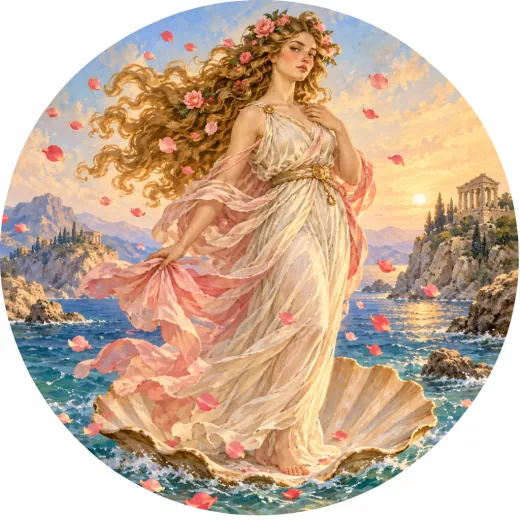
Aphrodite
Aphrodítē, in Ancient Greek
not scary at all
Aphrodite is the goddess of love and beauty. According to the poet Hesiod she was born from the foam of the sea and came ashore on the island of Cyprus; according to Homer, instead, she was a daughter of Zeus. According to Hesiod, grass grew beneath her feet. In a way, she was the cause of the Trojan War: according to later authors, to win a beauty contest she promised Prince Paris the most beautiful woman in the world, Helen, who was already married to the king of Sparta. The Romans called her Venus.
Did you know? many centuries later, the painter Botticelli showed her in “The Birth of Venus”, in the Uffizi in Florence, arriving over the sea standing on a shell.
The story
Before she even had a name, Aphrodite was foam.
Hesiod tells the story. When Cronus took power from his father Uranus, what was left of that god fell into the sea, and for a long time the waves carried it this way and that. A white foam formed around it, and out of the foam a girl was born.
First she touched Cythera, then she came to Cyprus. Wherever she walked, under her light feet, grass grew. The gods called her Aphrodite, “born from the foam”, and Eros, love, and Desire followed her. Her share was the whispers of girls, smiles, tricks, sweet delight and tenderness.
Homer, on the other hand, says she was the daughter of Zeus and the goddess Dione. A goddess with two births: perhaps that is why she can never keep still.
With her around, a war is never just a war. At Troy, for example.
Ten years of siege. One day it is decided to end everything with a duel: Menelaus, Helen's husband, against Paris, the Trojan prince who had carried her off. It is said that Aphrodite had promised him the most beautiful woman in the world, but Homer does not tell that part here.
The duel went badly for Paris. Menelaus grabbed him by the helmet and dragged him towards the Greeks, and the strap under his chin was choking him. Paris was about to suffocate.
Then the strap snapped. The empty helmet stayed in Menelaus's hand. Aphrodite, for whom it was all a game, had snatched Paris away in a cloud of mist and set him down in his perfumed bedroom.
Then she went to find Helen. She found her high up on the walls among the Trojan women, gazing at the plain, not knowing whether to hope for victory or defeat. From there she had seen everything, the duel and the mist.
Aphrodite had disguised herself as an old woman who spun wool, someone Helen had known back in Sparta. She tugged at the hem of Helen's dress. “Come, Paris is calling you. He's at home, on his bed, looking handsome in his fine clothes. You'd think he was coming back from a dance, not a duel.”
Helen felt her heart stir. Then she looked more closely at the old woman: she recognised the neck, the breast, the shining eyes.
“What do you want from me?” she said. “Do you want to carry me even further away? Menelaus has won, and he will take me home. You go to Paris. Sit beside him, forget about the sky, and fuss over him until he makes you his wife, or his slave. I'm not going. It would be shameful, and the women of Troy would despise me. I have enough sorrows already.”
Aphrodite grew angry. “Don't make me cross, you stubborn girl. I can abandon you, and hate you as much as I have loved you until now, and stir up a terrible hatred between Trojans and Greeks. And you will die a miserable death.”
Helen was afraid. She wrapped herself in her white veil and followed in silence, without any of the women noticing. In the room the goddess, smiling, brought her a chair and set it opposite Paris. Helen sat down and looked away.
“You've come back from the battle,” she said. “I wish you had died out there.”
“Don't scold me,” Paris replied. “Today Menelaus won with Athena's help. Another time I'll win. Come to bed, and enough of war. I have never wanted anyone the way I do now.”
Meanwhile, on the battlefield, Menelaus was prowling up and down like a wild beast, looking for Paris. No one could find him. And anyway, says Homer, everyone hated him like death, and nobody would have hidden him.
Later, in the battle, the goddess found herself in more serious trouble.
The Greek Diomedes had wounded the Trojan Aeneas, the son Aphrodite loved more than anyone. The goddess wrapped him in her white arms and in a fold of her robe to carry him away. Diomedes saw her. Athena herself had told him that day that he must not raise his spear against the other gods, but that if he saw Aphrodite in the battle he could wound her. He knew she was not a warrior goddess like Athena. He ran, and with his spear he grazed the palm of her hand, through the robe the Graces had woven.
From the cut came a clear, shining liquid. It was not blood: the gods eat no bread and drink no wine, and so they have no blood like ours, and they are immortal. It is called ichor.
Aphrodite screamed and dropped her son. Apollo caught him and wrapped him in a dark cloud.
“Get out of the war, daughter of Zeus!” shouted Diomedes. “Isn't it enough for you to fool weak women? If you come back to battle, you'll shudder just to hear its name.”
The goddess was moaning, and her skin had darkened. Iris took her by the hand and led her out of the fighting, to the left, where Ares was sitting with his chariot. Aphrodite fell to her knees. “Brother, give me your horses. I want to go back to Olympus. A mortal has wounded me, Diomedes, who would fight even against Zeus.”
Ares gave them to her. On Olympus Aphrodite fell into the arms of her mother Dione. “Who has done this to you?” her mother asked. “As if you had done something wicked in front of everyone.” Aphrodite told her about Diomedes. “Bear it, my child, even though it hurts,” said Dione. “Many of us on Olympus have suffered because of mortals.” Then, with both hands, she wiped the ichor from her wrist, and the wound closed, and the pain went away.
Athena and Hera, on the other side, were watching her and giggling. “Father Zeus,” said Athena, “Aphrodite has been persuading some Greek woman to run off with the Trojans, and while she was stroking her, she scratched her hand on a golden pin.”
Zeus smiled. He called Aphrodite to him.
“My child,” he said, “the work of war is not for you. Think about the lovely work of weddings. Let swift Ares and Athena take care of war.”
Aphrodite did not answer. She sat down again beside her mother, with her hand healed, and for that day the war was none of her business.
Relatives around the world
Listen / Read next
- Music to read by: Cinematic JourneyEpic film-style music, no lyrics, by Ciro Simone IrmiciSpotifyYouTube Music
Sources
- Hesiod, Theogony
- Homer, Iliad, Books III and V
