Enkidu
Enkidu, in Akkadian
not scary at all
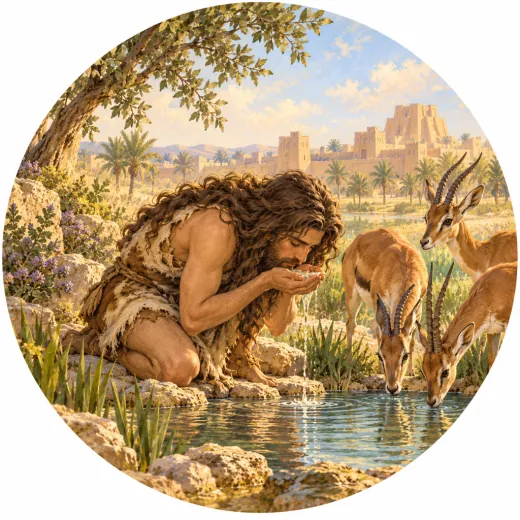
Enkidu was shaped by the gods out of clay and left in the steppe. He was covered in hair, ran with the gazelles, drank with them at the waterholes and freed animals from the hunters' traps. When he came to the city and learned to eat bread and dress like other people, he challenged Gilgamesh to a furious wrestling match. Neither of them won: in the end they embraced and became inseparable friends. His death is the saddest moment in the whole epic.
Did you know? The friendship between Gilgamesh and Enkidu is considered one of the oldest friendship stories ever written.
The story
The gods made him from a lump of clay, because in Uruk somebody had to stop a king.
The king's name was Gilgamesh. He was two-thirds god and one-third man, and nobody in the city was as strong as he was. That was exactly the problem: he was never tired enough to stop. He worked the young men until they dropped. He always wanted a challenge, a contest, a race. The mothers and fathers of Uruk, worn out, complained to the heavens.
The gods listened. And the goddess Aruru, who had made human beings, washed her hands, pinched off a little clay, threw it down on the faraway steppe, and Enkidu was born.
He was tall, and covered all over in hair, like the animals. His hair hung down to his shoulders, long as ears of wheat. He knew nothing of cities, of bread, of clothes. He ate grass with the gazelles. He drank with them at the waterhole when the sun came up, and when the gazelles moved on he ran beside them, the wind in his face. For him, that was the whole world: grass, water, sun, and the animals that were not afraid of him.
There was also a hunter on the steppe, and the hunter had a problem.
Every morning he went to check his traps, dug with great effort into the hard ground, and every morning he found them filled in with stones. His nets were torn. The gazelles were free. At last, one evening, hidden behind a bush, he saw who had done it: a huge man, covered in hair, moving among the animals as if he were one of them.
The hunter went home pale. His father listened to him, and said, “Go to Uruk. Ask Gilgamesh for a woman of the temple, Shamhat. When the wild man comes to the waterhole, she will see him. And the animals will leave him.”
And so it was. Shamhat went to the waterhole, sat down and waited. When Enkidu came, she didn't run away, and she didn't scream. She spoke to him. The text says they stayed together for six days and seven nights.
At the end of that time, Enkidu got up to go back to the gazelles.
The gazelles saw him, and ran away.
He chased after them, but his legs no longer obeyed him the way they used to. He stopped, panting, with a strange heaviness in his chest. He had lost his speed. But in exchange his mind had opened like a window: now he understood words, he understood thoughts, he even understood silences.
He went back to Shamhat, and she said to him, “You are wise, Enkidu. You are like a god. Why do you roam the steppe with the animals? Come with me to Uruk, the city of strong walls, where Gilgamesh lives.”
She dressed him in a cloak. She gave him bread to eat, and he stared at it without knowing what it was. She gave him beer to drink, and he drank seven cups, and began to sing, and his heart grew light. He washed, he rubbed himself with oil, and out of all that hair stepped a man.
They set off towards the city.
Meanwhile, in Uruk, Gilgamesh had had two dreams. In one, a star fell from the sky, heavy as a boulder, and he could not lift it. In the other there was an axe, and the people of the city crowded around it. His mother, the goddess Ninsun, listened and said, “A strong companion is coming. You will love him like a brother, and he will never leave you.”
It was a feast day in the city. Gilgamesh was on his way to the house where a wedding was being celebrated, and in front of the door stood a man blocking his way, with his foot planted against the doorpost.
Gilgamesh stopped. The two of them looked at each other.
Then they hurled themselves at each other.
The door gave way. The walls shook. The beams creaked, and dust fell from the ceiling. They wrestled like two bulls, gripping each other's necks, slamming into each other's sides, and the people of Uruk, gathered in the street, did not dare to speak. Neither of them gave way. Neither of them won.
At a certain point Gilgamesh dropped to one knee and stopped. The anger passed from his face like a cloud. He looked at this man, covered in dust, his hair still full of the steppe, and he saw that the man was like him.
“You are strong,” he said. “Like no one else.”
And they embraced. That was the moment a friendship was born which the storytellers of Babylon never stopped telling.
Together they travelled to the Cedar Forest, where the monster Humbaba lived. Enkidu knew that forest from the days when he ran with the gazelles, and he tried to persuade his friend not to go. It was Gilgamesh who gave him courage, and then, at the worst moment, it was Enkidu who gave courage to him. Together they defeated the guardian. Together they killed the Bull of Heaven, sent against them by an offended goddess. They were brothers. The king and the man of clay.
But when the gods saw what they had done, they met in council. And they said: one of the two must die.
They chose Enkidu.
He fell ill. First he cursed everything that had given him his life as a man: the door, the hunter, even Shamhat. Then the sun god spoke to him from the sky, and reminded him who had given him bread and beer, clothes, and a brother. Enkidu understood, and he blessed her.
In a dream he saw the place where the dead go, the House of Dust, which no one ever leaves, where people eat clay and walk in darkness, dressed like birds. He told Gilgamesh about it in a voice that grew fainter and fainter.
“I'm afraid,” he said. “It's not like dying in battle.”
Gilgamesh held his hand.
For twelve days the illness lasted. Then Enkidu spoke no more.
Gilgamesh called his name. He called it again, and again, and again. He covered him with a veil, the way a bride is veiled. He stayed beside him for six days and seven nights, and would not let him be buried. He wept, and he wept like a king, without shame.
He said, “I'm afraid too.”
And far away, the steppe did not answer.
Relatives around the world
In real history
Listen / Read next
- Music to read by: Cinematic JourneyEpic film-style music, no lyrics, by Ciro Simone IrmiciSpotifyYouTube Music
Sources
- Epic of Gilgamesh, Tablets I–II and VII
