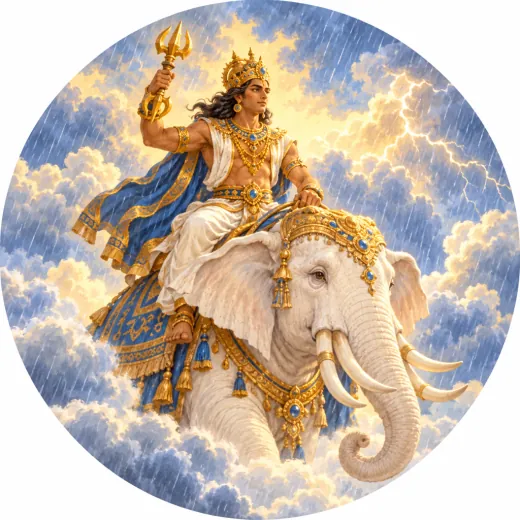
Indra
Indra, in Sanskrit
a little scary
Indra was the king of the gods in the Vedas, the oldest texts of India. He is the deity of thunder, storms and rain, and he wields the vajra, a weapon that is both a thunderbolt and a diamond. The most famous hymn to him tells of his victory over Vritra, an enormous serpent that had imprisoned the waters of the world: Indra defeated it and the rivers flowed to the sea once more. He rides a white elephant with many trunks, Airavata.
Did you know? The Rigveda, the oldest of the Vedas, contains about 250 hymns dedicated to Indra: more than to any other deity.
The story
Before there were rivers, say the poets of the Vedas, the world was thirsty.
The Vedas are the oldest texts of India. For centuries they were songs learnt by heart and chanted at dawn, in front of the fire, long before anyone thought of writing them down. One of the best-loved hymns begins like a solemn announcement: the poet says he will tell of the first great deeds of Indra, the lord of the thunderbolt.
Picture that world. The earth is dry and cracked. Animals look for a well and cannot find one. The sky is high, white and still, and not a single cloud comes down. And yet the water exists. It is up there, among the mountains, hidden like a treasure. It just cannot get out.
On that mountain, stretched out like a wall, lies Vritra.
He is an enormous serpent. His name means "the one who shuts in", and shutting things in is his job. He has coiled himself around the waters and keeps them prisoner, like a thief who locks cows in a barn that is not his. From inside the mountain comes a dull noise, a lowing: it is the rivers, wanting to run and unable to. The serpent has no hands and no feet, but he does not need them. His weight is enough.
The gods watch from far away. Nobody dares go near. Further down, in the valleys, people look up at the mountain every morning and every evening, and every morning and every evening the sky is the same as the day before. The herds grow thin. Children learn not to ask for a drink.
Then Indra steps forward.
Indra is the king of the gods, the lord of thunder and storm. The verses compare him to a bull: fierce, sure of himself. But even he needs something for this task. He needs a weapon.
Tvashtar, the divine craftsman, sees to it. In his forge, among sparks that look like stars, he makes him the vajra, which is both thunderbolt and diamond: a light that cuts and a hardness that never breaks. Indra takes it in his hand. Then he drinks the soma, the sacred drink that gives the gods their strength. He drinks three cups of it, one after another, and the poet records this carefully, the way you remember a ritual that has to be done right.
Then he climbs towards the mountain. The path is steep, the rock is scorching, and with every step the air grows heavier, as it does before a storm that has not yet made up its mind to break. Indra does not slow down. Behind him, far off, the other gods hold their breath.
The serpent sees him coming and does not move. He waits. Vritra is not only huge: he is cunning. The hymns speak of his spells, of the mist he spreads around himself, of the lightning, the thunder and the hail he hurls at his enemy. They all look like weapons of the sky, but against the true lord of the sky they are useless. The mist tears apart, the hail bounces off, the lightning fades before it arrives.
Vritra challenges Indra, with no hands and no feet, like a warrior who thinks he is stronger than he is. And Indra hurls the vajra.
The blow lands on the back of the serpent's neck. The crash fills the valley and rises up to the clouds, and the poets do not even try to describe it, because for a sound like that words are not enough. The monster's body breaks and tumbles down the mountain like a tree trunk felled by an axe. It lies stretched on the ground, motionless, and its coils hold nothing any more.
Beside him lies his mother, Danu, like a cow beside her calf. Perhaps she tried to protect him. It was not enough.
And then the thing the world had been waiting for happens.
First there is a dripping, in the cave where the water was shut away. Then a gurgling. Then a roar. The rock splits open, and the waters burst out all together, and run down towards the plain like cows finally coming home, lowing, one behind the other, never stopping. They are the rivers, the verses say, and they run straight to the ocean. They pass over the serpent's body and carry it away, down, into a long, nameless darkness.
Where there was thirst, there is now a steady sound: running water. In the valleys people come out of their houses without understanding, then they understand, and they stand still with their feet in the mud, staring. The herds race down to the bank. Somebody starts laughing, somebody starts singing.
The hymn says something else, too. After his victory, Indra brings forth the sun, the sky and the dawn. As if that prison had locked away not just the rivers, but the light as well. And no enemy, the poet adds, was left standing before him.
That would be a fine ending. But the Vedic poets, who knew the gods well, do not stop there.
With a question that sounds as if it came from a conversation, they turn to Indra. Whom did you see, they ask him, ready to avenge the serpent? For after the battle fear entered your heart, and you, like a frightened falcon, crossed ninety-nine rivers.
The hymn gives no answer. Perhaps the poet did not know either. All that is left is the image of the strongest god in the sky who, with the victory won, looks behind him and flees across the water.
Then, though, the verses return to their earlier tone, steady and solemn. Indra is king of everything that moves and everything that stands still, of tame animals and of horned ones. He rules over people the way the rim of a wheel holds its spokes together.
Perhaps that is also why the Rigveda dedicates so many hymns to him, more than to any other god: the rain that comes, every year, looks a little like that victory. First the sky turns black and still. Then you hear the rumble. Then the earth drinks.
And the water, with no one left to hold it back, runs down to the sea.
A living tradition, told with respect: how we tell myths.
Relatives around the world
In the trails
Listen / Read next
- Music to read by: Cinematic JourneyEpic film-style music, no lyrics, by Ciro Simone IrmiciSpotifyYouTube Music
Sources
- Rigveda, hymn 1.32
