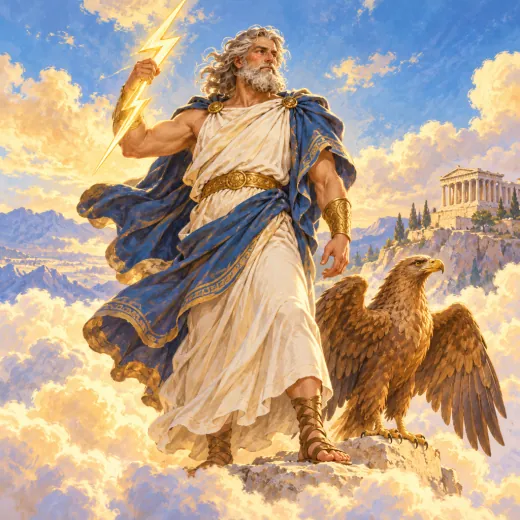
Zeus
Zeús, in Ancient Greek
a little scary
Zeus is the king of the gods of Olympus and the lord of the sky, the clouds and the thunderbolt. His father Cronus swallowed his children as soon as they were born, afraid of losing his throne; their mother Rhea saved little Zeus by hiding him in a cave on Crete and giving Cronus a stone wrapped in a blanket. When he grew up, Zeus freed his brothers and sisters and together they defeated the Titans. Then the brothers shared out the world: Zeus took the sky, Poseidon the sea, and Hades the kingdom of the dead.
Did you know? The ancient Olympic Games were held at Olympia in honour of Zeus: it was a very old custom of the Greeks.
The story
In the beginning, the sky belonged to no one.
There were gods before the gods we know. They were called the Titans: ancient giants, strong as mountains, and the most terrible of them all was Cronus. He was the one who ruled the world. And he was afraid of only one thing.
It had been foretold that one day one of his children would drive him from the throne.
Cronus had a wife, Rhea, and she gave birth to a child. The father took it without a word and swallowed it. He did the same with all the others. One after another, the children vanished down his throat, and Rhea was left alone, with empty arms.
Five times she watched him do it. When the sixth child was on the way, Rhea decided it would not happen again.
She went to her parents, Gaia, the Earth, and Uranus, the Sky, told them she was expecting another child and asked for help. Gaia and Uranus listened, and sent her to Crete, a faraway island, to a place where Cronus would never look for her.
Rhea arrived at night. She walked to a mountain, where a cave lay hidden in the rock, dark and deep, and there, in the dark, she gave birth to her baby. She wrapped him in swaddling clothes. She looked at him for a long time. She named him Zeus.
Then she went back to Cronus carrying a bundle of cloth.
“Here is your son,” she said.
Cronus took it. He did not look. He unwrapped it, and inside was a large stone. He did not even notice it in his mouth: he swallowed it like the others, without realising, and declared himself satisfied. Rhea stood perfectly still, her heart in her throat.
Meanwhile, in the cave, the little one was growing.
He grew fast, because gods are in a hurry to grow up. After one year he was strong; after another, he already knew everything. Nobody on earth knew his name. Now and then Rhea raised her eyes towards Crete and said nothing. Nobody knew that inside a mountain on Crete there was a boy, waiting.
When he was grown, he came back.
Gaia gave him some advice, and he followed it. He came before Cronus with a drink, and Cronus drank it without suspicion. At once the Titan doubled over. Out of his throat came first the stone, and then, one after another, the children he had swallowed, alive and whole, as if not a single day had passed. They were Hestia, Demeter, Hera, Hades and Poseidon.
Zeus took the stone, the one his father had mistaken for a son, and set it in the ground below the slopes of Mount Parnassus, at Pytho, so that people would look at it and marvel. Then he turned to his brothers and sisters. They were tall, strong and confused. They had spent all that time in the dark, inside their father's belly. They hugged one another.
That was the day the family of Olympus was born.
Cronus would not accept it. He gathered the Titans, and his children called their own allies. One side took Mount Othrys; the other climbed Olympus, the highest mountain of all. And for ten years the earth shook.
It was a war with no winner. Every day they fought, every night they went back to their peaks to count the wounded, and nothing changed. The Titans were too strong.
At that point, Zeus understood that he had to look for help elsewhere.
He went down into the depths of the earth, to a dark place where his father had imprisoned other beings: the Cyclopes, one-eyed smiths, and the Hundred-Handers, giants with a hundred arms. He set them free. He gave them divine food and drink, and when they were strong again, he said, “Are you with me, or with them?”
The Cyclopes answered with a gift. They gave him thunder, and lightning, and the thunderbolt.
That was when Olympus changed. Zeus climbed to the summit, and when he raised his arm the sky turned black, and the crash of his weapons echoed from one end of the world to the other. The Hundred-Handers hurled masses of rock, three hundred at a time, and the Titans were buried under the boulders. Thunderbolts flew everywhere, with a roar that made the sea tremble. The earth burned. The air glowed with heat. Smoke rose all the way to the stars.
For a long moment after the last thunderclap, there was no sound at all. Then, little by little, a bird began to sing again, and the sea began to move.
When it was all over, the Titans lay in chains in the depths, beneath the earth and beneath the sea, in a place called Tartarus. Silence fell over the world. Up on Olympus, the three brothers looked at one another.
The other gods, who had fought beside him, gathered and said to him, “You be our king. Rule over us, and give each of us the place we deserve.” Zeus accepted. It was not an easy choice: whoever rules has to decide for everyone.
Zeus, Poseidon, Hades. Now there was a world to divide.
Homer tells us the gods did it fairly. Each of them drew his lot. Poseidon got the grey sea, Hades the darkness without light, and Zeus the sky, with the clouds and the thunderbolt. The earth and Olympus were shared by all. The draw was accepted. But Poseidon, long afterwards, reminded Zeus that they were brothers with equal rights, and that each of them should keep to his own share.
From then on, Zeus was king. Not because he was the strongest, but because, when it mattered, he had known how to wait. For years, in a cave on Crete, there had been a child nobody was looking for. His victory began there.
Over time, people held great festivals in his honour: in the valley of Olympia, every four years, athletes from all over Greece gathered to run, wrestle and compete for him. During those days, it was said, weapons stayed hanging on the walls and wars came to a stop. It was a way of remembering that the king of the gods did not love endless war, he who had won such a long one.
And even today, when the summer sky grows heavy and the first thunder rolls over the hills, the old folk smile and say, “Zeus is coming back.”
Relatives around the world
In the trails
In real history
Listen / Read next
- Music to read by: Cinematic JourneyEpic film-style music, no lyrics, by Ciro Simone IrmiciSpotifyYouTube Music
Sources
- Hesiod, Theogony (8th–7th century BC)
- Homer, Iliad
