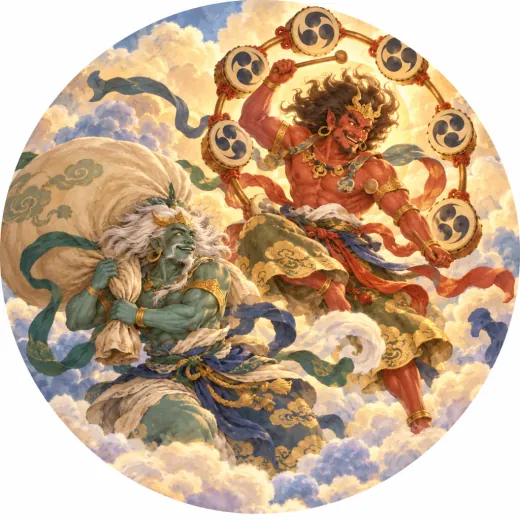
Raijin and Fūjin
雷神 and 風神, god of thunder and god of wind
a little scary
Raijin is the deity of thunder: he looks wild and plays a ring of drums that he carries on his back. When he beats the drums, thunder is born. His inseparable companion is Fūjin, the deity of the wind, who carries a large bag full of winds on his shoulders and opens it to unleash storms. The two are often shown together, on either side of temple gates, as guardians. A popular tradition told children to cover their tummies during thunderstorms.
Did you know? The folding screen “Fūjin and Raijin” by the painter Tawaraya Sōtatsu, from the seventeenth century, is a National Treasure of Japan and is kept in Kyoto.
The story
When the sky turns black over Japan, grandmothers tell children to cover their tummies.
“Why?” asks the little boy.
“Because Raijin is on his way.”
Outside, the daylight had gone out in a few minutes. Down in the street someone was running to bring in the washing, and in the houses the dogs had started barking. The air was still and heavy, and smelt of warm earth. The cicadas had all stopped singing at once. From the mountains, far away, came a dull boom, like a drumbeat inside a cave.
“There,” said Grandmother. “Cover it.”
The boy pulled his T-shirt right up to his chin, then thought better of it and pulled it back down over his tummy, then put his hands on top as well. Grandmother smiled and lit a lamp.
“Let me tell you who he is.”
Raijin is the god of thunder. He does not look like a calm, gentle lord: his skin is a colour no human has ever had, his hair stands on end, his eyes flash, and he has fangs and claw-like fingers. All around him, hanging in a ring behind his shoulders, are his drums. He beats them with two sticks, one after another, and every beat is a thunderclap. When he gets angry he beats lots of them at once, and the rumble makes the windows rattle.
“And the lightning?”
“The lightning is when he smiles.”
The boy could not tell whether that was a joke.
But Raijin never travels alone. With him there is always Fūjin, the god of wind. Fūjin looks wild too, and on his shoulders he carries a great bag, as wide as a sail, bulging with every wind there is. When he opens it, storms rush out. When he closes it, the calm comes back.
The two of them are never apart. That is why, in many temples in Japan, you can see them carved on either side of the entrance, one on the right and one on the left, standing guard. And that is why a great painter, long ago, painted them on a golden folding screen, one on each panel, each in a corner, like two guests eyeing each other from a distance among the clouds. That screen is kept in Kyoto today, and it is a national treasure.
The boy had seen them once, at the entrance to a temple, on a school trip: two enormous statues with fierce faces, one on each side, in the half-light. He had squeezed his mother's hand and refused to look any more.
A tremendous bang made the windows shake. The boy pulled his legs up.
“Are grown-ups scared of them too?” he asked.
“Even emperors,” said Grandmother. “Do you want to hear?”
So she told him about an emperor, a long time ago. He was a powerful man, used to having everything. One day he was told that a god lived on Mount Mimuro, and that this god was an enormous serpent, so big that you needed the courage of a madman just to imagine it.
The emperor smiled.
“I want to see it,” he said. “Who will bring it to me?”
There was a man called Sugaru, one of the strongest at court. He bowed.
“I will try, Your Majesty.”
He climbed the mountain alone, without weapons, and he climbed for a whole day. The path grew narrow, then disappeared. No birds sang any more. The woods grew thick, then silent, then dark, and at a certain point Sugaru smelt wet earth and something very old. Nobody tells clearly what he saw up there. They only say that when he came down he was carrying a big, terribly heavy serpent in his arms, and that he did not dare look it in the eye.
He took it to the palace. He set it down before the emperor.
For a moment, nothing happened.
Then the air changed.
The serpent reared up. A rumble came out of its body that made the floors tremble. Its eyes blazed like lightning, two yellow flashes that shot right across the hall from one side to the other, and thunder boomed under the roof.
The emperor, who had not even purified himself properly before meeting a god, covered his face with his hands. He did not look. He did not dare breathe. On legs that could barely hold him, he ran into the inner rooms of the palace and hid, while outside the hall filled with light and noise.
“Take it back to the mountain,” he shouted from behind the door. “At once!”
They took it back. The serpent returned among the trees, and little by little the noise died away. And the emperor, when he managed to find his voice again, gave that hill a name that meant “thunder”: Ikazuchi.
“And then?” asked the boy.
“Then nothing. When something thunders, you don't go and fetch it out of curiosity. You let it pass.”
Grandmother put out the lamp. Outside, the rain began drumming on the roof, first in big drops, then in torrents, like a thousand fingers on wood. The wind whistled around the house. They could hear the trees bending, and something rolling down the street.
The boy sat perfectly still, his hands on his tummy. A thunderclap, close, very close, made the whole room shake.
“Is that them?”
“That's them.”
The boy listened to the wind going round and round the walls. Between one whistle and the next, he thought he heard something like a laugh.
“And the bag?” he whispered. “Where does he keep it when there isn't a storm?”
“Up in the sky, where nobody can reach. But every now and then he gives it a little shake, to check the winds are all still in there.”
“And why do they have so much fun?”
“Because they are as old as the sky, and every now and then they feel like playing.”
A long minute went by. Then another. The rain grew lighter. The wind, after one last puff, went back into its bag. There was a single drumbeat, far away, already on the other side of the mountain.
“Have they finished?”
“For this time.”
Grandmother opened the window. The air was cool and smelt of grass. Outside, under the rinsed sky, the cicadas began to sing again.
The boy took his hands off his tummy.
But, just to be safe, he waited a little longer.
A living tradition, told with respect: how we tell myths.
Relatives around the world
In the trails
Listen / Read next
- Music to read by: Cinematic JourneyEpic film-style music, no lyrics, by Ciro Simone IrmiciSpotifyYouTube Music
Sources
- Nihon Shoki (720)
- Tawaraya Sōtatsu, folding screen Fūjin and Raijin (17th century), Kennin-ji, Kyoto
