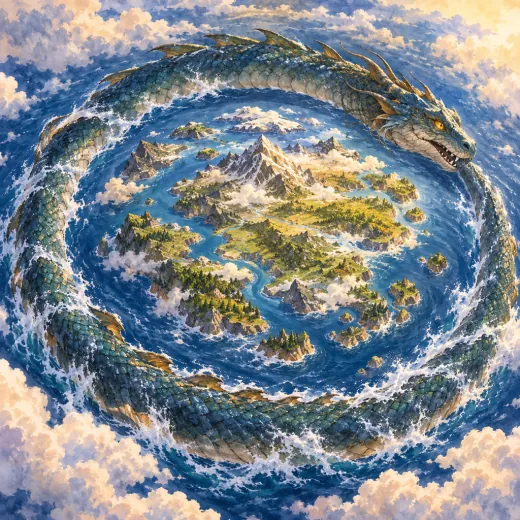
Jörmungandr
the World Serpent
scary
Jörmungandr, another of Loki's children, was thrown by Odin into the ocean that surrounds the world of humans. There it grew so big that it could wrap itself around the whole earth, biting its own tail. Thor met it several times. Once, while fishing with a giant, he used an ox's head as bait and managed to haul the serpent up to the edge of the boat, but the terrified giant cut the line. The two will face each other for the last time at Ragnarök, the end of the world.
Did you know? A serpent biting its own tail is a very ancient symbol, also found in Egypt and Greece: it is called the ouroboros.
The story
Odin had been afraid of him ever since he was small.
He was a serpent, one of the three children Loki had with a giantess. The other two were a wolf and a girl who was half alive and half dead, called Hel. The gods had seen what all three of them would become. Odin seized the serpent and hurled him down from the city of the gods, straight into the sea that surrounds the world of humans.
The sea was so deep it seemed to have no bottom. The serpent fell and fell, and when he stopped falling, he began to grow. He grew in the dark, among blind fish and cold currents, and he grew so much that in the end he was as long as the ocean itself. He could wrap himself around every land there was, and to hold on, he bit his own tail.
His name was Jörmungandr. People also called him the Midgard Serpent.
No mortal had ever seen him. But everyone knew he was there.
Once, the god Thor came to the great hall of the giant Útgarða-Loki, and the giants set him a challenge.
“It's child's play,” they said. “All you have to do is lift our cat.”
The cat was grey, big and calm. Thor put his hands under its belly and lifted. The cat arched its back. Thor lifted higher, and the cat arched higher still, until just one paw came off the floor. That was as far as he got.
Later, the giants told him the truth. That was no cat. It was the Midgard Serpent, brought there in disguise. Thor had lifted him so high that his body had almost touched the sky, and ever since, the giants had been terribly afraid of him.
Thor did not forget.
Another time, disguised as a boy, he came to the house of a giant called Hymir. The giant was a fisherman.
“I'm taking the boat out today,” said Hymir the next morning.
“I'm coming with you,” said Thor.
“You're too small, you'd be no use. Besides, if I row out to the open sea like I usually do, you'll freeze.”
“I'll row.”
“Are you sure?” asked Hymir. “Those waters aren't for everyone.”
“I'll row,” Thor repeated, and the giant stopped arguing.
Hymir snorted. “Then find your own bait. I'm not giving you any.”
Thor went to look in the pastures. He found the biggest ox of all, whose name was Himinhrjótr, and with a single blow he struck off its head. He carried it to the boat. Hymir said nothing. He had stopped snorting.
The boat slid over the water. Thor rowed, and with every stroke the shore grew smaller. Soon they could no longer see the house or the woods. There was only the sea, flat and grey, without a breath of wind.
“Here,” said Hymir at last, stopping. “This is where we usually fish.”
“Further out,” said Thor.
“Further out is the Midgard Serpent.”
“Further out.”
They rowed on. The water changed colour, from grey to dark blue, then to black. A strange silence settled over the boat, as if someone had shut a door. There weren't even any birds.
Hymir stopped talking.
Thor put down the oars. He took a fishing line as strong as a rope and hooked the ox's head onto it. Then he threw it into the sea, and the head sank, and sank, and for a long time nothing happened.
Hymir, bent over the side, held his breath.
Then the line went tight.
Something down there had taken the bait. They both knew it in the same instant, with a shiver that rose up through the bottom of the boat. Thor gripped the line with both hands and pulled.
The serpent pulled the other way. The sea swelled. Thor braced his feet against the bottom of the boat so hard that the wood gave way. His feet smashed through the planks and planted themselves on the seabed below, among the weeds and the stones. Then Thor pulled, and the serpent came up.
He rose out of the dark, slow and stubborn. First the surface of the water rippled. Then, a few steps from the boat, a head as big as a hill broke the surface, covered in dripping scales. Two yellow eyes, without eyelids, stared at Thor.
Thor stared back. He didn't blink.
For a long moment, neither of them moved. A gust of poison came out of the serpent's mouth, and the air turned sharp and bitter, burning their throats. Hymir went as white as sea foam. Water began to pour in through the holes in the bottom of the boat, and even the sound of the waves seemed to him like a voice.
Thor reached for his hammer.
At that moment Hymir, trembling, took out his knife and cut the line.
The serpent sank. For an instant he churned the water, then vanished in a flash of scales. The sea closed over his head as if nothing had happened. Thor hurled his hammer after him, into the deep. Some say it struck him on the head, down there in the dark. But the serpent did not die. Thor waded back to shore, with the water up to his waist, without a word.
The serpent was alive, and waiting.
Because the gods know. On the day Ragnarök comes, the end of the world, the seas will burst their bounds. Jörmungandr will thrash in a giant's rage, and the waves will rise up and flood the land. His coils will rise out of the water and his poison will spread across the sky. Thor will go out to meet him, one last time.
They will fight. Thor will kill him, but after nine steps he will fall too, poisoned by the serpent's breath.
And if anyone, on a dead-calm evening, has ever found themselves in the middle of the sea without a single wave, and felt a slow movement beneath the boat, like something very large turning over in its sleep, perhaps they understood.
The serpent is down there. He bites his tail. And every now and then, slowly, he starts to breathe again.
Relatives around the world
In the trails
Listen / Read next
- Music to read by: Cinematic JourneyEpic film-style music, no lyrics, by Ciro Simone IrmiciSpotifyYouTube Music
- And in our homes: the corn snakeBestiepedia, guides for people who live with a pet
Sources
- Snorri Sturluson, Prose Edda, Gylfaginning
- Poetic Edda, Hymiskviða
