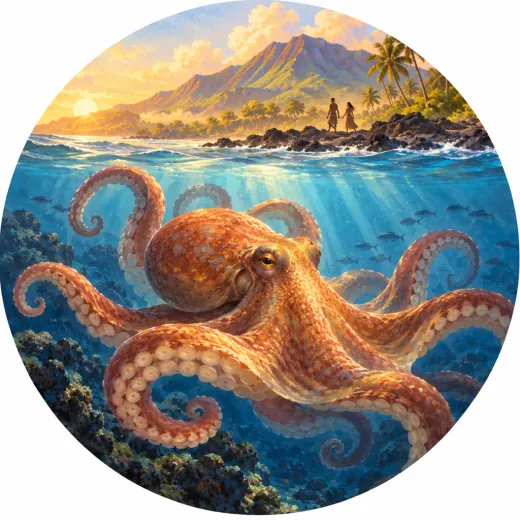
Kanaloa
Kanaloa, in Hawaiian
not scary at all
In Hawaii Kanaloa is one of the four great deities, linked to the deep ocean and to the octopus. In Hawaiian stories he almost always travels together with the god Kāne, and the two are inseparable companions. A well-known story says that, as they walked across the islands, Kanaloa was thirsty: so Kāne struck the rock with his staff and a spring of fresh water gushed out. That is why many places in Hawaii have springs called “the water of Kāne”. Kanaloa also protects those who sail and fish on the open sea.
Did you know? The island of Kahoʻolawe, used for fifty years as a firing range by the US Navy, was returned to Hawaii in 1994 and also bears the ancient name of Kanaloa.
The story
Before he was a god who lives at the bottom of the sea, Kanaloa was a great walker.
That, at least, is what the old Hawaiian stories say. When the islands were still young, with warm earth and smoking volcanoes, there were two companions who travelled them from end to end. One was Kāne, god of light, of the skies, of the fresh water that runs down from the mountains. The other was Kanaloa, who loved the deep ocean and everything that lives in it: the currents, the cuttlefish, the octopuses.
They were very different. Kāne was upright, slow, solemn. Kanaloa talked with his hands, changed mood the way the sea changes colour, and sometimes turned to a stone to pay it a compliment.
And yet they were never apart.
“Why do you always wear that face,” Kanaloa would say, “as if you were about to announce a law?”
“And you,” Kāne would answer, “why do you laugh at everything, even things that aren't funny?”
“Because the sea is big. If you don't laugh, it all seems too much.”
They walked from valley to valley and from beach to beach. Wherever they passed, the land seemed more alive. Along the way they stopped to drink ʻawa, the bitter, calming drink that Hawaiians still use in ceremonies. They drank a bowl each, in silence, watching the waves.
But one day they went far from the sea, into a dry, rocky valley, where the air was still and the sun beat down hard. There was no stream, not even a puddle. Kanaloa's mouth was parched, and the ʻawa he had drunk made him thirstier still.
“Kāne,” he said, “I'm thirsty.”
“I can see that.”
“I have a thirst as big as the whole sea, and the sea is far away. And here there isn't a single drop.”
Kāne looked around. He was in no hurry. He always thought before he acted. He looked at the rock, which blocked the valley like a wall. Then he looked at his staff, a long staff of hard wood.
“Move aside,” he said.
Kanaloa stepped back two paces. Kāne lifted the staff in both hands and struck the rock. Just once. The sound boomed through the valley, and for an instant nothing happened.
Then, from the crack, came a thread of water.
One thread, then two, then a clear stream that gurgled and ran down between the stones, transparent as glass, cool as shade. Kanaloa knelt and drank for a long time, with both hands. When he lifted his face his eyelashes were wet, and he was laughing.
“This,” he said, “is the best thing I have ever drunk.”
“Just as well,” said Kāne, “because it's yours now.”
From that day on, they say, in many parts of the islands there are springs that rise from the rock, and Hawaiians call them the water of Kāne. No one knows how many there are. Almost every valley has its own.
“Stay,” said Kāne, when the thirst had passed and silence had returned to the valley. “There are still many islands to see.”
“We'll see them,” said Kanaloa. “But the sea is calling me, and you have the mountains. I'll leave you the fresh water, and I'll keep the salt. That way, when we meet again, we'll have something to swap.”
Kāne smiled, which for him was a rare thing.
Then Kanaloa went back to the sea. That was where he felt at home. He sank into the dark waters where light never reaches, where creatures move that no one has ever seen. He took the shape of the octopus, which has eight arms, no bones, and can change colour to vanish into a rock. But he never forgot the water of Kāne.
In those years there was a fisherman who went out to sea every night in his canoe.
One evening, many hours from the shore, the sky closed in. The wind swung round all at once. The sea, which until then had been as smooth as a mat, began to rise. The canoe climbed waves as tall as houses and dropped down again. The fisherman lost his course and could no longer see the coast.
He was afraid. But he was a man used to the sea, and he knew that on board, fear is dead weight. He let go of his paddle and did the one thing he remembered from the old people. He took the finest fish he had caught that night, held it up high in both hands and said out loud:
“Kanaloa, lord of the deep water, this is for you. I have lost my way. If you are willing, bring me home.”
And he let it drop into the water.
For a long time nothing happened. The wind kept howling. Then, beneath the canoe, the sea lit up with a strange glow, a pale patch spreading wider, and something enormous rose from the depths. The fisherman saw an eye. A big, round, calm eye, looking at him the way an old acquaintance would.
Then an arm rose out of the water, long, supple, covered in suckers, and wrapped itself gently around the prow of the canoe.
The canoe began to move. Not where the wind was going, but against it. Among the high waves a calm path opened, a tongue of flat water, and the fisherman, clinging to the sides, did not breathe a word.
At dawn he saw the coast. The canoe slid onto the sand of a beach he knew well. When he turned back towards the sea, the arm had gone. There was only a line of foam, which melted away as he watched.
The fisherman washed his face with water from the nearby valley, the water that came out of a rock, cool and fresh. He drank for a long time.
As he drank, they say, he thought he heard laughter far away. A small, satisfied laugh, from someone who has done a good job and needs no thanks.
From that night on, the fisherman never went out to sea without setting aside one fish for Kanaloa. And every time he came back to shore, tired, he stopped at the spring to drink his share.
In the sea and on the land, the two friends still watch each other from afar. One with his staff, the other with eight arms. And the water, fresh and salt, passes from one to the other and never stops.
A living tradition, told with respect: how we tell myths.
Relatives around the world
Listen / Read next
- Music to read by: Cinematic JourneyEpic film-style music, no lyrics, by Ciro Simone IrmiciSpotifyYouTube Music
Sources
- Martha Beckwith, Hawaiian Mythology, Yale University Press (1940)
- Kahoʻolawe Island Reserve Commission, Kahoʻolawe
