Tiki
Tiki, in Māori; Kiʻi, in Hawaiian
not scary at all
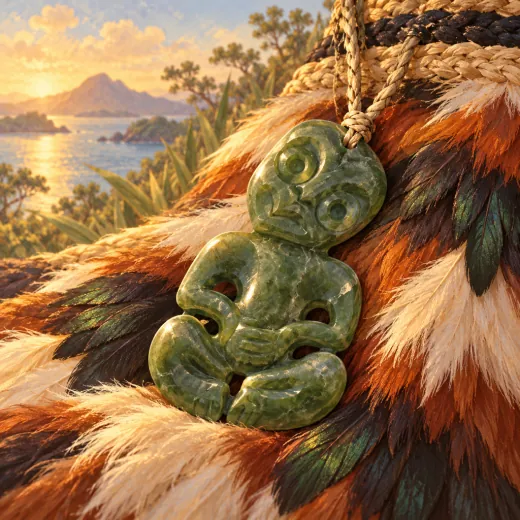
In many Polynesian traditions Tiki is the first human being, or the ancestor from whom people descend. Some Māori accounts say he was made by the god Tāne, others by the god Tūmatauenga; in others still Tiki is himself the creator of humans. His name has also passed to the human figures carved in wood or stone, which represent the ancestors. In New Zealand the hei-tiki is a pendant of green stone, pounamu, with a human figure whose head is tilted: it is given as a gift and handed down from generation to generation.
Did you know? “Tiki bars”, with flower garlands and colourful drinks, are an invention of 1930s America that has little to do with the Polynesian tradition.
The story
The first breath, they say, was a sneeze.
That day the world was already full. Tāne, lord of the forests, had pushed the sky apart from the earth and dressed his mother in trees. Ferns opened their fronds like hands, and the first birds sang at the tops of the branches. There was light. All that was missing was someone to look at it.
Tāne bent down in a clearing and gathered some red earth, the damp kind that sticks to your fingers. He began to shape it slowly, patiently. First a head, then shoulders, arms, legs. When he had finished, the figure lay there, motionless, red as clay after rain.
Tāne brought his face close to the figure's and breathed into its nostrils.
For a moment nothing happened. Then the figure wrinkled its nose, drew a deep breath, and sneezed.
“Tihei mauri ora!” said Tāne, and laughed. It is the cry the Māori still use today when something is born, or when a speech begins: the breath of life!
And so Tiki was born.
He opened his eyes, and the first thing he saw was a patch of light among the leaves, green and gold, gently swaying. He reached out to touch it, and his hand passed through the air. He did not yet know what a hand was. He knew nothing at all. He only felt as if he had been left behind in a place far too beautiful.
He sat up. The earth beneath him was warm. All around, everything was moving: a butterfly, the wind in the branches, a bird singing one short phrase and repeating it, always the same. Tiki sat very still, his head tilted a little to one side, listening. It was not something he had learned. It just came.
He walked all day, going nowhere. He touched the bark of a tree, rough as an animal's hide. He tasted a berry and pulled a face. He drank from a stream with his hands cupped.
It was at the stream that he saw the face.
It was on the bottom, among the pebbles, staring up at him. It had big eyes and a tilted head, just like his. Tiki stopped. The other stopped. Tiki smiled; the other smiled. He raised a hand, and the other raised one with him.
“Are you me?” Tiki asked. It was the first sentence in the story.
The water, of course, did not answer.
Evening came. The sounds changed. The wind became a whisper, and the birds fell silent one by one, until only a few crickets were left. Tiki curled up at the foot of a great tree. For the first time he felt something strange, an emptiness, like a space in his chest that was not meant to stay empty. He did not know it was called loneliness.
He looked up. Above the branches the sky had turned dark and full of points of light, so many that they seemed to have been scattered by the handful. Tiki gazed at them for a long time, mouth open. It seemed to him that they were looking back. For the first time he felt small, and for the first time he did not mind.
That was when he heard a voice that seemed to come from the branches, the leaves and the earth all at once.
“You are not alone.” It was Tāne. “This forest is yours as much as it is mine. But what you are missing is not in the forest. It will come after you.”
“After me? Who?”
“Those who will be born. Children, and children's children. So many you will not be able to count them. And you will be the first name in a long line.”
Tiki did not quite understand. But that night he slept with his back against the trunk, and the feeling that behind him there was something very large and very patient.
The rest, in the stories, is told in a few words. Tiki had descendants, and the descendants had theirs. They learned to weave flax, to build canoes, to follow the stars. And every evening, around the fire, someone recited the names: the father, the grandfather, the grandfather's grandfather, and so on, back and back, all the way to the name of Tiki, which finished the list the way a knot finishes a rope.
The names were a way of not getting lost.
Many generations went by. One day, in a cold, fast river, one of the descendants found a stone as green as a leaf in the sun, smooth and heavy. It was pounamu, the stone the Māori hold as a treasure: hard, tough, difficult to work, and precious for that very reason.
He held the stone all evening, turning it over and over. He studied its shape, the way it caught the light, the paler vein running through it, and he spoke to it the way you speak to a guest. He was in no hurry. Something made in a hurry, he thought, cannot keep anyone's memory safe.
He knew how to carve, and he took a long time, with tools of rock and sand, stroking the stone until it took on a shape. He hollowed out two big eyes. He hollowed out a mouth. He tilted the head a little to one side, like someone listening to a bird that always sings the same phrase.
It was Tiki.
On the day he finished, the light of the sunset passed through the stone and made it glow a deep green, like the water where the river runs deepest. The man sat looking at it without a word. He had made an object. But he knew he had also made something else, something he could not name.
The pendant, which they called hei-tiki, was hung around a girl's neck, to remind her of her ancestors. When she grew old, she gave it to a grandson. And the grandson gave it to his daughter.
A hei-tiki is not bought. It is received. It passes from hand to hand, and every hand that wears it leaves a little warmth inside the stone. Whoever wears it on their chest carries the line of names with them, all together, from the most distant one right down to themselves.
And if one evening, in the forest, you happen to hear a bird repeating the same phrase, stop for a moment and tilt your head a little.
That is how the first one listened.
A living tradition, told with respect: how we tell myths.
Relatives around the world
Listen / Read next
- Music to read by: Cinematic JourneyEpic film-style music, no lyrics, by Ciro Simone IrmiciSpotifyYouTube Music
Sources
- Te Ara, the Encyclopedia of New Zealand, Māori creation traditions
- Te Papa Tongarewa museum, Hei-tiki
