The Kelpie
kelpie, in Scots
scary
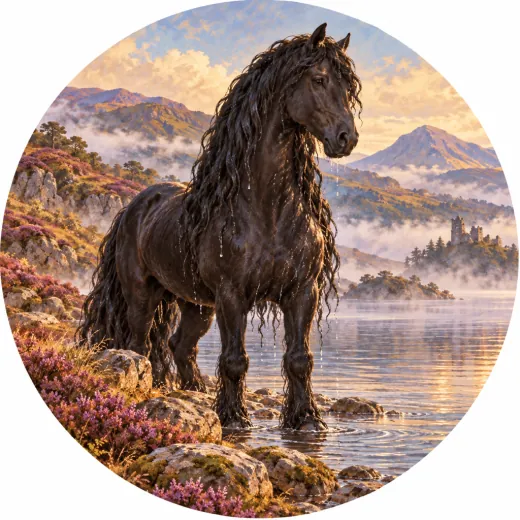
The kelpie is a spirit of Scottish rivers and lochs that usually takes the shape of a handsome horse. It waits on the bank, calm and saddled, as if expecting someone. But whoever jumps on its back sticks to it and is carried straight into deep water. It is thought the stories were meant to keep children away from dangerous rivers. If someone manages to put a bridle on it, though, the kelpie becomes strong and obedient.
Did you know? Near Falkirk, in Scotland, there are two huge steel horse heads thirty metres tall, called “The Kelpies”.
The story
The children of that village knew they must not go down to the loch after sunset.
They were told so every evening, in the same voice people use to say don't touch the fire. But children are children, and on summer afternoons the loch was the most beautiful thing in the world: still water, black and smooth as glass, with the mountains hanging upside down in it.
That day they had stayed too long. There were seven of them, eight, maybe nine: the biggest ones in front, the smallest trotting along behind with their shoes in their hands. The sun was low, and the air had that smell of grass and cold water that comes just before dark.
It was one of them, the smallest, who stopped first.
“Look,” he said.
On the shore, a few steps from the water, stood a horse.
It was pitch black, glossy, beautiful. It had a high, arched neck and big dark eyes, and it stood as still as if it had been waiting for ever. On its back there was even a leather saddle, and the reins lay across its neck, as if its owner had got down for a moment and would be back any second. Its mane was dripping onto its shoulders. And yet it had not rained that day, and the wind was dry. The grass around its hooves was wet, as if it had just come out of the water.
“Whose is it?” asked a girl.
“Nobody's,” said the eldest. “There's nobody here.”
“Look how calm it is.”
It was true. All around them the loch was silent: not a duck, not the flick of a fish, not even a breath of air moving on the water. The horse didn't swish its tail. It didn't snort. It watched them with a strange patience, almost kindly, and when the smallest reached out a hand it lowered its head to be stroked.
Its coat was cold. Cold and wet, like a stone from a river.
“Can I get on?” asked the eldest.
Nobody answered, because nobody knew what to say. The horse didn't move. The boy put one foot on a rock and climbed onto its back, and the horse stayed still and calm, as if he weighed nothing at all.
“Let me on too!” shouted a girl, and up she climbed.
Then a third. Then a fourth.
Nobody noticed that with every child the horse's back grew a little longer. It seemed wide enough for all of them, even for the smallest, who had scrambled up on his short legs. The horse carried them the way a boat would. Now and then it flicked its tail, and drops of black water fell from it.
Only one of the children had not climbed on. He was a boy of ten or eleven, with a little fruit knife in his pocket. He had stayed back to watch, with a small frown between his eyes.
Something wasn't right. A horse with no owner, in a place where horses never came. A saddle nobody had put on, and yet there it was.
He went closer. The horse didn't even look at him. It was looking at the children, one by one, and each time it seemed to be counting them. Just to be sure, the boy touched its neck with one finger, only one, the way you test the water with the tip of your toe.
His finger stuck.
He couldn't pull it free. He tugged, and the coat held on to him the way a limpet holds on to a rock. He tried to shout, but his voice stopped in his throat.
At that instant the horse lifted its head.
Its eyes were no longer dark and kind. They were full of water. Deep water, from the bottom of the loch, with nothing animal about it. Out of its mouth came a low sound, like a gurgle. It was not a neigh. It sounded like someone laughing under water.
The children on its back understood all at once. They began to scream. They tried to get down, but they couldn't move their legs.
The boy with the stuck finger did the only thing he could. He took out the little knife, closed his eyes, and cut.
He felt no pain. Fear filled his whole body, and for a moment there was no room for anything else.
He fell backwards onto the grass.
The horse set off.
It didn't gallop, because it didn't need to. It leapt towards the loch in a single bound, with all the children on its back, and the water opened to take them without a splash. For a moment the mane could be seen on the black surface. Then came a wide wave, which rolled all the way to the shore and wet the shoes of the one who was left behind.
Then the loch was smooth again.
The boy stayed sitting on the grass, his hand closed tight. He stayed there a long time. Around him the dusk was turning blue. A frog began to croak, then another. From the village, far away, came the voice of a woman calling her children in for supper, and she kept on calling, and nobody answered.
When the grown-ups arrived with their lanterns, all they found on the shore was him and a little heap of shoes.
They didn't believe him at first. A mother shook him by the shoulders, asking where the others were, and all he could say was “in the loch”, once, quietly. Then they looked at his hand. And they looked at the grass, where there was the print of a large hoof, full of water.
That night nobody in the village slept.
The old folk, who knew more about kelpies than anyone else, said there is only one way to tame a spirit like that: you have to catch it when it is out of the water and slip a bridle over its head before it notices. Then, and only then, the kelpie becomes obedient and strong, and works for you like ten horses. But nobody can do it alone. And nobody has the courage to try at night.
That is why, even today, in the villages near the Scottish lochs, children are told the same thing. If you see a beautiful horse near the water, and nobody is riding it, and nobody is watching over it, and its coat is wet even though it isn't raining, stop.
Don't touch it. Don't look it in the eye.
And go home before it gets dark.
Relatives around the world
Listen / Read next
- Music to read by: Cinematic JourneyEpic film-style music, no lyrics, by Ciro Simone IrmiciSpotifyYouTube Music
Sources
- Walter Gregor, Notes on the Folk-Lore of the North-East of Scotland (1881)
- Robert Burns, Address to the Deil (1786)
