Kappa
河童, “river child”
a little scary
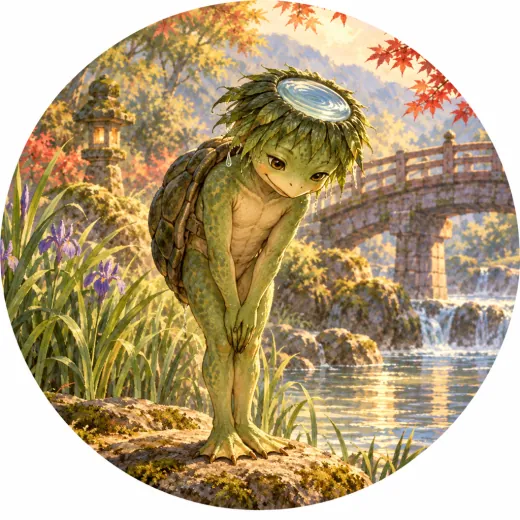
The kappa is a river spirit the size of a child, green, with a turtle shell on its back and a beak. On its head it has a little dish full of water: as long as the dish is full, the kappa is extremely strong. It loves cucumbers and wrestling, and sometimes it drags people into the water if they come too close to the bank. But it is also very polite: if you bow to it, it bows back, the water spills from its head and it loses its strength. According to some folk traditions, certain kappa, once defeated, teach people the art of setting broken bones.
Did you know? In Japan, sushi rolls with cucumber are called “kappa maki”, precisely because cucumber is the kappa's favourite food.
The story
Grandfather said it every summer, ever since the boy was old enough to go down to the river on his own.
“If you see small footprints on the sand, like a child's hand, but with the fingers joined by a thin skin, turn back. If you can't turn back, remember three things.”
“What things?”
“One: never be a bully. Two: always carry a cucumber. Three…”
Grandfather always paused at that point. He would scratch his beard and look out of the window, where the fields were baking in the sun.
“Three: be polite. More polite than you are with me.”
The boy would laugh. Then, every time, he forgot the lot.
That afternoon it was so hot that the heat sat on his shoulders like a sack. The boy led the horse down the path to the river, where the water made a wide, deep pool, dark green, with reeds leaning over the bank. In his pocket he had a cucumber, sneaked out of the kitchen. He did not even know why.
The pool was calm. Too calm. There were no dragonflies, no frogs, and the buzzing of the cicadas, from high up on the hill, sounded as if it came from another world.
The horse lowered its nose to drink. Then it jerked its head up, nostrils wide.
“Easy,” said the boy. “What is it?”
The horse grew restless. Something under the surface was moving. A small ripple rose from the bottom, spread out in slow rings, and reached his feet.
Then he saw the footprints.
They were right there, a step from his sandal: small, wet, with the fingers joined. They started at the water and came up the bank. They stopped halfway.
“Turn back,” said a little voice in his head. It was Grandfather's voice.
Too late. With a splash, a head rose out of the water.
It was a round head, an old green, like a river stone. It had two bulging eyes, a bird's beak and, on top, a smooth hollow full of water, like a little dish. A shell stuck out behind its shoulders, like a tortoise's. Its body was small, the size of a six-year-old child's, but its arms were long and nimble like a monkey's.
The kappa climbed out of the water, shook itself, and stared at him with eyes that never blinked.
“A horse,” it said, in a voice like a gurgling drainpipe. “Nice horse. I want it.”
“It isn't mine,” the boy stammered.
“Then I'll take you instead.” The kappa grinned, and its beak opened. “Let's wrestle. If I win, I'll drag you both down. If you win…”
It stopped, as if the idea had never crossed its mind.
“You never win,” it concluded.
The boy knew it was all over. The kappa was smaller than him, but it moved like a river in flood. His legs were shaking. For a moment he thought of running away. Then, somehow, he remembered the last thing Grandfather had said.
Be polite.
He stood up straight. He closed his eyes. He took a breath.
And he bowed. Not the quick little nod you give without thinking to someone you pass in the street. A slow, deep bow, with his back straight and his hands at his sides, the way he would have bowed to his teacher. A bow that went on and on.
For a moment nothing happened.
Then the kappa, on the other side, went stiff. It opened its beak. It closed it again. Something inside it clicked: because that is how kappa are made, good manners run in their blood, and a bow as fine as that simply has to be returned.
Slowly, with its back rigid and its eyes wide open, the kappa bent forward.
The little dish tipped.
The water slid out in a thin trickle. Then all at once, with a small sound, down onto the sand.
The kappa froze halfway through its bow. Its eyes went blank. Its arms, which a moment before had seemed made of steel, dropped limp. With a moan as long as a sigh, it slumped onto the bank and lay there, small and floppy as a frog, its shell rising and falling with every breath.
The boy did not move.
“Water,” said the kappa, in a tiny voice. “Please.”
“Why should I? You wanted to drag me to the bottom of the river.”
“Because… because I can't manage… Please.”
It was the voice of a child who has done something wrong and knows it.
The boy looked at the horse. He looked at the river, he looked at the creature on the sand. Then, slowly, he knelt down. He scooped up river water in his cupped hands and carefully poured it into the little dish.
The kappa filled out like a flower in the sun. It opened its eyes, sat up and looked at its hands.
“I was a bit rude,” it admitted, and for the first time it seemed ashamed.
“A bit.”
“I won't do it again. I promise. Not to you, not to your horse, not to anyone in the village.” It scratched its shell. “I owe you something.”
From the bottom of the pool it pulled out a small ceramic bowl, stoppered with a leaf. Inside was a dark green ointment that smelt of herbs and river.
“For broken bones. For people who fall, people who get hurt. Only we know how to make it, and I'm giving it to you.”
The boy took the bowl. After a while he remembered the cucumber as well, took it out of his pocket and held it out with both hands, the way he had seen grown-ups do.
The kappa looked at it. Its eyes lit up like two lanterns. Then it bit into it, and for a long minute there was no other sound than the crunching of a cucumber, and of a creature that was overjoyed about it.
The next day, on the doorstep, the boy found a fish. Just one, plump and still wet. Nobody could say who had brought it.
Grandfather looked at it, then at his grandson, then at the bowl.
“Did you bow?” was all he asked.
“Yes.”
“Good boy.”
Ever since that summer, whenever the boy passes a wide, deep pool, he stops, straightens his back and greets the water with a small bow.
And sometimes the water answers with a small ring.
A living tradition, told with respect: how we tell myths.
Relatives around the world
In the trails
Listen / Read next
- Music to read by: Cinematic JourneyEpic film-style music, no lyrics, by Ciro Simone IrmiciSpotifyYouTube Music
Sources
- Kunio Yanagita, Tōno Monogatari, The Legends of Tōno (1910)
- Michael Dylan Foster, The Book of Yōkai (2015)
