Kintarō
金太郎, “the golden boy”
not scary at all
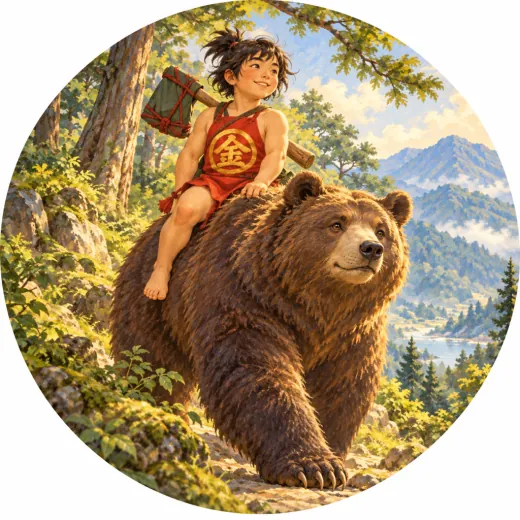
Kintarō was a boy of incredible strength who grew up in the woods of Mount Ashigara. His friends were the animals: he wrestled with bears, ran with deer and rode a bear as if it were a horse. He always carried a big axe and, in popular images, wore a little red apron. One day, to help the animals cross a river, he pulled up a tree and made it into a bridge. A general of the great warrior Raikō saw him and brought him to his lord. Popular tradition identifies him with Sakata no Kintoki, one of Raikō's warriors who fought against the oni.
Did you know? On 5 May, Children's Day in Japan, many families display Kintarō dolls, hoping their children will grow up strong and healthy.
The story
There is a mountain in Japan called Ashigara, and for a long time the woodcutters climbed it with a certain respect. Not because of the wolves, nor the landslides. Because of the child.
He lived in the forest with his mother, in a hut with no neighbours. He was a child like many others, with a round face and red cheeks. But at a few months old he could already lift stones that grown-ups could not shift, and at two, whenever his mother was not looking, he would wander off to find someone to play with.
The forest had plenty of friends to offer, and he soon found them.
The first was a bear. An enormous bear, who happened to be passing and found a very small child standing in front of him, hands on hips.
“Shall we wrestle?” said the child.
At first the bear did not understand. Then he understood perfectly, when the child grabbed him by the fur and sat him down on his bottom with a thump that sent the birds flying.
That was the start of a great friendship. The bear, the deer, the monkey and the hare all came, one after another, to see this child who was not afraid. And he, whose name was Kintarō, the “golden boy”, because kin means gold, became king of that forest without a crown.
Every morning Kintarō tied on a little red apron, put his axe, almost as big as he was, over his shoulder and went out. You could hear him from far away, because he sang. The animals waited for him in a clearing, in a row, and he organised the contests: the monkey wrestled the hare, who usually won and got a little too pleased with herself, and the deer raced against everyone. The bear was the referee, sitting on a rock, with one paw raised like a flag.
In the end, though, it was always the bear's turn. He was the biggest, the strongest, and the surest of winning. Kintarō pushed him on his big belly with one finger, and the bear went flying. Then Kintarō climbed on his back and off they went through the forest, the boy with the axe on his shoulder, the bear with a look of resigned pride.
“You're a beautiful horse,” Kintarō would say.
“Thank you,” the bear would grumble. “If only you weren't so heavy.”
One evening he came home after a day of contests, and his mother had made him rice balls. He ate in huge mouthfuls, cheeks bulging, while she watched him and shook her head.
“One day you'll be a great man,” she said. “But in the meantime, please, wash that apron.”
One afternoon, when his friends had gone with him further than usual, they came to a river. The water rushed down hard, white with foam, and on the other side were the woods where the mushrooms were finest and the blackberries sweetest. But there was no bridge. The animals stopped on the bank and stared at their feet.
“How do we get across?” asked the deer.
“We can't swim,” said the monkey.
“I can, but not with all this luggage,” said the bear.
Kintarō looked around. Then he put his hands on his hips, as on that first day, and looked at an enormous tree growing right on the bank, its trunk wider than a house.
“Like this,” he said.
He took hold of the trunk with both hands, and pulled.
The forest creaked. The earth cracked around the roots. Birds flew off in clouds. The tree, which had seemed eternal, leaned, groaned, and with a sharp crack came away, roots and clods and all. Kintarō lifted it over his head, laid it across the river, and the bridge was made.
The animals stood frozen, mouths open. Then the monkey started clapping, and everyone joined in.
They crossed to the other side one at a time, smiling. The last was Kintarō, who received a round of applause and pretended not to notice.
But on the far bank of the river, at that moment, a man was watching open-mouthed. He looked like a woodcutter. In truth he was much more: he was Sadamitsu, a general of the famous warrior Raikō, in disguise, travelling the mountains in search of strong men. He had seen a great deal of strength in his life. Never anything like this.
He followed the boy without being seen, wanting to know whose child he was. He climbed up to the hut, and talked with the mother for a long time. He told her that a son like hers, in the forest, would stay a hidden treasure; that at court he could learn to fight, to read, to serve a great lord.
The mother did not answer at once. She looked at Kintarō, asleep in a corner with his axe under his head. She dried her eyes.
“If it's for his good,” she said at last.
On the morning they left, the animals were waiting on the path. The bear's eyes were wet. “Will you come back and visit?” he asked.
“Of course,” said Kintarō. “And don't you forget to do your exercises.”
He went away with Sadamitsu, along the long roads of Japan, all the way to Raikō, who took him in and made him the leader of his Four Braves. Later, popular tradition gave him the adult name by which many remember him: Sakata no Kintoki. With his lord and his companions he climbed the mountains of the monsters, and faced the oni, the real ones, with red skin and spiked clubs. But that is another story, and probably a noisier one.
Today, on the fifth of May, Children's Day in Japan, many families display a Kintarō doll at home: a chubby boy with a red apron and an axe on his shoulder, sometimes riding a bear. They say it brings luck, and helps children grow up strong and healthy.
And every now and then, the old people say, on Mount Ashigara you can still hear a distant thump, like something big landing on its bottom. Then a laugh. Then a bear, grumbling.
A living tradition, told with respect: how we tell myths.
Relatives around the world
Listen / Read next
- Music to read by: Cinematic JourneyEpic film-style music, no lyrics, by Ciro Simone IrmiciSpotifyYouTube Music
Sources
- Yei Theodora Ozaki, The Japanese Fairy Book (1903)
- Noriko T. Reider, Japanese Demon Lore, Utah State University Press (2010)
